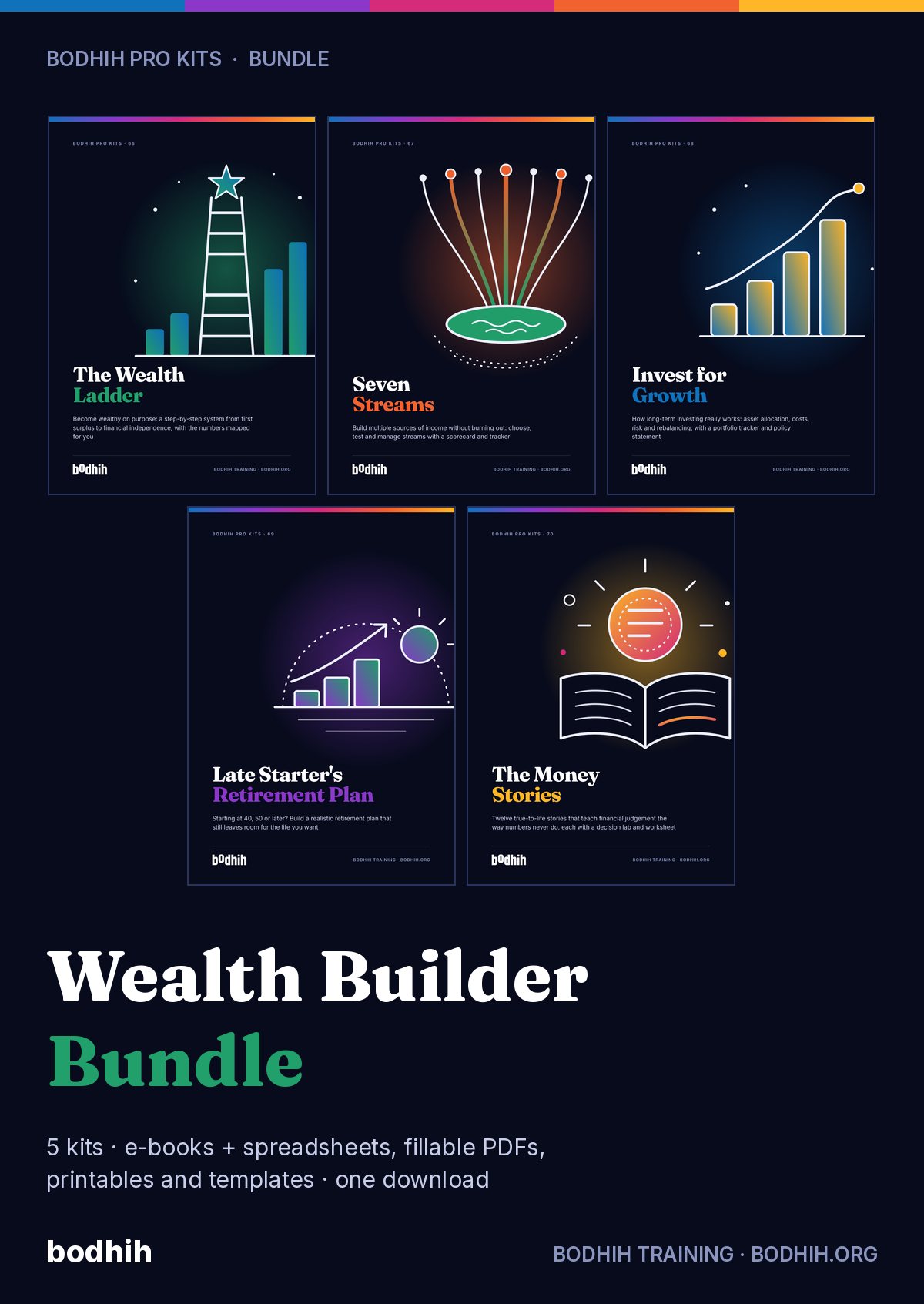
The Wealth Ladder is a seven-rung system from your first monthly surplus to financial independence, with a workbook that does the arithmetic in any currency and shows cautious, base and optimistic scenarios. Educational, practical and free of product pitches.
The Wealth Ladder · Bodhih Pro Kits · 66 by Bodhih Training, trainers to 2,000+ companies since 2008.
Climb in order: create a monthly surplus, build an emergency fund and core insurance, clear high-cost debt, automate saving of 15% or more, then let invested assets grow through 1x, 5x and 10x to about 25x your annual spending. The Wealth Ladder kit from Bodhih Training gives you the method and the workbook to track it.
Want the full free guide first? Read How to Build Wealth on a Salary: The 7-Step Ladder.
Salary in, salary out, an investment app here, a card balance there. You are busy with money and still cannot say whether you are getting richer or poorer. A ladder with tests replaces the guesswork with a position.
Investing while carrying card debt, or with no emergency fund, means one broken gearbox forces you to sell at a loss. The seven rungs put every good idea in sequence so each step protects the next.
Your income has grown and your savings rate has not. Without a rule made in advance, spending takes all of every rise. The half-and-half rule and a payday pipeline fix it without a budget app.
Six years of discipline and the growth would barely buy a used car. Most people quit just before compounding becomes visible. Milestones in multiples of your own spending give you something real to celebrate on the way.
Online tools often show a single rosy projection in one currency. This kit shows ranges, in today's money, with your own assumptions, and says plainly that past performance does not predict the future.
Imagine the first Saturday of next month. You make tea, open the workbook and type six balances into the next row of the Net Worth sheet. Twenty minutes later you know your net worth, how it changed, and that your invested assets are 1.4 times your annual spending. You close the laptop. No trading, no worry.
As you fill in the Assumptions sheet for the first time, you'll notice something shift. The Rung Checker stops being abstract and says, in a plain cell, Rung 3: working on it. You know what the test is. You know what to do on Monday. And when you set up that first automatic transfer for the day after payday, the plan starts running whether you feel motivated or not.
Picture a year from now. You sit down for your annual money review, and the sheet separates what you added from what markets did. Most of the growth is your own doing. You colour another box on the poster, raise the transfer by half of your pay rise, and re-sign a one-page policy that tells you what to do when markets fall.
You already know that wealth on a salary comes from order, automation and time. You already suspect that the big mistakes matter more than the clever picks. So whether you start with the workbook tonight or the first chapter tomorrow morning, you can begin climbing from exactly where you stand.
The e-book shows you how. The tools make it happen. Here is exactly what you download.
The guide: methods, worked examples, scripts and exercises
Sixteen-sheet workbook: assumptions in any currency, savings rate calculator, rung checker, monthly net worth tracker, Rate Lab simulator, milestone ladder, three scenarios, independence numbers, 40-year projection, Big Ticket Lab, automation plan, annual review and dashboards.
Fillable one-page plan: your rung, savings rate, next test, payday automation, crash rule and review dates, with a second page for the year's three moves.
Fillable three-page worksheet that turns 'enough' from a feeling into a described life, a yearly cost and lean, regular, fat and coast numbers.
Fillable 90-minute yearly review in three pages: the year in numbers, what you did versus what markets did, a protection and paperwork check, and next year's assumptions and moves.
One-page reference: each rung, its pass test, the next action and the three honest exceptions.
The master-lever table: years to 25x spending at every savings rate from 5% to 75%, at three real returns, from zero and with a head start.
Two-page defence card: the five big leaks, scam warning signs, a script for unsolicited offers and an annual tick list.
Dated two-page overview of common long-term savings accounts in three countries, the five questions to ask of any account and where to verify current rules.
Editable Word template for a 45-minute money meeting with a partner or family: ground rules, agenda, opening scripts, decisions log and a parking list.
Editable Word template for your own written investing rules: purpose, time horizons, mix, contribution plan, limits, crash rule and review rhythm.
Fourteen monthly net worth dates with a different mini-check each month, three quarterly step-ups and two annual reviews, importable into Google, Outlook or Apple Calendar.
Two colour pages to print: the seven-rung ladder poster with tick circles, and a 100-box tracker where each box is a quarter of a year of spending invested.
The savings rate versus years table as raw data, ready to paste into your own spreadsheet or chart.
Each chapter opens with a real situation, gives you a method and ends with something to do today, using the tools in your kit.
Why capable earners drift, and how a ladder with rungs replaces financial activity with direction.
The seven rungs, the pass or fail test for each, three honest exceptions and how to find your rung in twenty minutes.
Why your savings rate beats your investment return, how to measure it honestly and the half-and-half rule that stops lifestyle inflation.
Finding a monthly surplus, building a one-month buffer, sizing an emergency fund and insuring the catastrophes.
Sorting debts into red, amber and green, and a six-step sprint to clear the red before you invest.
Designing a payday pipeline that saves 15% or more without monthly willpower, plus the principles of where invested money goes.
How compounding really behaves, sensible real returns, the 1x to 25x milestone ladder and five ways through the flat years.
The 20-minute monthly net worth date and the 90-minute annual review that keep you oriented.
Pricing a home, car or course in years on the ladder, with the 70% option and six questions to ask first.
The five leaks that drain wealth, scam warning signs, a script for unsolicited offers and an annual tick list.
The independence number, lean, regular, fat and coast versions in plain words, and how to define enough as a life.
Know your rung, do the next thing, automate it, review it, and take some of 'enough' now.
Plain-words notes on EPF, PPF, NPS, ISAs, pensions, 401(k)s and IRAs, with the five questions to ask of any account.
Savings rate, real return, NPER, future value, coast number and the rule of 72 explained without jargon.
Every outcome is practised with a worked example and a tool, not just described.
People who measure before and after improve faster and can show it. AssessAll, our sister assessment platform, has AI-graded assessments that pair with this kit. Take one now, work through the kit, then re-take it.
Tunde is 38, runs operations for a logistics firm in Lagos, and earns more than he ever expected to. On a Sunday evening he opens his banking app, scrolls through the month, and feels the familiar small drop in his stomach. The salary came in. The salary went out. Somewhere in the middle there was a school fee, a car repair, a wedding contribution, a new phone he mostly needed, and a transfer to an investment app that a colleague swore by. He has no idea whether he is getting richer or poorer. He suspects neither.
Tunde is not careless. He is busy, he is generous, and nobody ever handed him a map. He has plenty of financial activity and no financial direction, which is the most common money condition we see among capable working adults.
| Free templates and typical advice | This kit | |
|---|---|---|
| Method | A blank tracker with no order of steps | Seven rungs with pass or fail tests and a next action for each |
| Currency and country | Dollar signs and US-only assumptions | No currency symbols, an Assumptions sheet, and India, UK and US notes marked verify |
| Projections | One optimistic number in future money | Cautious, base and optimistic scenarios in today's money, with plain warnings |
| Formulas | Often broken or hidden | Tested formulas, sample data for a fictional saver and a Start here sheet |
| Behaviour | Left to willpower | Automation plan, half-and-half rule, written crash rule, calendar dates and a family meeting agenda |
| Honesty | Hints of quick riches | No product picks, no return promises, no shortcuts: a slow, steady climb |
Bodhih Training has designed and delivered corporate programmes since 2008. Bodhih Pro Kits package what works in those workshops into a guide plus the exact tools we use, so you can apply it the same day without a facilitator in the room.
Name, email and country. UPI, card or netbanking in India; international cards everywhere else. No account to create.
Your download page opens at once, with every file and a one-click ZIP. A permanent link lands in your inbox too.
Start with the quick-start chapter, then the main spreadsheet or planner. Most buyers use something from the kit the same day.
You can open the workbook and know your rung in twenty minutes, or read the first chapter with a cup of tea and start tomorrow. Either way, the next rung is closer than it looks from where you are standing.
Personal licence for the buyer's own use (and use with your own household). Please don't share or resell the files. Team and company licences: solutions@bodhih.com.
Budget, clear debt and build an emergency fund.
Start earning outside your job.
250+ AI-graded assessments to measure skills and earn verified credentials.
Individual development plans that start from evidence and stay yours.
Run this topic as a live workshop for your team, in person or online.
Book a vetted coach for career, leadership or communication. Pay per session.
Certification pathways in Applied AI, Workplace English and management.
No. The Wealth Ladder is educational: it teaches general principles and gives you planning tools. It is not financial, tax, legal or investment advice, recommends no products and promises no returns. Past performance does not predict the future. Check your local tax rules and speak to a qualified, registered adviser before important decisions.
Yes. Amounts carry no currency symbol, percentages and returns are yours to set on the Assumptions sheet, and all projections are in today's money. The e-book and a dated cheat sheet include short India, UK and US account notes as examples, with a reminder that rules change and must be verified.
You need three inputs: your savings rate, your invested assets today and a real return assumption. The Rate Lab and Scenarios sheets calculate the years using a standard spreadsheet function, and show cautious, base and optimistic cases side by side. Treat the answer as a range for comparing choices, not a forecast.
The kit uses 15% of take-home pay as the test for the investing-habit rung, and shows what higher rates buy you. From a standing start at a steady 4% real return, a 15% rate takes roughly 48 years to reach 25 times spending, 30% about 31 years and 50% about 18. Those are illustrations with simplifying assumptions.
No. The first four rungs are about surplus, protection, debt and automation, and they need no investing knowledge. Chapter 5 explains the principles reputable regulators repeat: diversify, mind costs, match risk to time, use tax-advantaged accounts. The choice of specific investments is yours, ideally with a qualified adviser.
The Rung Checker gives you your financial position. To measure the skills behind good money choices, AssessAll offers Money Decision Judgment, the Patience and Delay Tolerance Profile for Everyday Money, Study and Work Choices, and a Business Arithmetic test covering percentages, profit and loss and interest. They pair well with the kit's first chapter.
Complete the Wealth Plan on a Page, then set one goal per quarter for your current rung. Jobulary's guide to the WOOP method (wish, outcome, obstacle, plan) is a useful companion for turning each goal into a development plan with the obstacle named in advance.
Lean means independence on a stripped-back budget; fat means independence with a more generous lifestyle; coast means you have enough invested that it should grow to your full number by normal retirement age without further saving. Chapter 10 explains each in plain words and the Independence Numbers sheet calculates all of them.
Yes. The licence covers your household. The Family Wealth Meeting template gives you a 45-minute agenda, opening scripts and a decisions log, and the monthly net worth date works best when you take turns typing.
Digital kits are non-refundable once downloaded, except for corrupted files not fixed within 3 working days, duplicate charges or failed delivery. The sales page lists every file so you can see exactly what you are buying.
₹999 including 18% GST for buyers in India, or $29 for buyers outside India. One-time payment, no subscription, with an automatic invoice.
Instantly. Your download page opens the moment payment succeeds, and a permanent download link is emailed to you. Download each file separately or everything in one ZIP.
Any of the usual tools: Excel or Google Sheets for spreadsheets, Word or Google Docs for templates, Adobe Acrobat Reader, Preview, Xodo or GoodNotes for the fillable PDFs, and Google, Outlook or Apple Calendar for the calendar plan.
Because it is a digital download, kits are not refundable once downloaded. We always refund a duplicate charge or a failed delivery, and if a file is corrupted and we cannot fix it within 3 working days. Full terms: bodhih.org/refunds.
Yes. Team and company licences, and workshops on this topic run by Bodhih Training, are available. Write to solutions@bodhih.com or call +91 99000 11601.