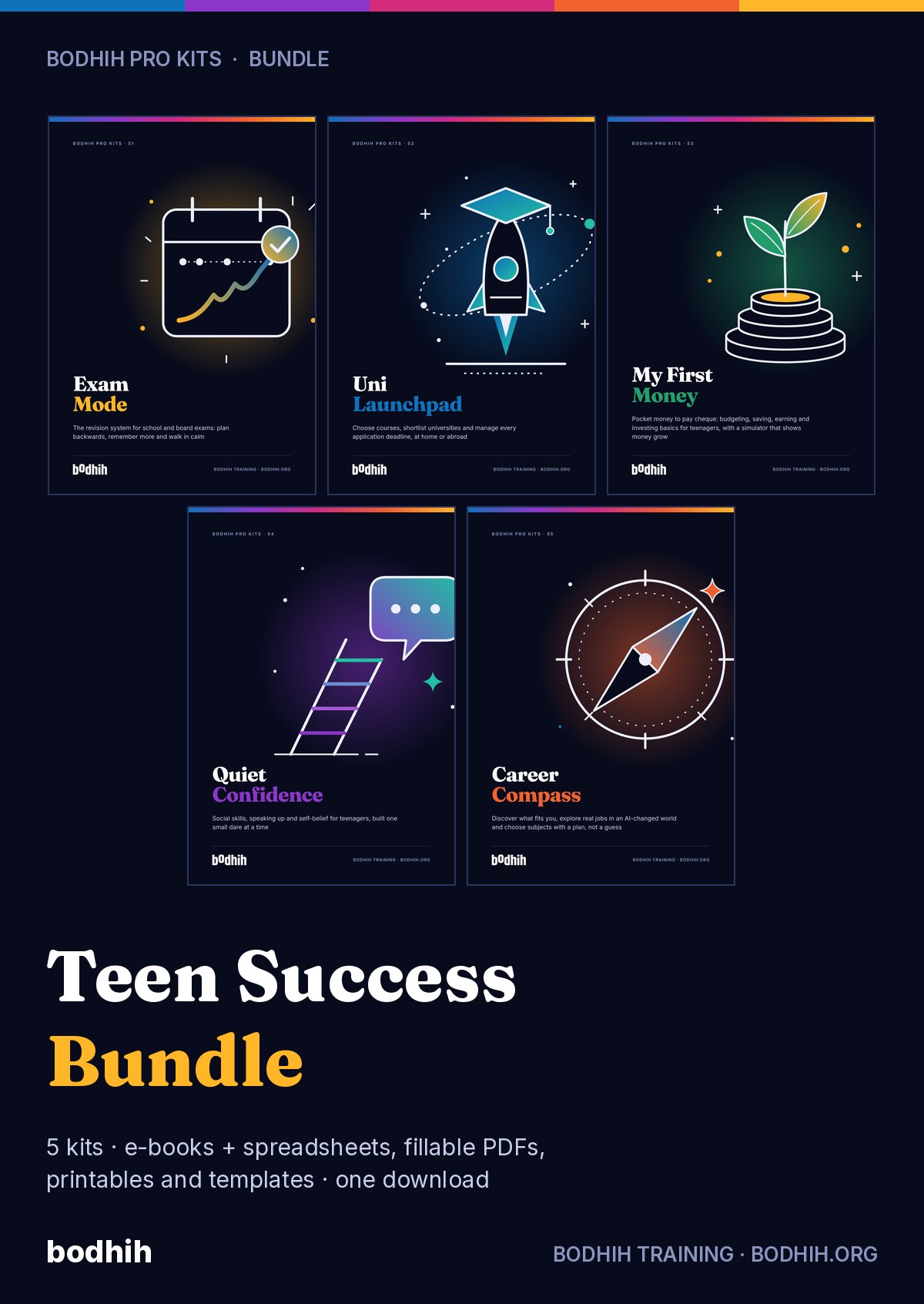
Uni Launchpad is a complete application system for students aged 16 to 19 and their parents, built for the US, UK, India, Canada, Australia, Europe and Singapore, at home or abroad. It teaches the process and hands you the tools to run it.
Uni Launchpad · Bodhih Pro Kits · 52 by Bodhih Training, trainers to 2,000+ companies since 2008.
Start with evidence about your interests and strengths, choose the course before the university, learn how each country's system works, build a balanced reach, match and safe shortlist, compare total cost in your own currency and count back from every deadline. The Uni Launchpad kit from Bodhih Training gives you the method and the trackers to do it.
Want the full free guide first? Read How to Choose a University and Course: A 7-Step Method.
There is too much information, most of it written for one country, and none of it says what to do first. You bounce between rankings, forums and videos and end the evening no further forward.
Shortlists copied from ranking tables are usually all reaches, with one safety nobody wants. Spring arrives with too few offers, or none you would be happy to accept.
Families plan around the tuition figure and discover rent, deposits, flights, insurance, visa costs and later-year fee rises afterwards. In three currencies, comparison by guesswork is impossible.
It is rarely the main deadline that gets missed. It is the scholarship that closed three weeks earlier, the test score that took a fortnight to arrive, or the reference requested four days before.
Blank-page panic pushes students towards sample essays and AI drafts, which read alike and can break integrity rules. The real material, specific moments from their own life, stays unused.
One side nags, the other goes quiet. Nobody has agreed who does what, what the budget is or who makes the final call.
Picture a Sunday evening a few weeks from now. Instead of forty tabs, there is one workbook open on the table. As you type your own currency into the Settings sheet and enter the first three courses, the total cost of each whole degree appears in a single column, and for the first time the options can be compared honestly.
When you fill in the Deadlines sheet, something shifts. Each deadline has its tail underneath it: the test date, the registration date, the day you ask your teacher. The Days left column is counting down quietly, and the Alert column tells you what matters this fortnight, so you can stop carrying it all in your head.
Imagine the essay, too. You have fifteen real moments on the planner, three of them run through the evidence chain, and a first draft that is rough but unmistakably yours. A teacher reads it and says, 'This sounds like you.' Because it is.
And when the offers arrive, you set your weights, score each one and look at the ranking, then notice how you feel about it. Whether you begin with the Course and Career Explorer tonight or open the Command Centre at the weekend, the next step is small, clear and already laid out for you.
The e-book shows you how. The tools make it happen. Here is exactly what you download.
The guide: methods, worked examples, scripts and exercises
One workbook for the whole application: shortlist with total cost in your own currency, countdown deadline tracker, documents, tests, scholarships, weighted decision matrix, first-year budget and a live dashboard.
Three fillable pages that turn a week of evidence about your interests and strengths into a short list of subjects to test against real courses and real graduates.
Mine fifteen moments, run the best through the evidence chain (moment, action, insight, link) and plan each answer before you draft. Works for UK statements, US essays and motivation letters.
Score any campus visit, virtual tour or student chat on eight criteria out of 40 before the glow wears off, with questions to ask and red flags to watch for.
Put up to four offers side by side: conditions, total cost after confirmed funding, housing, deposits and reply dates, then record your decision and your reasons.
Editable emails for asking, reminding and thanking a recommender, plus a one-page brag sheet that makes it easy for a teacher to write something specific.
An editable scaffold for three formats (three-question course statement, personal essay, motivation letter) with reflection questions under each part and a self-edit pass. Your words go in; nothing is pre-written.
A friendly one-evening agreement covering who does what, money, check-ins, decision rights and life after leaving home, so the application year has fewer arguments.
A dated side-by-side of how applying usually works in seven systems, the seven questions to ask of any system and the official sites to check.
The whole application year on one sheet: seven phases counted back from your start date, the jobs in each, the tool to use and an exam-rank route variant.
A six-step method for finding, qualifying and ranking scholarships in any country, with a reusable application kit and a scam check.
Thirty-two practical skills to practise before you go, covering money, food, home, health and safety, documents, study and people, plus an arrival plan.
Thirty-six calendar entries over twelve four-week blocks: two milestone sessions and one 15-minute review per block, importable to Google, Outlook or Apple Calendar. Move them to suit your own dates.
Sixty questions sorted by type, each with what it is really testing and a tip, for mock interviews and honest self-reflection. Opens in any spreadsheet app.
Each chapter opens with a real situation, gives you a method and ends with something to do today, using the tools in your kit.
Why the hard part is the order of things, how the kit works and where to check every rule.
Use an evidence week and three circles (interests, strengths, opportunities) to choose a subject from facts about you.
How to read a course page in ten minutes and why the same title can hide very different degrees.
The three families of admissions system and seven questions that decode any country's process.
Build a balanced portfolio of choices so you end with at least two affordable offers you would accept.
Total cost of attendance in your own currency, funding in the right order, scholarships and return thinking.
Count back from every deadline through results, test dates and registration, and plan tests with room for a resit.
The evidence chain for statements and essays, a drafting method, and AI as a coach and never a ghostwriter.
Make it easy for recommenders to be specific, curate a portfolio and think aloud at interview.
The visa as a second application, gap years with a plan, and routes that are not a traditional degree.
Compare offers properly, use the weighted matrix as a mirror, then practise running your own life.
What a good process gives you, and the three things to carry forward.
Seven phases counted back from your start date, with an exam-rank variant.
Plain-English meanings for the terms that differ between countries.
Every outcome is practised with a worked example and a tool, not just described.
People who measure before and after improve faster and can show it. AssessAll, our sister assessment platform, has AI-graded assessments that pair with this kit. Take one now, work through the kit, then re-take it.
Reach. Your grades or scores are below the typical admitted student, or the course admits so few applicants that nobody is a safe bet. Worth trying. Not worth relying on. Match. Your profile sits comfortably within the typical range. You have a realistic chance, though no promise. Safe. Your profile is clearly above the typical range, you would be content to attend, and you can pay for it. A place you would hate is not a safety. It is a wasted application. How do you find the "typical range"? Use published entry requirements, past cut-offs or closing ranks, admitted-student profiles and offer-rate data where the system publishes them. Be conservative. Predicted grades are predictions, and last year's cut-off is not this year's.
| Free templates and typical advice | This kit | |
|---|---|---|
| Countries covered | US college tracker only | US, UK, India, Canada, Australia, Europe and Singapore, with principles that travel |
| Method | A blank tracker with no guidance | A 10-chapter e-book that teaches the whole process, with the tools tied to each step |
| Cost comparison | A tuition column in dollars | Total course cost in your own currency from tuition, living, other costs, years and scholarships |
| Deadlines | A list of dates | Days-left countdown, alerts and the tail of tasks behind each deadline |
| Decision | Pros and cons list | Weighted decision matrix with ranking, plus an offer comparison sheet |
| Essays | Sample essays to imitate | A planner and scaffold that draw out your own material, with clear integrity guidance on AI |
| Parents | Not considered | A planning agreement and scripts for the money conversation |
Bodhih Training has designed and delivered corporate programmes since 2008. Bodhih Pro Kits package what works in those workshops into a guide plus the exact tools we use, so you can apply it the same day without a facilitator in the room.
Name, email and country. UPI, card or netbanking in India; international cards everywhere else. No account to create.
Your download page opens at once, with every file and a one-click ZIP. A permanent link lands in your inbox too.
Start with the quick-start chapter, then the main spreadsheet or planner. Most buyers use something from the kit the same day.
You already know the kitchen-table feeling of too many tabs. When you open the Command Centre and enter your first three courses, the plan starts to take shape. Whether you begin with the Explorer worksheet tonight or the shortlist this weekend, you can start today.
Personal licence for the buyer's own use (and use with your own family; counsellors and tutors may use it with their own students). Please don't share or resell the files. Team, school and company licences: solutions@bodhih.com.
Study techniques backed by research, with a 2027 study planner.
Speak and write clearly, with AI practice.
250+ AI-graded assessments to measure skills and earn verified credentials.
Individual development plans that start from evidence and stay yours.
Run this topic as a live workshop for your team, in person or online.
Book a vetted coach for career, leadership or communication. Pay per session.
Certification pathways in Applied AI, Workplace English and management.
Yes. The method is built on principles that apply in any system, and the Systems Compared cheat sheet covers the US, UK, India, Canada, Australia, Europe and Singapore. The workbook lets you set any home currency. For exact dates, fees and requirements you still check the official sites, and the kit tells you which ones.
No, on purpose. Deadlines, fees, test rules and visa rules change every year, so the kit teaches how each system works and gives you a tracker to enter the current official dates yourself. Sample universities, fees and scholarships in the workbook are invented for illustration.
Start with evidence about yourself: what holds your attention, what comes easily and what you avoid. Then test your guesses against real course modules and real graduates before looking at rankings. Chapter 1 and the Course and Career Explorer worksheet walk you through it in about a week.
Enough to hold a balanced portfolio within your system's limits: roughly a quarter reach, half match and a quarter safe, with at least two choices you would be glad to attend and can afford. The Dashboard counts your tiers and flags an unbalanced list.
If you would like something more structured than reflection, AssessAll offers What You'd Actually Like Doing, a work-interest inventory, and the Occupational Ability and Role Fit Assessment with an Occupation Shortlist. Its Structured Business Writing Work Sample is aimed at working professionals but can interest older students curious about their writing. Treat results as conversation starters, not verdicts.
Use the 15-minute weekly check-in in the workbook and the 12-month calendar. For goal setting, Jobulary's guide to the WOOP method (wish, outcome, obstacle, plan) is a good companion for turning it into a development plan you follow through on.
No. It gives you a planner, an evidence chain and a scaffold of reflection questions so you can write your own. It explains how to use AI assistants as a coach for questions and checks, and why submitting generated text as your own can break application integrity rules.
No. The kit is educational. It helps you add up total costs, list funding sources and ask good questions, but it is not financial, legal or immigration advice. Check loan terms, scholarship conditions and visa rules with the lender, the university, official government sites or a qualified professional.
Both. The e-book speaks to the student, because the student must own the application, with guidance for parents on money, decisions and when to step back. The Parent-Student Planning Agreement gives you one calm evening to agree who does what.
The workbook opens in Excel, Google Sheets or LibreOffice; the PDFs are fillable in Adobe Acrobat Reader and most PDF apps; the templates open in Word or Google Docs; the calendar imports to Google, Outlook or Apple Calendar. Digital kits are non-refundable once downloaded, except for corrupted files not fixed within 3 working days, duplicate charges or failed delivery.
₹699 including 18% GST for buyers in India, or $19 for buyers outside India. One-time payment, no subscription, with an automatic invoice.
Instantly. Your download page opens the moment payment succeeds, and a permanent download link is emailed to you. Download each file separately or everything in one ZIP.
Because it is a digital download, kits are not refundable once downloaded. We always refund a duplicate charge or a failed delivery, and if a file is corrupted and we cannot fix it within 3 working days. Full terms: bodhih.org/refunds.
Yes. Team and company licences, and workshops on this topic run by Bodhih Training, are available. Write to solutions@bodhih.com or call +91 99000 11601.