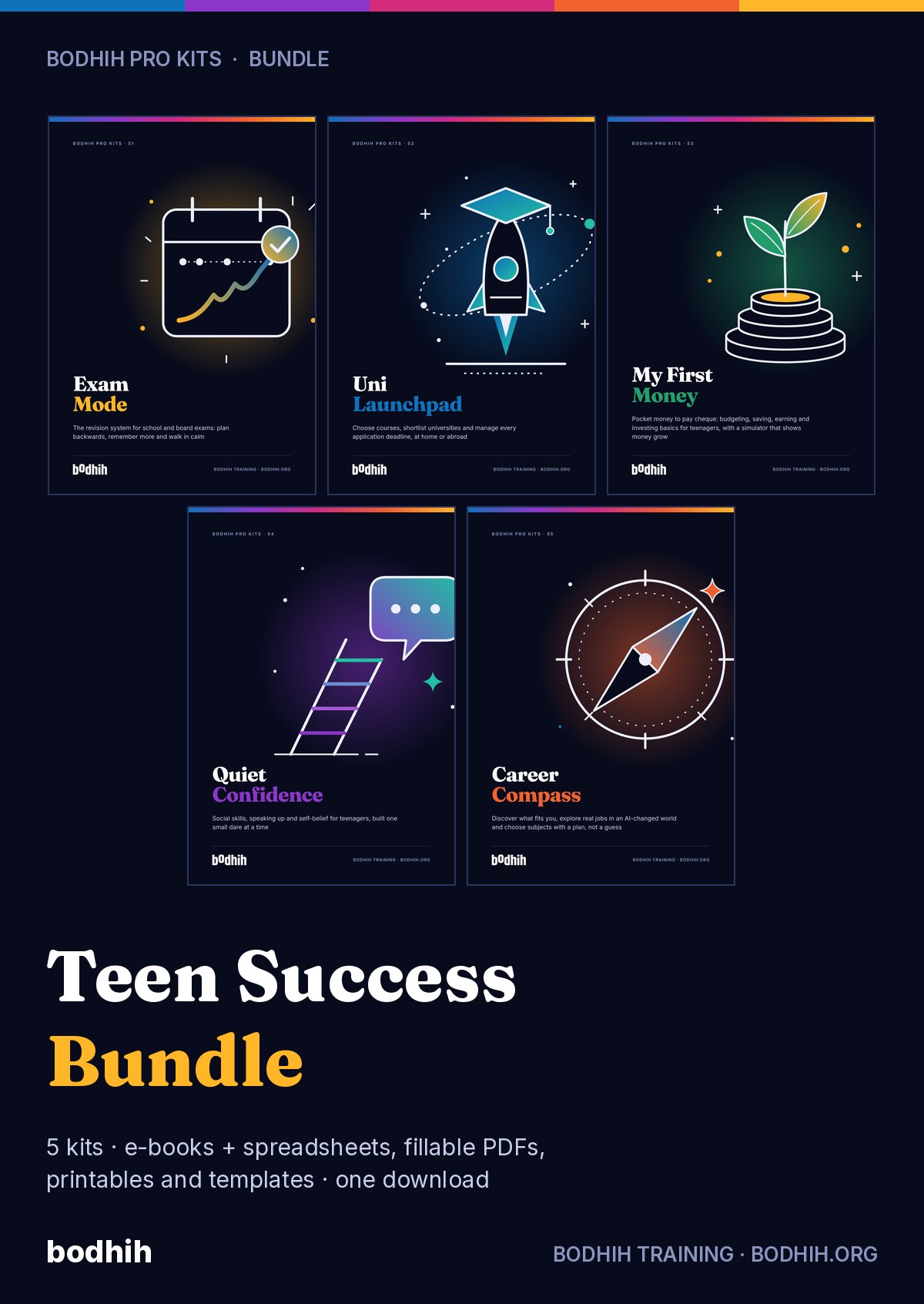
Quiet Confidence shows teenagers how to build real self-belief from small, safe, self-chosen dares. Written to the teen, friendly and never preachy, with a short note for parents. A skills kit, not therapy.
Quiet Confidence · Bodhih Pro Kits · 54 by Bodhih Training, trainers to 2,000+ companies since 2008.
Confidence grows from evidence, not pep talks. List small, safe actions that feel slightly scary, rate each from 0 to 10, start at about a 3, repeat until the fear halves, and write down what happened. The Quiet Confidence kit from Bodhih Training gives teens the dare ladder, tracker, scripts and 30-day plan to do it.
Want the full free guide first? Read How to Build Confidence as a Shy Teenager: 7 Small Steps.
You know the answer. Your hand lifts a few centimetres, your heart gets loud, and someone else says exactly what you were going to say. It happens again the next day.
You rehearse a sentence so many times that the conversation has moved on. When you do speak, your face goes red and you are sure everyone has noticed.
'Just be confident' and 'just go and talk to them' describe the destination and say nothing about the first step. Trying the big step, freezing and retreating makes things worse.
The loudest person takes charge, someone disappears, and you end up finishing the slides at midnight without having said a word in the planning.
A vague 'maybe' gets heard as 'keep pushing'. You go along with things you did not want, then feel annoyed with yourself for days.
Imagine a Tuesday morning three weeks from now. The teacher asks a question in your strongest subject. You have already written a question in your margin, because that is what you do now. You breathe out, count down from five, and your hand is up before the nervous voice has finished its first sentence.
Your voice wobbles on the first word and steadies by the fourth. Nothing terrible happens. That evening, as you open the Confidence Tracker and log the dare, you notice the numbers: fear 6 before, 3 after. The workbook adds the points to your week and the line on the dashboard climbs a little.
When you fill in your dare ladder, you choose every rung yourself, so nothing on it is anyone else's idea of brave. Some days you go down a rung and do an easier one. That still counts, and the kit tells you so. By the end of the 30-day plan you have a file of thirty small facts about what you can do, and facts are hard to argue with.
You are still you. Still thoughtful, still happier with three friends than thirty. The difference is that you decide when to speak, and your nerves no longer decide for you. Whether you start with the evidence file tonight or the first calendar dare tomorrow morning, you can begin smaller than you think.
The e-book shows you how. The tools make it happen. Here is exactly what you download.
The guide: methods, worked examples, scripts and exercises
Dare log with fear-before and fear-after ratings, an automatic weekly courage score with trend chart, a 60-dare bank, speaking practice log, wins list and three dashboards.
Four fillable pages: set a three-month goal, then build ten Warm-up, ten Stretch and ten Brave dares with fear ratings and a plan for each.
Plan one conversation in five minutes (opener, two questions, exit line), then log what happened and what you would keep or change.
Build any talk in four evenings: one-sentence message, structure, key-word card, rehearsal log and a calm plan for the day.
Three fillable pages that correct your brain's unfair record: past proof, a daily evidence log and a one-page pep sheet to read before hard things.
Write your own kind, clear, close refusals before you need them, plan a broken-record line, and set up an exit plan with a trusted adult.
Sixty plain, friendly openers sorted into ten everyday situations, each paired with a follow-up question, plus exit lines and space to write your own.
Three fill-in-the-blank talk outlines with worked examples: Point Reason Example Point, Past Present Future, and Hook Three Points Close, plus a self-introduction and a campaign speech.
Fifty-four editable scripts for teasing, peer pressure, apologising, conflict, asking teachers and adults for help, group projects and interviews, plus a mock interview sheet for your practice partner.
A one-page card for the moment between deciding and doing: count down, move once, and let if-then plans make the decision in advance.
Start, four easy topics and a warm exit on one page, with open questions, the Ask Add Ask pattern and rescue lines for blank moments.
A fold-into-your-pencil-case card: five-count breathing, three grounding exercises, a three-part reset before any dare, and when to ask an adult for more help.
Roles, a 15-minute first-meeting agenda, a shared plan table and calm scripts for speaking early, being talked over and chasing a missing teammate.
Eight colourful A4 pages to print and cut: 24 conversation cards with follow-ups, 24 dare cards in three levels with fear boxes, 8 blank cards and four games to play with them.
Thirty short daily prompts that drop into Google, Outlook or Apple Calendar: one small dare a day, with a review every seventh day.
Each chapter opens with a real situation, gives you a method and ends with something to do today, using the tools in your kit.
Why your brain keeps an unfair record of you, and how an evidence file corrects it.
Turn any scary goal into thirty graded dares, start at a 3 and let the before and after numbers persuade you.
Five-count breathing, grounding and the 5-second start for the moment your body sounds the alarm.
Boring openers, the Ask, Add, Ask pattern, a four-topic small talk map and exits that let you leave warmly.
Visible listening and five honest signals that stop you sending 'go away' when you mean 'talk to me'.
A five-step participation ladder, the first-ten-minutes rule and how to claim your role in group projects.
Three structures, a four-evening build and what to do when you lose your place.
The kind, clear, close refusal, flat answers to mean teasing, I-statements and proper apologies.
Changing friendships, carrying your online strengths into real life and asking adults for help.
Three true stories, the five questions you will almost certainly get and a ten-minute mock interview.
Every outcome is practised with a worked example and a tool, not just described.
People who measure before and after improve faster and can show it. AssessAll, our sister assessment platform, has AI-graded assessments that pair with this kit. Take one now, work through the kit, then re-take it.
Arjun, 15, from Pune, has a theory about himself. "I'm just not a confident person." He says it the way you'd say "I'm left-handed". As proof he offers the time in Class 8 when he forgot his lines in assembly, and the fact that he never knows what to say at family gatherings. Now look at what Arjun leaves out. He taught himself guitar from videos. He once told a shopkeeper he'd been given the wrong change. He joined a new coaching class in June knowing nobody, and by August he had two friends there. None of that made it into the theory. His brain keeps a careful file of failures and throws the successes in the bin. Yours probably does too. It is not a personal flaw. Human brains are built to remember threats more sharply than wins, because for most of history remembering the threat kept you alive. The side effect is a lopsided story about who you are.
| Free templates and typical advice | This kit | |
|---|---|---|
| Method | A page of affirmations or a blank 'confidence journal' | A taught method: evidence file, dare ladder, fear-before and fear-after ratings, weekly review |
| Tools | One PDF tracker with empty boxes | 15 tools: workbook with formulas and charts, five fillable planners, three Word files, four cheat sheets, cards and a calendar |
| Words to say | 'Just be yourself' | 60 starters with follow-ups, 54 scripts and three talk structures, all editable |
| Tone | Written at teens, or for their parents | Written to the teen as a capable person, with one short appendix for parents |
| Where it works | Assumes one country's school system | Examples from India, the UK, the US, Nigeria, Kenya, Singapore, the Philippines and Australia; no exam-system assumptions |
| Safety | No guidance on when shyness is something more | Clear signposts to trusted adults and helplines, and firm rules that every dare is safe, legal and kind |
Bodhih Training has designed and delivered corporate programmes since 2008. Bodhih Pro Kits package what works in those workshops into a guide plus the exact tools we use, so you can apply it the same day without a facilitator in the room.
Name, email and country. UPI, card or netbanking in India; international cards everywhere else. No account to create.
Your download page opens at once, with every file and a one-click ZIP. A permanent link lands in your inbox too.
Start with the quick-start chapter, then the main spreadsheet or planner. Most buyers use something from the kit the same day.
You don't need a new personality. You need a first rung. Download the kit, open My Evidence File and write one line, and whether you do your first dare tomorrow morning or at lunch, let yourself notice how much smaller it was than you expected.
Personal licence for the buyer's own use (and use with your own family, or with the students or young people you personally teach or mentor). Please don't share or resell the files. Team, school and company licences: solutions@bodhih.com.
Study techniques backed by research, with a 2027 study planner.
Speak and write clearly, with AI practice.
250+ AI-graded assessments to measure skills and earn verified credentials.
Individual development plans that start from evidence and stay yours.
Run this topic as a live workshop for your team, in person or online.
Book a vetted coach for career, leadership or communication. Pay per session.
Certification pathways in Applied AI, Workplace English and management.
It is a list of small, specific actions connected to one goal, each rated from 0 to 10 for how scary it feels and arranged from easiest to hardest. You start at about a 3, repeat each rung until the fear roughly halves, and then climb. The idea comes from graded exposure, described here in plain words as a skills exercise. The teen chooses every rung.
No. Quiet Confidence is educational content for building everyday social and speaking skills. It is not medical or psychological advice and cannot diagnose or treat anything. If fear of social situations is stopping a young person from attending school or doing things they need to do, or if bullying is involved, please speak to a doctor, school counsellor or another trusted adult. The e-book explains how and points to helpline directories.
Stop waiting to feel confident and collect evidence instead. Do one small thing each day that the nervous part of you votes against, write down your fear before and after, and note what it proves. Over a few weeks the record changes how you see yourself. The kit's evidence file and tracker make that record easy to keep.
Start with the easiest kind of contribution: a clarifying question in your strongest subject. Write it in your margin before the lesson, and ask it in the first ten minutes using a silent count from five. Then move up to 'I agree, and...', then answers, then opinions. Chapter 6 lays out the full ladder.
It is written for ages 13 to 19 and speaks directly to the teen. Examples come from India, the UK, the US, Nigeria, Kenya, Singapore, the Philippines and Australia, and nothing depends on a particular exam system, religion or political view. There is no dating, body-image or diet content.
The kit's own fear ratings give you a simple before-and-after record. Older teens and students heading to college or work who want a formal measure can also look at AssessAll: the Assertive Communication Profile, the Group Discussion and Panel Round Readiness Assessment and the Presentation Delivery Assessment each give a structured picture of where you stand. They are optional and separate from this kit.
After the 30-day plan, set a new three-month goal and build a second ladder. The kit uses if-then plans throughout; the Jobulary article 'If-then plans that make habits stick' explains the research behind them and helps you turn single dares into lasting habits and a personal development plan.
Lightly. Appendix A is a short note for parents and carers: let your teen choose the dares, resist rescuing too early, praise attempts over outcomes, and offer to be a ten-minute practice audience. The appendix also lists signs that it may be more than shyness and worth a conversation with a doctor or school counsellor.
The workbook opens in Excel, Google Sheets or LibreOffice. The Word files open in Word or Google Docs. Fillable PDFs work in Adobe Acrobat Reader and most PDF apps, or can be printed. The calendar file imports into Google, Outlook or Apple Calendar. The cards need a printer and scissors.
Because this is a digital download, kits are non-refundable once downloaded. The exceptions are a corrupted file that we cannot fix within 3 working days, a duplicate charge, or a failed delivery. Write to solutions@bodhih.com and we will sort it out.
₹449 including 18% GST for buyers in India, or $14 for buyers outside India. One-time payment, no subscription, with an automatic invoice.
Instantly. Your download page opens the moment payment succeeds, and a permanent download link is emailed to you. Download each file separately or everything in one ZIP.
Because it is a digital download, kits are not refundable once downloaded. We always refund a duplicate charge or a failed delivery, and if a file is corrupted and we cannot fix it within 3 working days. Full terms: bodhih.org/refunds.
Yes. Team and company licences, and workshops on this topic run by Bodhih Training, are available. Write to solutions@bodhih.com or call +91 99000 11601.