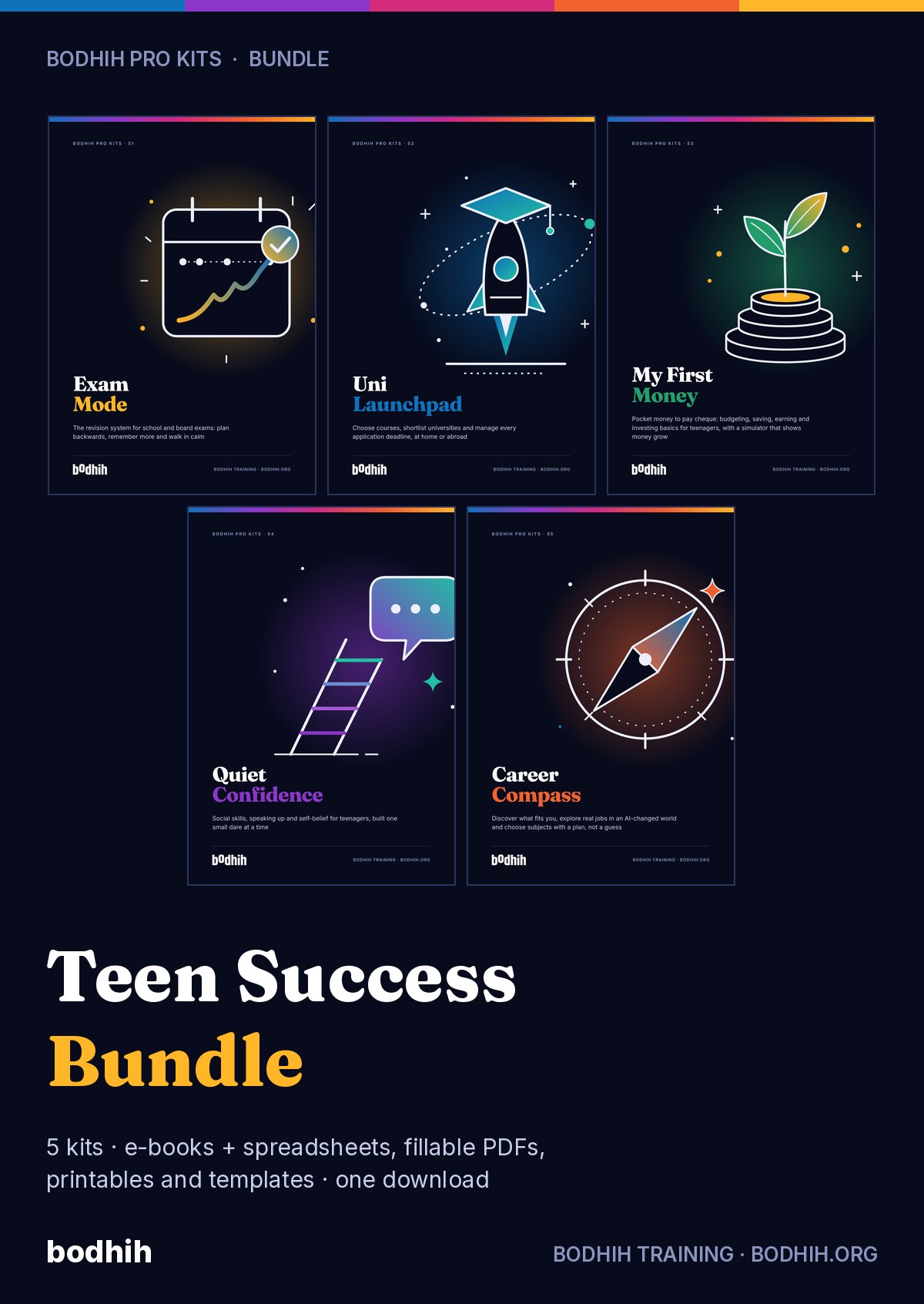
Career Compass gives teens aged 14 to 19 a four-step method, Notice, Explore, Sample, Weigh, and fifteen practical tools to find what fits, test it against real jobs in an AI-changed world, and explain the choice calmly at home.
Career Compass for Teens · Bodhih Pro Kits · 55 by Bodhih Training, trainers to 2,000+ companies since 2008.
Stop looking for one perfect answer and run small tests. Notice your interests, strengths and values, explore job families beyond the few you know, talk to people in real jobs, try short experiments, then weigh options against entry requirements. Career Compass for Teens from Bodhih Training provides the method and the tools for each step.
Want the full free guide first? Read How to Choose a Career as a Teenager When You Have No Idea.
Subject and stream choices land at fourteen, fifteen or sixteen, long before most people know what they want. Without a method, the choice gets made by friends, rumours or whoever spoke last.
Most teens can name a handful of careers. The OECD reported in 2025 that teenagers' job expectations have changed little since 2000 and bear little relation to where demand is. A wider list changes the whole decision.
Half-truths about AI knock good ideas off the list for the wrong reasons. Looking at tasks, not titles, gives a much calmer and more accurate picture.
A code or a list of job titles is where exploration should start, not end. What is missing is the follow-through: conversations, experiments and evidence.
A teen with a feeling and a parent with a fear is a recipe for a four-minute argument in the car. A teen with a process, evidence and a specific ask is a different conversation.
Picture a Saturday morning three weeks from now. The cards are spread across your bedroom floor in three piles, and for the first time you can see a pattern: most of your Love it cards are purple and blue. You write five verbs on the score sheet, and as you read them aloud you notice they sound like you.
A fortnight later you open the Career Explorer workbook and there are sixteen careers on your long-list, four of which you had never heard of in January. The spreadsheet has ranked them. Next to your top three, the Evidence column has changed from 'Guess only' to 'Some', because you have had a twenty-minute call with someone who does one of those jobs, with a parent in the next room, and you asked her what she did yesterday.
Now imagine the evening you sit down with your parents. You are not announcing anything. You put your Compass Card on the table, show them the entry requirements you checked and say you would really like their opinion. Because you have already written down their three likely worries and found evidence for each, the conversation is slower, kinder and far more useful than the last one.
And when the form is finally handed in, you can explain your choice in three sentences: what you chose and why, what it keeps open, and your fallback. Whether you begin with the card sort tonight or the first chapter tomorrow, that is where this kit is designed to take you.
The e-book shows you how. The tools make it happen. Here is exactly what you download.
The guide: methods, worked examples, scripts and exercises
Score and rank a long-list of careers on interest, strength and values fit, log conversations and experiments, plan skills, compare options in a weighted decision matrix and watch it all on a dashboard.
48 colour-coded activity cards across six interest themes, with sort headings, instructions and a score sheet. Print, cut and sort in 20 minutes.
Ten fillable pages that take you from 'I don't know' to a one-page Compass Card of your interests, strengths and values, plus a first career brainstorm.
A two-page fillable sheet to prepare for, run and review a 20-minute conversation with someone about their job, with built-in safety checks.
Plan and review job-shadow days and small career experiments, from a one-hour look to a six-week project, with a four-question review for each.
Check which doors each subject opens, score subjects on four tests, compare combinations and write your choice in three clear sentences.
Prepare for a calm, evidence-based conversation with parents or carers about subjects and careers: their worries, your evidence, your ask and an agreed plan.
A menu of 25 friendly, revealing questions in five groups, with tips on choosing six or seven for a 20-minute conversation.
Ten editable messages for asking adults about their work, each built for parent or teacher involvement: first contact, reminders, shadowing requests, thank-yous and more.
An editable six-section portfolio for course, college, scholarship and part-time job applications: profile, Compass Card, projects, activities, courses and reflections.
The whole world of work on two pages: twelve job families, example jobs at different levels, interest themes and useful subjects.
A dated briefing on what major studies say, the three-pile task sort with a blank grid, and five habits that hold their value.
University, technical college, apprenticeship, work then study, starting something and a gap year side by side, with questions to ask any provider.
Ten common career myths, what is closer to the truth and what to do instead, plus a ready answer to 'what do you want to be?'.
Two short sessions a week for twelve weeks, taking you once round the compass. Imports into Google, Outlook or Apple Calendar.
Each chapter opens with a real situation, gives you a method and ends with something to do today, using the tools in your kit.
Why a compass beats a map, the four points (Notice, Explore, Sample, Weigh) and what is in the kit.
Five myths that make choosing harder, and the idea of planned happenstance that replaces them.
Six interest themes in plain words, and how to run the 48-card sort and check it against your real week.
How to find strengths with evidence, rank twelve work values by forced choice and build a one-page Compass Card.
Twelve job families, where employers expect growth, and how to build and score a long-list of 12 to 20 careers.
The task-bundle view of work, a three-pile sort for any career and the skills that hold their value.
Safe, polite informational interviews and job shadowing, with scripts, questions and note-taking.
The six-rung experiment ladder, the four-question review and how to turn experiments into a portfolio.
Checking real entry requirements, four tests for each subject, the decision matrix and a three-sentence choice.
University, technical college, apprenticeship, work then study and starting something, compared with five questions.
How to prepare evidence, open the conversation and reach a plan the whole family can back.
What to say at the next family gathering, and why you will go round the compass again.
A week-by-week plan matched to the calendar file, with a checklist of what you will have at the end.
How adults can help most: process questions, lending their network, updating their map and holding doors open.
Every outcome is practised with a worked example and a tool, not just described.
People who measure before and after improve faster and can show it. AssessAll, our sister assessment platform, has AI-graded assessments that pair with this kit. Take one now, work through the kit, then re-take it.
Priya, sixteen, in Pune, had done the work. Card sort, long-list, two interviews, a decision sheet. Her conclusion was product design. Her parents' conclusion, reached years earlier, was engineering. The first attempt at a conversation took place in the car, lasted four minutes and ended with "we'll talk about this later" in a tone that meant never. If your parents or carers have strong views about your future, start from one fact: nearly always, the view comes from wanting you to be safe. They may know what money worries feel like. They may know which jobs were respected when they were young, and they may not know that the map has changed. You are not trying to win an argument. You are trying to turn two opposing sides into one team with a shared problem.
| Free templates and typical advice | This kit | |
|---|---|---|
| Starting point | A quiz that outputs a label or a list of job titles | A hands-on card sort, checked against your real week, plus strengths and values with evidence |
| World of work | The same ten famous careers | Twelve job families with example roles at every qualification level, and a scored long-list |
| AI and the future | Hot lists or doom headlines | A task-by-task method and a dated briefing citing the World Economic Forum and the ILO |
| Reality check | None: you are left with the list | Interview questions, outreach templates, a six-rung experiment ladder and logs |
| Spreadsheet | A blank tracker, if any | Weighted fit scores, automatic ranking, an evidence meter, a decision matrix and dashboards, with sample data |
| Family | Not mentioned | A parent conversation planner and a note for parents and carers |
| Country | Assumes one school system | Written for any country, with prompts to check local entry rules and routes |
Bodhih Training has designed and delivered corporate programmes since 2008. Bodhih Pro Kits package what works in those workshops into a guide plus the exact tools we use, so you can apply it the same day without a facilitator in the room.
Name, email and country. UPI, card or netbanking in India; international cards everywhere else. No account to create.
Your download page opens at once, with every file and a one-click ZIP. A permanent link lands in your inbox too.
Start with the quick-start chapter, then the main spreadsheet or planner. Most buyers use something from the kit the same day.
Print the cards, sort them on the floor and see what your own choices tell you. Whether you start with the card sort tonight or read the first chapter with a parent at the weekend, you will end the week knowing more about yourself than you did at the start of it.
Personal licence for the buyer's own use (and use with your own family). Please don't share or resell the files. School, team and company licences: solutions@bodhih.com.
Study techniques backed by research, with a 2027 study planner.
Speak and write clearly, with AI practice.
250+ AI-graded assessments to measure skills and earn verified credentials.
Individual development plans that start from evidence and stay yours.
Run this topic as a live workshop for your team, in person or online.
Book a vetted coach for career, leadership or communication. Pay per session.
Certification pathways in Applied AI, Workplace English and management.
It is written for ages 14 to 19 and is suitable from 13 with a parent alongside. The examples cover subject choices at 14 to 16 and route choices at 17 to 19. Parents, carers and counsellors can use the same tools to guide the process.
Start with what you like doing, not with job titles. The card sort gives you interest themes in twenty minutes, the Discovery Workbook adds strengths and values, and from that Compass Card you brainstorm and score a long-list. Then you test the top few with conversations and small experiments. You don't need the answer, only the next step.
No. It is an educational exploration kit, not a psychological assessment, and it will not name one job for you. The interest themes follow the six-theme model credited to John Holland, described in our own words; no proprietary test is reproduced. If you want a measured starting point alongside the kit, AssessAll offers 'What You'd Actually Like Doing' and the 'Occupational Ability and Role Fit Assessment with an Occupation Shortlist'.
Yes. The method avoids assumptions about any one exam system and uses examples from India, the UK, the US, Nigeria, Kenya, Singapore, the Philippines, the UAE and Australia. Where rules differ, such as entry requirements, apprenticeships or work experience for under-18s, the kit tells you to check official local sources.
Chapter 5 teaches you to break any career into tasks and sort them into three piles: AI does it, AI speeds it up, humans keep it. The dated briefing summarises the World Economic Forum's Future of Jobs Report 2025 and a 2025 International Labour Organization study, with a grid to run the sort yourself. Tool names are kept out of the book because they change too fast.
Safety is built into every tool. Teens are asked to involve a parent, carer or teacher, copy them into messages, use school email where possible, meet by video or in public places, and have an adult present if under 16. One template is written for a parent to send on the teen's behalf. Serious worries should always go to a trusted adult or local helpline.
The workbook opens in Excel, Google Sheets and LibreOffice. The fillable PDFs work in Adobe Acrobat Reader and most PDF apps, including GoodNotes on a tablet. The cards are best printed on A4 or US Letter with 'fit to page', though you can sort on screen by writing card numbers in three columns.
Prepare before you speak. Write down their likely worries, find evidence for each, decide on a specific request and bring your working. Open by asking for their opinion, not announcing a decision. The Parent Conversation Planner walks you through it, and Chapter 10 gives the exact words.
You go round the compass again, faster. Keep adding to the Experiment calendar and your portfolio. Older teens can turn their Skills builder sheet into a longer plan with measurable goals: Jobulary's individual development plan guide shows how to turn it into a development plan.
No. The kit is educational. It does not replace a qualified careers adviser, counsellor or doctor, and it does not give financial advice about fees or loans. Entry requirements, costs and rules change, so confirm them with official sources. It makes no promises about grades, admissions or jobs.
Digital kits are non-refundable once downloaded, except where a file is corrupted and not fixed within 3 working days, you were charged twice, or delivery failed. Write to solutions@bodhih.com and we will sort it out.
₹499 including 18% GST for buyers in India, or $15 for buyers outside India. One-time payment, no subscription, with an automatic invoice.
Instantly. Your download page opens the moment payment succeeds, and a permanent download link is emailed to you. Download each file separately or everything in one ZIP.
Any of the usual tools: Excel or Google Sheets for spreadsheets, Word or Google Docs for templates, Adobe Acrobat Reader, Preview, Xodo or GoodNotes for the fillable PDFs, and Google, Outlook or Apple Calendar for the calendar plan.
Yes. Team and company licences, and workshops on this topic run by Bodhih Training, are available. Write to solutions@bodhih.com or call +91 99000 11601.