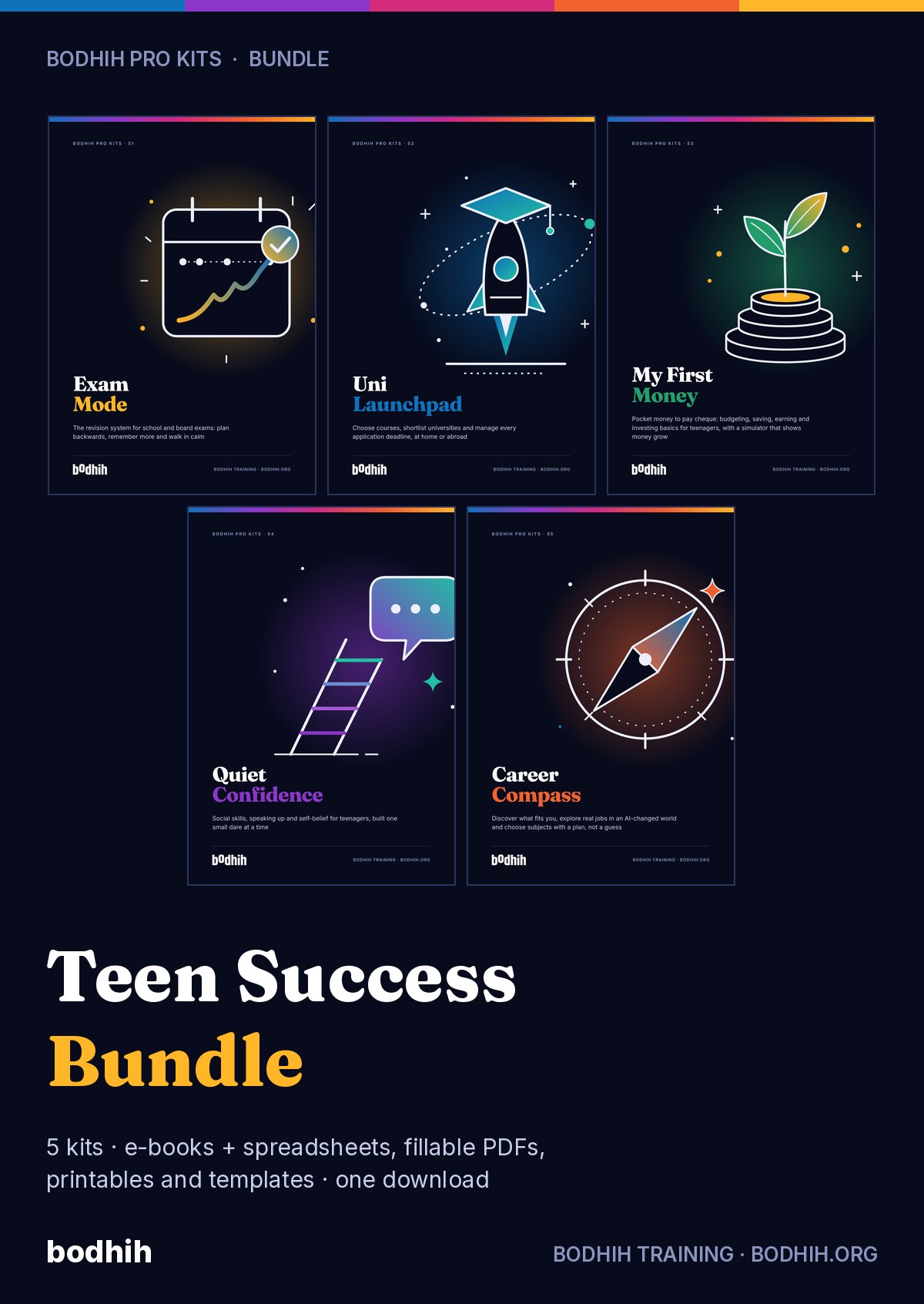
My First Money is written to teens aged 13 to 19, not about them. It teaches a ten-minute weekly method for earning, splitting, saving and staying scam-safe, with tools that do the maths in any currency.
My First Money · Bodhih Pro Kits · 53 by Bodhih Training, trainers to 2,000+ companies since 2008.
Start with small real amounts and a weekly habit. Split every amount into Save, Spend and Give, move the savings first, log spending, wait 48 hours on wants and learn the five scam red flags. The My First Money kit from Bodhih Training gives teens the e-book, workbook and trackers to do this in ten minutes a week.
Want the full free guide first? Read How to Manage Money as a Teenager: A 6-Step Method.
Birthday money, allowance or a week's wages can disappear into snacks, skins and small taps in one afternoon. Without a simple split and a log, there is nothing to learn from afterwards.
The goal is fuzzy, the money sits in the same wallet as everything else, and something always comes up at the halfway mark. Most blank trackers do nothing about any of that.
Fake giveaways, game trades, easy-money tasks and money mule offers arrive through friends' accounts and look normal. Teens are rarely told the simple rule that you never enter a PIN to receive money.
Parents lecture, teens switch off, and the same disagreements about app purchases and what the allowance covers come round every month.
Imagine a Sunday evening a few weeks from now. Your teenager opens the workbook without being asked, types in six lines from the week, and sees the Budget sheet update by itself. Food out is a little over. They move a small amount across from fun money and close the laptop. Ten minutes, no drama, no lecture.
If you are the teen reading this, picture it from your side. You know what is in your account, you know what the concert ticket costs in hours of work, and as you colour in the next band of your goal thermometer you can see the date you will get there. When a friend forwards a free-coins link, you spot two red flags before you have finished reading it.
Because the kit starts small, you can simply open the Start here sheet today, type in one number, and let the rest follow. Whether you begin with the workbook tonight or print a savings tracker tomorrow, the first week teaches more than a year of being told to be careful.
And when the first real pay slip arrives, it will not be a mystery. Gross, deductions, net: three zones you already know. That is a quiet kind of confidence, and it tends to stay.
The e-book shows you how. The tools make it happen. Here is exactly what you download.
The guide: methods, worked examples, scripts and exercises
Money log, Save-Spend-Give budget, savings goals, hours-of-work calculator, subscription tracker, earning ideas ranker, growth simulator and dashboards in one file
Turn one wish into a goal with a price, a date, a weekly amount and an if-then plan
Sort 20 everyday items, then your own last ten purchases, into Need, Want or Depends
A two-page agreement a teen and parent or carer fill in together: allowance, what it covers, apps, privacy and what happens when things go wrong
Twelve realistic messages to judge as scam or real, with a full answer page and the red flags behind each
Compare three options for a phone, laptop or other big buy: jobs, whole cost, cost per year and a simple score
Forty money words in plain English, from allowance to yield
The five flags, the six scams aimed at teens and exactly what to do in the first hour
A one-page card for phones, laptops and other big buys: six steps, cost per year and second-hand safety checks
How to read a pay slip anywhere, what the common deductions are called in six countries and what to ask on day one
Four colourful printable trackers that work in any currency: goal thermometer, 100-box challenge, 26-week step-up and 30-day money bingo
Thirty-one word-for-word scripts for asking, agreeing, refusing and reporting, to edit into your own voice
Thirteen weeks of ten-minute money checks with a longer review each month, for Google, Outlook or Apple Calendar
Thirty safe ways for teens to earn, with type, safety note, typical age and start-up cost, ready to paste into the workbook
Each chapter opens with a real situation, gives you a method and ends with something to do today, using the tools in your kit.
Five taps for earning, the rules bit in brief, and a scorecard that ranks your options by pay, fun, fit and safety.
Three piles instead of two, why urgency is manufactured, and how to price anything in hours of work.
Save, Spend, Give: a ten-minute method with a worked example and a log that fills the budget for you.
A price, a date, an awkward place for the money and a tracker you can colour in, plus a WOOP plan for obstacles.
What accounts and payment apps are, and five safety habits that make a tap feel like spending again.
The six scams teens meet most, five red flags, and the Stop, Check, Tell routine.
A fifteen-minute audit that turns small repeating payments into a yearly cost and a clear decision.
Why starting early beats starting big, and what shares, bonds and funds are, as concepts only.
Debt in plain words, buy now pay later, and how to read gross, deductions and net on any pay slip.
A six-step method for a first phone or laptop, giving on purpose, and a script for a calm money talk with parents.
Every outcome is practised with a worked example and a tool, not just described.
People who measure before and after improve faster and can show it. AssessAll, our sister assessment platform, has AI-graded assessments that pair with this kit. Take one now, work through the kit, then re-take it.
Here is the second tool, and it tends to change more minds than any other. Prices are abstract. Hours of your life are not. Take what you earn per hour. If you have a job, use your real take-home pay. If you live on an allowance, work out a fair number: what a neighbour would pay you for an hour of babysitting or tutoring. Then divide the price by it. Chloe takes home about 15 dollars an hour at the café. The trainers cost 55 dollars, so they cost her 3 hours and 40 minutes of carrying plates. That is most of a shift. Are they worth a shift? Maybe. That is her call. But it is a much clearer question than "are they worth 55 dollars?"
| Free templates and typical advice | This kit | |
|---|---|---|
| Method | A blank budget sheet with no explanation | A ten-minute weekly method taught in ten short chapters, with a task at the end of each |
| Currency and country | Dollar signs and US-only assumptions | No currency symbols, a Settings sheet, examples from eight countries and a dated country guide for pay slips |
| Formulas | Static tables or broken totals | Budget fills from the log, goals show weeks to go and a finish date, sample data shows it all working |
| Compound growth | A paragraph telling teens to start early | A simulator and Start Age Race that recalculate with the teen's own amount, rate and age |
| Scam safety | Usually missing | A chapter, a cheat sheet, a 12-message quiz with answers and scripts for telling an adult and calling the bank |
| Parents | Left to work it out | A note for parents, a Family Money Agreement to fill in together and scripts for both sides |
Bodhih Training has designed and delivered corporate programmes since 2008. Bodhih Pro Kits package what works in those workshops into a guide plus the exact tools we use, so you can apply it the same day without a facilitator in the room.
Name, email and country. UPI, card or netbanking in India; international cards everywhere else. No account to create.
Your download page opens at once, with every file and a one-click ZIP. A permanent link lands in your inbox too.
Start with the quick-start chapter, then the main spreadsheet or planner. Most buyers use something from the kit the same day.
Money skill is built with practice on small sums, long before the big ones arrive. Open the Start here sheet, type in one number, and the rest follows. Whether you start with the workbook tonight or a savings tracker on the wall tomorrow, the first week is the one that counts.
Personal licence for the buyer's own use (and use with your own family). Please don't share or resell the files. School, team and company licences: solutions@bodhih.com.
Study techniques backed by research, with a 2027 study planner.
Speak and write clearly, with AI practice.
250+ AI-graded assessments to measure skills and earn verified credentials.
Individual development plans that start from evidence and stay yours.
Run this topic as a live workshop for your team, in person or online.
Book a vetted coach for career, leadership or communication. Pay per session.
Certification pathways in Applied AI, Workplace English and management.
It is written for ages 13 to 19 and speaks directly to the teen. A 13-year-old will get most from the chapters on needs and wants, budgeting, saving and scams. Older teens will also use the chapters on pay slips, credit and big purchases. There is a short note for parents and carers.
Give them real money to manage, a clear list of what it must cover, and room to make small mistakes. Then talk through one real decision at a time. The Family Money Agreement and the weekly ten-minute check in this kit give you a structure, so the conversation is about the plan and not about them.
Yes. The workbook uses plain numbers with no currency sign, and the trackers work in units you set. Examples come from India, the UK, the US, Nigeria, Kenya, Singapore, Australia and the UAE. Rules on jobs, tax and accounts differ by country, so the kit teaches the principle and tells you to check your official local source.
No. My First Money is educational. It explains general ideas such as budgeting, compound growth, risk and credit so teens can ask better questions. It does not recommend any product, account or investment. For decisions about tax, accounts or investing, check official sources and speak to a parent, carer or qualified professional.
No. Investing is explained as concepts only: what a share, a bond and a fund are, and how risk and return travel together. The growth simulator uses a fixed illustrative rate to show how compounding works and is not a forecast.
The workbook opens in Excel, Google Sheets or LibreOffice. The worksheets are fillable PDFs you can complete on screen or print. The scripts open in Word or Google Docs, and the calendar file imports into Google, Outlook or Apple Calendar. A phone is enough to read the e-book and cheat sheets.
The Spot the Scam Quiz in the kit gives a quick score. For a fuller picture, AssessAll offers Money Decision Judgment, the Everyday Scam and Fraud Resistance Assessment for Consumers and Numerical Ability Foundation at assessall.com. Parents may find it useful to take one too and compare notes.
Pick one savings goal and write a WOOP plan for it on the Money Goals Poster Sheet. Jobulary has a clear guide to the WOOP method for goal setting at jobulary.com, which pairs well with the 13-week calendar in this kit.
There is no single right split. A reasonable starting point is about half to Spend, four tenths to Save and one tenth to Give, then adjust. If you pay for your own transport or lunches, Spend needs to be larger. The Settings sheet lets you change the split in seconds.
Digital kits are non-refundable once downloaded. If a file is corrupted and we cannot fix it within 3 working days, if you were charged twice, or if delivery failed, contact us and we will put it right.
₹449 including 18% GST for buyers in India, or $14 for buyers outside India. One-time payment, no subscription, with an automatic invoice.
Instantly. Your download page opens the moment payment succeeds, and a permanent download link is emailed to you. Download each file separately or everything in one ZIP.
Yes. Team and company licences, and workshops on this topic run by Bodhih Training, are available. Write to solutions@bodhih.com or call +91 99000 11601.