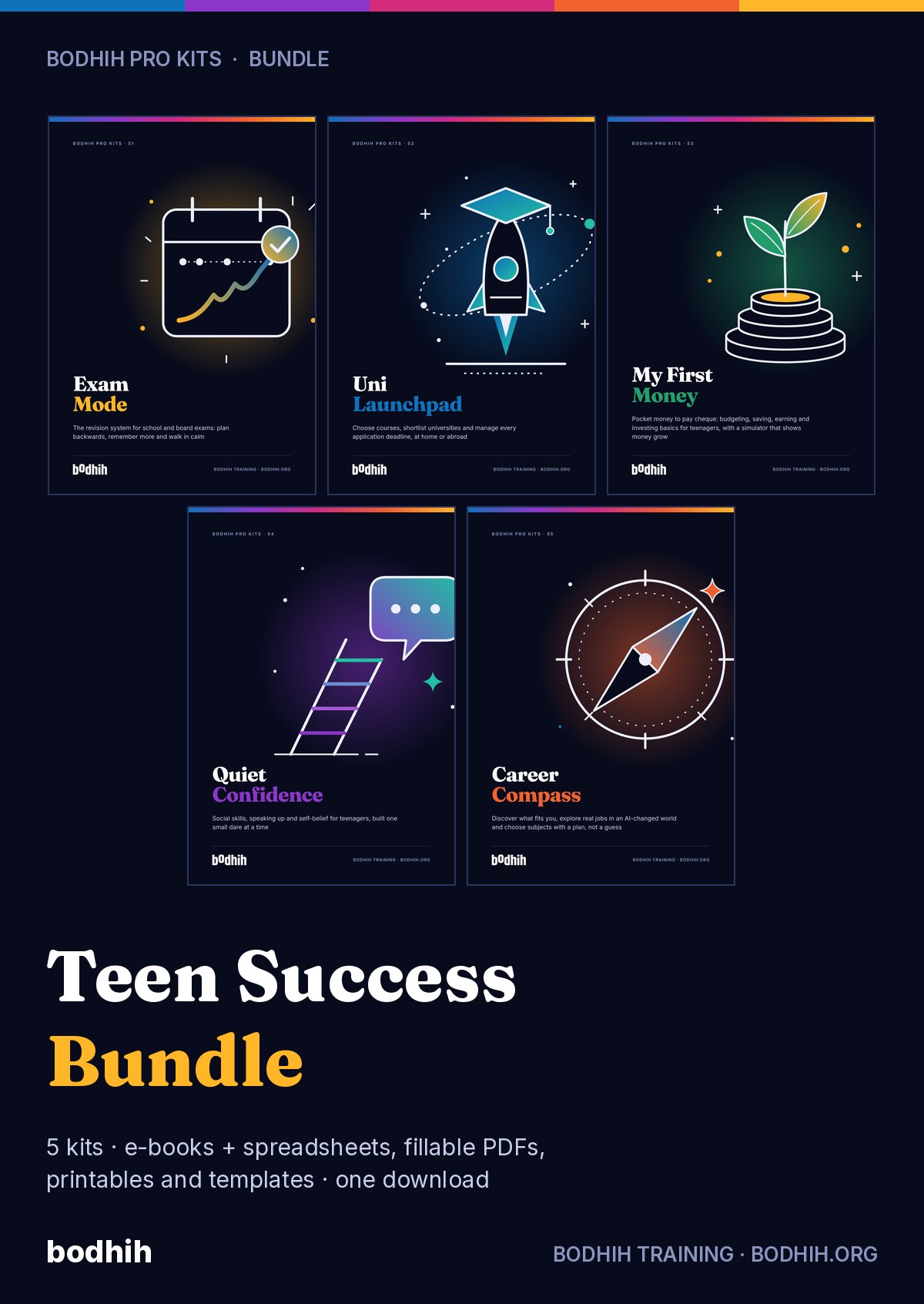
Exam Mode is the revision system for school and board exams. It swaps rereading and highlighting for the methods that learning science supports, and gives you the planner, logs and checklists to run them for any exam board in any country.
Exam Mode · Bodhih Pro Kits · 51 by Bodhih Training, trainers to 2,000+ companies since 2008.
Test yourself and spread your revision out. Research reviews rate practice testing and spaced practice as the most useful study techniques, while rereading and highlighting rate low. Plan backwards from your exam dates, review each topic after 1, 3, 7 and 14 days, sit timed past papers and log every mistake. The Exam Mode kit from Bodhih Training gives you the tools.
Want the full free guide first? Read How to Revise for Exams Effectively: A 6-Week Plan That Works.
Rereading makes a page feel familiar, and familiar feels like known. Then the exam asks you to produce it on a blank sheet, and it is not there. The problem is the method, not your memory.
Plans that start from today, give every subject equal time and assume you never get tired are built to fail. A plan needs to start from the exam date, follow the marks and keep spare slots.
Sitting papers measures you. It only improves you when each lost mark is sorted, fixed and retested. Most students skip that step because nobody showed them how.
Timing, command words and panic are skills, and they can be practised. A simple routine for the first two minutes and the last ten protects marks you already own.
Being asked how it is going five times a day helps nobody. One agreed weekly check-in with a dashboard to look at changes the conversation.
Picture a Sunday evening six weeks before your first paper. You open the Revision Planner, and the Dashboard tells you three things: 41 days to chemistry, two reviews due today, and the single topic that deserves your next hour. You don't have to decide where to start. You just start.
By Thursday you notice something odd. A topic you studied on Monday comes back to you on a blank page with no notes open, and the gaps you missed are written in green so you know exactly what to fix. As you tick the +3 review, the sheet quietly sets the next one for you.
Imagine the Saturday after your third timed paper. The error log chart shows that a third of your lost marks were slips and misread questions. Marks you already knew how to get. You add a two-minute checking routine, and when you sit the next paper, the line on the Paper trend chart moves.
And then the morning itself. Your bag was packed last night from the Exam-Day Checklist. You read your last-look page once, stand away from the corridor panic, and when you turn the paper over you already know your minutes per mark and which question you will begin with. That is what calm feels like when it comes from a plan.
The e-book shows you how. The tools make it happen. Here is exactly what you download.
The guide: methods, worked examples, scripts and exercises
Exam countdown, topic triage with priority scores, automatic spaced review dates, weekly timetable, past-paper log with trend chart, error log and three dashboards.
Shrink any topic to a single page: big idea, key terms, must-know facts, typical questions and your usual mistakes. Fill it from memory first.
A structured review for every practice paper: score, time, lost marks sorted by mistake type, three topics to restudy and one habit to change.
One page per exam week: papers, daily plan, sleep and stop times, if-then rules and who to talk to.
Night-before packing list, morning routine, time budget calculator and the in-hall routine for every paper.
A wall chart of the six evidence-based techniques, what each looks like at your desk, and the habits to drop.
The block routine, a menu of eight block types, phone rules and if-then plans for staying on task.
A five-minute plan layout, command-word table, paragraph pattern and time-per-mark guide for essays and extended answers.
A calm-down routine for the desk and the exam hall, what to do after a bad paper, and where to find help.
Six colour pages: question, formula, key term and mistake cards (8 per page), a page of example cards to copy, and five-box dividers for spaced flashcard review.
42 daily prompts for Google, Outlook or Apple Calendar, from setting up your plan to the night before the first paper. Move the events so day 42 is the day before your first exam.
A ready-shaped CSV with question, answer, subject and tag columns and ten example cards. Fill it in any spreadsheet and import it into your flashcard app.
A one-page editable agreement to fill in together: study hours, phone rules, chores, the weekly check-in and what to say on exam mornings.
Each chapter opens with a real situation, gives you a method and ends with something to do today, using the tools in your kit.
Why the usual revision method fails and how this kit fits together.
The illusion of fluency, what the research rated high and low, and the six techniques the kit uses.
Exam dates, topic triage, real study slots, three phases and a weekly timetable with a buffer.
Five ways to test yourself, the five-box flashcard system and how to write good cards.
The forgetting curve, the 1, 3, 7, 14 review schedule and how to interleave topics.
One-page summaries from memory, simple diagrams, asking why, and the last-look page.
How to sit a practice paper properly and turn every lost mark into a fix.
What the techniques look like in each kind of subject.
Short defined study blocks, phone rules without the lecture and if-then plans.
Why sleep protects marks, simple self-care and a 90-second reset for panic.
Packing, time budgets, the in-hall routine, recovering from a bad paper and planning for results.
The whole method on one page and permission to follow it imperfectly.
A week-by-week plan, plus what to do when time is short.
What helps, what doesn't, and when to seek more support.
Every outcome is practised with a worked example and a tool, not just described.
People who measure before and after improve faster and can show it. AssessAll, our sister assessment platform, has AI-graded assessments that pair with this kit. Take one now, work through the kit, then re-take it.
There is a quick way to tell good revision from the comfortable kind. Ask: "At any point in the last 25 minutes, did I have to produce something from memory, and did I find out whether I was right?" If yes, you were revising. If you only looked at things, you were reading. Good revision feels harder than rereading. You will get things wrong. You will stare at a blank page and feel stupid for about ninety seconds. That discomfort is the feeling of memory being built, and researchers have a friendly name for it: desirable difficulty. The students who do best are often not the ones who study longest. They are the ones willing to feel slightly uncomfortable for short periods, every day.
| Free templates and typical advice | This kit | |
|---|---|---|
| Method | A blank timetable grid and a list of tips | A full method based on learning-science research, with sources named |
| Planning | Starts from today, equal time for every subject | Counts back from each exam date and ranks topics by weakness and marks |
| Spaced review | You work out the dates yourself, or don't | Type one date and the +1, +3, +7 and +14 reviews appear, with due and overdue flags |
| Past papers | A column for the score | Score trend chart plus an error log that sorts lost marks by type and tracks retests |
| Country | Built around one exam system | Works for any exam board, with examples from India, the UK, the US, Nigeria, Kenya, Singapore and Australia |
| Wellbeing | Ignored, or a motivational quote | Sleep, panic reset, bad-paper recovery and clear signposts to trusted adults and helplines |
| Parents | Not considered | A short note for parents and an editable Exam Season Agreement |
Bodhih Training has designed and delivered corporate programmes since 2008. Bodhih Pro Kits package what works in those workshops into a guide plus the exact tools we use, so you can apply it the same day without a facilitator in the room.
Name, email and country. UPI, card or netbanking in India; international cards everywhere else. No account to create.
Your download page opens at once, with every file and a one-click ZIP. A permanent link lands in your inbox too.
Start with the quick-start chapter, then the main spreadsheet or planner. Most buyers use something from the kit the same day.
Whether you start with the Exams sheet tonight or one blank-page recall tomorrow morning, the first step takes about five minutes. Open the planner, type in your first exam date, and let the countdown begin working for you.
Personal licence for the buyer's own use (and use with your own family or the students you personally tutor). Please don't share or resell the files. Team, school and company licences: solutions@bodhih.com.
Study techniques backed by research, with a 2027 study planner.
Speak and write clearly, with AI practice.
250+ AI-graded assessments to measure skills and earn verified credentials.
Individual development plans that start from evidence and stay yours.
Run this topic as a live workshop for your team, in person or online.
Book a vetted coach for career, leadership or communication. Pay per session.
Certification pathways in Applied AI, Workplace English and management.
The best-supported techniques are testing yourself (retrieval practice) and spreading revision over time (spacing). A 2013 research review led by John Dunlosky rated both as high utility, and rated rereading and highlighting as low. Exam Mode builds your whole plan around those two, plus mixed practice, worked examples, past papers and an error log.
Yes. The method is the same for GCSE, A-level, CBSE, ICSE, IB, SAT, ACT, WAEC, O-levels, HSC and entrance tests, and the planner lets you enter your own subjects, papers and dates. The kit does not include syllabus content or exam rules, so take dates, formats and equipment rules from your school or the official exam board site.
Start from the exam date and count back. List every topic, rate your confidence and its exam weight, count the study slots you really have, and keep one slot in five empty as a buffer. Then plan one week at a time with an exact task in every block. The Revision Planner does the counting and ranking for you.
No. The e-book includes a six-week countdown and a ten-day emergency version that tells you what to prioritise and what to drop. The less time you have, the more it matters to stop rereading and start testing yourself on the topics that carry the most marks.
Inside the kit, the Topics sheet gives you a confidence rating for every topic and an average score on the Dashboard. If you would like a wider picture of your study habits, the AssessAll assessments Study Skills & Learning Strategies and Study Conditions and Exam Preparation Environment Assessment for Students, Parents and Tutors are a useful first step, and the Sustained Attention and Monitoring Assessment looks at how well you hold focus.
Chapter 8 teaches if-then plans, where you decide in advance what you will do when a predictable obstacle appears. Jobulary has a helpful article, If-then plans that make habits stick, that shows how the same idea works in adult life, and you can use it to turn your exam routine into a longer development plan.
No. The Revision Planner opens in Excel and in Google Sheets, which is free. The planners are fillable PDFs that work in Acrobat Reader or can be printed, the agreement opens in Word or Google Docs, and the calendar imports into Google Calendar, Outlook or Apple Calendar.
No. Exam Mode is educational content about study methods. The parts on sleep, food, stress and panic are general information, not medical advice. If you are struggling, please talk to a parent, carer, teacher, school counsellor or doctor, and contact a local helpline or emergency services if you feel unsafe.
Yes. There is a short note for parents and carers and an editable Exam Season Agreement to fill in together. Tutors can use the kit with their own students under the personal licence. Schools and tuition centres should contact us about a team licence.
Put your pen down, plant your feet and breathe out slowly for longer than you breathe in, five times. Name five things you can see, then find one question you can answer and start there. The Panic Button cheat sheet gives you the full 90-second routine to practise before the day.
Digital kits are non-refundable once downloaded, except where a file is corrupted and not fixed within 3 working days, you were charged twice, or delivery failed. Please read the description and file list before you buy.
₹499 including 18% GST for buyers in India, or $15 for buyers outside India. One-time payment, no subscription, with an automatic invoice.
Instantly. Your download page opens the moment payment succeeds, and a permanent download link is emailed to you. Download each file separately or everything in one ZIP.
Any of the usual tools: Excel or Google Sheets for spreadsheets, Word or Google Docs for templates, Adobe Acrobat Reader, Preview, Xodo or GoodNotes for the fillable PDFs, and Google, Outlook or Apple Calendar for the calendar plan.
Because it is a digital download, kits are not refundable once downloaded. We always refund a duplicate charge or a failed delivery, and if a file is corrupted and we cannot fix it within 3 working days. Full terms: bodhih.org/refunds.
Yes. Team and company licences, and workshops on this topic run by Bodhih Training, are available. Write to solutions@bodhih.com or call +91 99000 11601.