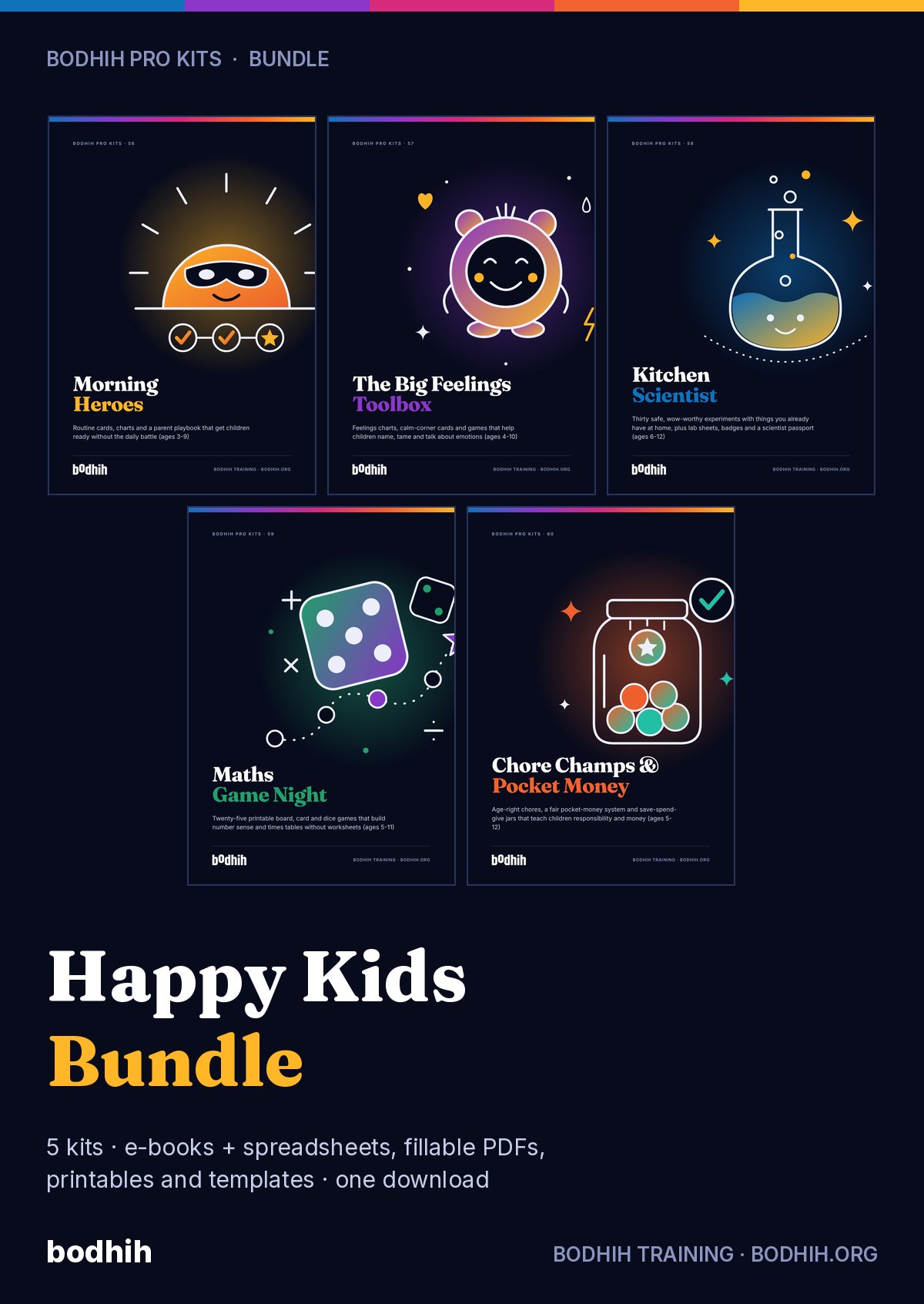
Morning Heroes moves the reminding from your voice to the wall. Bright picture cards, charts and a parent playbook help children aged 3 to 9 get themselves ready for the day, for after school and for bed, in any home, anywhere in the world.
Morning Heroes · Bodhih Pro Kits · 56 by Bodhih Training, trainers to 2,000+ companies since 2008.
Put the routine on the wall instead of in your voice. Choose three to seven picture steps for your child's age, keep the same order every day, plan backwards from the time you leave, prepare clothes and bag the night before, and ask "What's next on your chart?". The Morning Heroes kit from Bodhih Training gives you the cards, charts and playbook to do it.
Want the full free guide first? Read Morning Routine for Kids: Get Out the Door Without Nagging.
You say every step out loud, several times, every day. The more reliably you remind, the less your child needs to remember, and by 7.40 your voice has changed.
One sock feels wrong, the tower is not finished, the bus leaves in nine minutes. Small children find stopping and switching hard, and a sudden "time to go" lands like a thunderclap.
A treat got them into the car on Monday. By Friday they are negotiating a price for seatbelts. You know it is not working, and you are not sure what to do instead.
You have printed pretty charts before. They went up with enthusiasm and became wallpaper by Thursday, because nobody told you how to launch, fade or rescue them.
Imagine tomorrow evening. You and your child are sitting on the floor with a page of bright cards and a pair of scissors. As you let them choose five cards for the morning, you notice they are already telling Pip the fox what comes first. The cards go up at their eye level, and you do one silly rehearsal before bed.
Now picture the morning. You open the blinds, the same cue as you agreed, and instead of the usual list you say one sentence: "What's next on your chart?" A small finger points at a T-shirt. You move the arrow on the timer wheel to yellow, and nobody has to be told that time is nearly up. The bag has been by the door since last night.
When a wobbly day comes, and it will, you already know your emergency three. You go low and slow, shrink the routine, and write two lines in the Troubleshooting Log that evening. By the end of the week the pattern is plain to see, and you change one thing.
A fortnight in, you count your spoken instructions again. The number has dropped. Your child colours another planet on the rocket chart and asks which badge comes next. And one ordinary morning you finish your tea while it is still hot.
The e-book shows you how. The tools make it happen. Here is exactly what you download.
The guide: methods, worked examples, scripts and exercises
48 bright picture cards in four colour families (morning, after school, bedtime, any time), six per page, plus a page of draw-your-own cards. Print, cut and stick up at your child's eye level.
Four weekly charts with seven picture steps and a tick circle for every day, starring Sunny the star, Bolt the robot and Pip the fox. Slip into a plastic sleeve and reuse with a whiteboard pen.
Four colour-in progress charts: Rocket to the Moon, Grow a Hero Garden, Treasure Map and a Family Team Jar for siblings. Each has space to agree a shared celebration in advance.
A First-Then board and a First-Next-Then board sized for the routine cards, a cut-out green, yellow and red get-ready wheel with arrow, and three door hangers with tick lists.
Morning Hero and Bedtime Star certificates plus 16 cut-out badges for milestones such as a five-day streak, packing your own bag or a brave try.
All 48 routine cards and the three ready-made charts as clean black outlines. Uses very little ink, and children can colour in their own set.
Four fillable pages for grown-ups: time your real morning, work back from the door, choose the cards, plan the hand-over and agree how you will encourage and review.
A calm-moment plan for bad mornings plus a simple log that reveals the pattern: what happened just before, what you tried and what helped.
A grown-up's tracker for up to several children: daily log with automatic points, hero days and streaks, a per-child scoreboard with goals, a step check that shows which step jams, weekly tick grids and a live dashboard.
A fridge-door cheat sheet of swap lines for the ten most common morning moments, plus transition lines, noticing phrases, the emergency three and if-then plans for grown-ups.
A one-glance guide to how many steps, which cards, what children can usually manage, what still needs you and which choices to offer at ages 3 to 4, 5 to 6 and 7 to 9.
Everything you need to turn the files into a working routine wall in under an hour: paper, printer settings for A4 and US Letter, cutting, laminating, sticking, the ink-saver route and storage.
Fourteen short daily prompts for the grown-up, plus a week-3 check and a first monthly review, ready to import into Google, Outlook or Apple Calendar.
Each chapter opens with a real situation, gives you a method and ends with something to do today, using the tools in your kit.
Why mornings fail, what is in the kit and how to start with three chapters and one page of cards.
Why spoken reminders backfire, what young brains can hold, and the four parts of a routine that sticks.
How to choose cards, pick cards or charts by age, and set up a routine wall your child helps build.
Plan backwards from the door, protect a ten-minute buffer and move the hard parts to the night before.
A landing routine for after school and a wind-down for bedtime that protects sleep and tomorrow morning.
Make time visible with the timer wheel, warn before every switch and use First-Then without threats.
The hand-over ladder, what to expect at ages 3 to 9 and the kind of choices that win cooperation.
Tell bribes from planned rewards, notice out loud, and use streak charts so they stay small and fade.
What to do in a meltdown, the five checks to run afterwards and when to ask for professional help.
Adjustments many neurodivergent children find helpful, plus charts, team goals and jobs for siblings.
Screens in their place, loose weekends, holidays, the return to school and a monthly review.
The whole method on one page and what to expect in your first two weeks.
A day-by-day table of the launch plan that matches the calendar file.
The public guidance this book draws on, checked in October 2026.
Every outcome is practised with a worked example and a tool, not just described.
People who measure before and after improve faster and can show it. AssessAll, our sister assessment platform, has AI-graded assessments that pair with this kit. Take one now, work through the kit, then re-take it.
Harvard's Center on the Developing Child uses a lovely image for the skills that let us plan, focus, switch between tasks and resist distraction. It compares them to an air traffic control system in the brain. These skills are usually called executive function and self-regulation. The Center is clear that children are not born with them. They are born with the capacity to build them, slowly, with practice and with adults who provide the scaffolding. A four-year-old's air traffic control tower has one runway and a controller who keeps wandering off to look at a snail. Asking that child to "get ready" is asking them to hold five steps in mind, in order, while ignoring a dinosaur. A picture chart does the holding for them. That is why it works, and it is also why it isn't cheating. You are lending them a skill until they grow their own.
| Free templates and typical advice | This kit | |
|---|---|---|
| Method | A pretty chart with no instructions | A full parent playbook: launch, hand over, encourage, fade and rescue |
| Cards | 12 to 20 clip-art cards for mornings only | 48 original illustrated cards for morning, after school, bedtime and any time, plus blanks |
| Ink | Full-colour only | Colour set plus a complete ink-saver set children can colour in |
| Rewards | A sticker grid that invites bribery | Four themed charts designed around shared celebrations, with a fade plan and a sibling team jar |
| Transitions | Not covered | First-Then boards, a cut-out timer wheel and word-for-word warning scripts |
| Tracking | None | Workbook with automatic points, streaks, a step check and a dashboard, in any country |
| Where it works | US Letter and US school assumptions | A4 and US Letter, any school hours, any household, globally neutral |
Bodhih Training has designed and delivered corporate programmes since 2008. Bodhih Pro Kits package what works in those workshops into a guide plus the exact tools we use, so you can apply it the same day without a facilitator in the room.
Name, email and country. UPI, card or netbanking in India; international cards everywhere else. No account to create.
Your download page opens at once, with every file and a one-click ZIP. A permanent link lands in your inbox too.
Start with the quick-start chapter, then the main spreadsheet or planner. Most buyers use something from the kit the same day.
Whether you print the colour cards tonight or let your child colour the ink-saver set at the weekend, you can have five pictures on the wall before the next school run. Choose the cards together, ask "What's next?", and let the wall do the reminding.
Personal licence for the buyer's own family, or your own class or childcare group. Please don't share or resell the files. Team, school and company licences: solutions@bodhih.com.
Protect your family online.
Study techniques for older children and adults.
250+ AI-graded assessments to measure skills and earn verified credentials.
Individual development plans that start from evidence and stay yours.
Run this topic as a live workshop for your team, in person or online.
Book a vetted coach for career, leadership or communication. Pay per session.
Certification pathways in Applied AI, Workplace English and management.
It is designed for children aged 3 to 9. The playbook and the Routines by Age cheat sheet show how many steps to use and how much to hand over at 3 to 4, 5 to 6 and 7 to 9. Younger children use picture cards; older ones move to the charts.
Time your real morning, plan backwards from the moment you leave and add a ten-minute buffer. Move clothes and bag to the night before, put the steps on the wall as pictures, and replace instructions with "What's next on your chart?". Chapter 3 and the planner walk you through it.
Public guidance from the CDC and the American Academy of Pediatrics supports regular, predictable routines for children. A chart works when it is short, at the child's eye level, built with the child and backed by calm follow-through. It stops working when adults go back to spoken reminders, which is why the kit includes a launch plan and a troubleshooting log. Every child is different and results vary.
They can become bribery if a treat is offered mid-fuss. Chapter 7 explains the difference and shows how to agree a small, shared celebration in advance, reward the whole routine, never remove what was earned and fade the chart once the habit is in place. You can also skip the charts and rely on specific praise.
Visual schedules, First-Then boards and timers are widely used to support neurodivergent children, and many families find them helpful at home. Chapter 9 suggests adjustments such as smaller steps, fewer words and sensory comfort. It is general, educational guidance and not a substitute for advice from the professionals who know your child.
Yes. The Ink-Saver Colour-In Set contains all 48 cards and the three ready-made charts as clean black outlines that use very little ink. Children can colour their own set, which many enjoy more. The Set-Up Guide also covers copy shops, paper choices and laminating alternatives.
Yes. The pages are designed at A4 size with generous margins. On US Letter, choose "Fit to page" or "Scale to fit" in your print settings and everything prints cleanly.
No. Morning Heroes is educational content for everyday family life, drawing on public guidance from bodies such as the CDC, the American Academy of Pediatrics, UNICEF and Harvard's Center on the Developing Child. It cannot assess your child. If you are worried about sleep, behaviour, anxiety or development, please talk to your doctor or a qualified professional.
If you would like a structured look at your own judgment, AssessAll offers the Early Years and Childcare Practice Judgment, the Digital Parenting and Online Safety Judgment and the Family and Elder Caregiving Judgment at assessall.com. They are optional and separate from this kit, and useful for carers and early-years staff who want to measure their starting point.
Use if-then plans: decide in advance what you will do at the moment things usually go wrong, such as "If I hear myself say hurry up, then I will point at the chart". The Parent Scripts sheet has examples, and Jobulary has a helpful guide to if-then plans that you can use to turn this into a personal development plan.
The personal licence covers your own family, or your own class or group of children. Please do not share or resell the files. For schools, nurseries and organisations that want team or site licences, write to solutions@bodhih.com.
Digital kits are non-refundable once downloaded. We will help if a file is corrupted and we cannot fix it within 3 working days, if you were charged twice, or if delivery failed.
₹499 including 18% GST for buyers in India, or $15 for buyers outside India. One-time payment, no subscription, with an automatic invoice.
Instantly. Your download page opens the moment payment succeeds, and a permanent download link is emailed to you. Download each file separately or everything in one ZIP.
Any of the usual tools: Excel or Google Sheets for spreadsheets, Word or Google Docs for templates, Adobe Acrobat Reader, Preview, Xodo or GoodNotes for the fillable PDFs, and Google, Outlook or Apple Calendar for the calendar plan.
Because it is a digital download, kits are not refundable once downloaded. We always refund a duplicate charge or a failed delivery, and if a file is corrupted and we cannot fix it within 3 working days. Full terms: bodhih.org/refunds.
Yes. Team and company licences, and workshops on this topic run by Bodhih Training, are available. Write to solutions@bodhih.com or call +91 99000 11601.