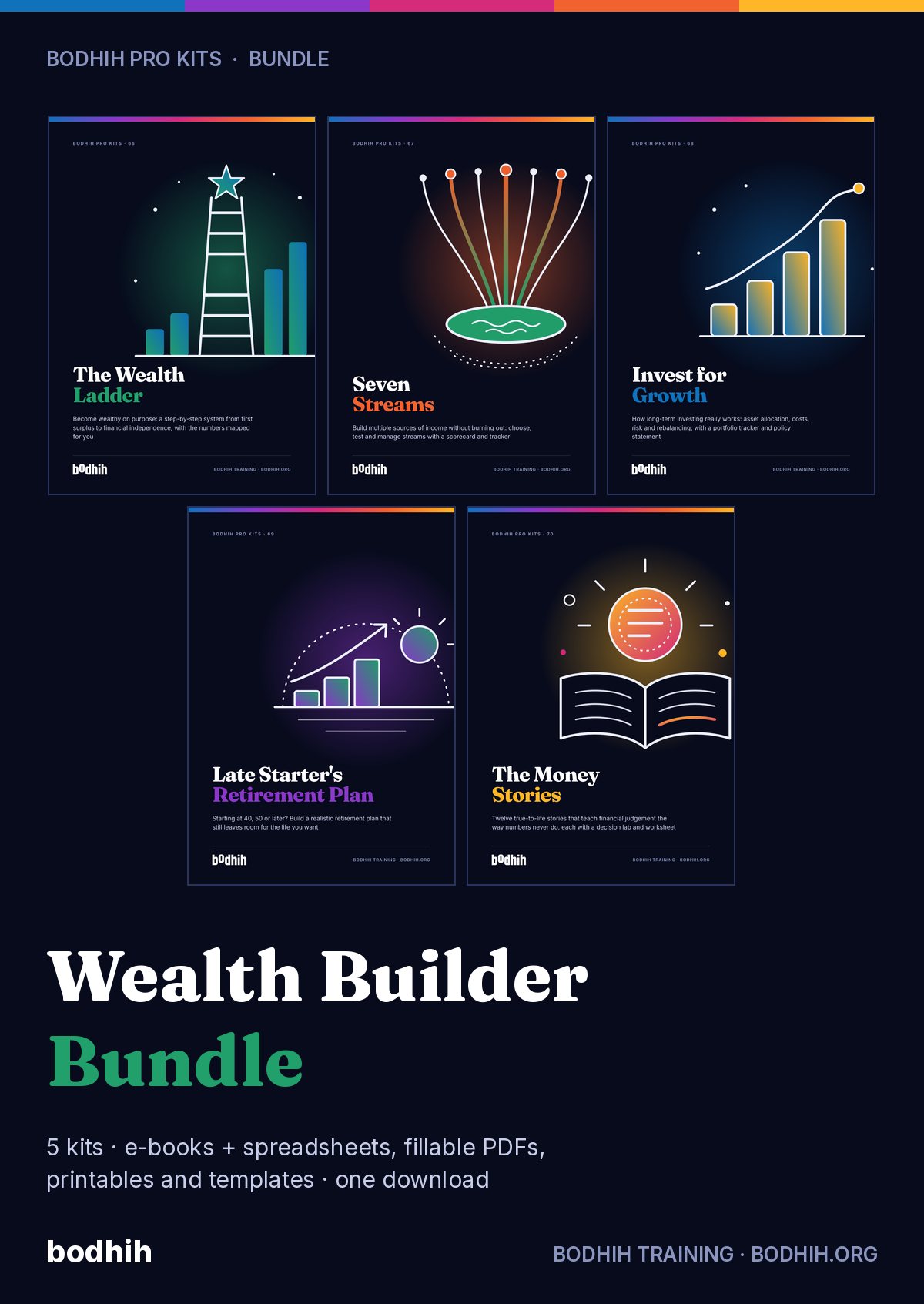
Twelve short, original stories set from Pune to Dublin show capable people making the money decisions we all face. Each one comes with the principle behind it, the honest numbers and a lab that turns it into your own decision.
The Money Stories · Bodhih Pro Kits · 70 by Bodhih Training, trainers to 2,000+ companies since 2008.
Learn from stories instead of formulas. The Money Stories kit from Bodhih Training tells twelve short, fictional stories about saving late, lifestyle creep, scams, family loans, windfalls, insurance and inheritance, then shows the principle, the numbers as a range and a decision lab so you can apply each lesson to your own choices.
Want the full free guide first? Read How to Make Better Money Decisions: 8 Biases to Beat.
Almost everyone knows they should save earlier, read the contract and ask the awkward question. Knowing is rarely the problem. The moment is, and the stories show you exactly what those moments look like from the inside.
Percentages and jargon slide off. A retired teacher explaining to his daughter why he trusted the choir's investment club does not. You will remember Mr Otieno long after you have forgotten a definition of a Ponzi scheme.
Asking a partner or parent about money directly can feel like an accusation. Reading a story together and asking 'which of these is most like us?' is a far gentler way in.
A blank budget sheet cannot tell you whether to lend to your cousin or how big a house is too big. The labs here start with a worked story, then let you change the numbers to your own.
Imagine a quiet evening this week. You pour a tea, open Chapter 1 and read about two friends in Pune who started saving ten years apart. It takes nine minutes. Somewhere in the middle you notice yourself thinking, that's me, and you keep reading because you want to know how it ends.
When you open the Decision Lab Workbook, the story's numbers are already there. You type your own amount over Priya's, change one start year and watch forty rows recalculate. Nobody has lectured you. You have simply seen, in your own currency, what a delay costs at a cautious, a middle and a hopeful return.
As you work through a story a week, you will begin to hear the characters at useful moments. A raise arrives and you think of Jake. A friend mentions a sure thing and you hear Wanjiru ask, 'Who regulates them?' You find yourself saying, 'I never sign on the day,' and meaning it.
Picture three months from now. There is a card on your fridge that asks whose hurry this is. Your decisions journal has six entries, each with a review date. And the conversation you had been putting off, with a partner, a parent or a business partner, has happened, because a story made it easy to start.
The e-book shows you how. The tools make it happen. Here is exactly what you download.
The guide: methods, worked examples, scripts and exercises
Six story labs with working formulas (compounding, lifestyle creep, family loan, rent or buy, concentration, windfall), one Assumptions sheet for any currency, a decisions journal and three dashboards.
One fillable page per story: where you recognised yourself, the principle in your words, three decision lab prompts, your numbers as a range and one action with a date.
Twelve honest statements, one per story, scored 1 to 5, with a key that points you to the chapters to reread first and a three-line plan.
A 15-minute fillable worksheet that imagines the decision has failed, finds the reasons, sets tripwires and records the range before you commit.
Gentle opening questions, a 20-minute money date agenda and a shared picture table for couples, parents and adult children, and siblings.
Session plans for all twelve stories: opening question, five discussion prompts, a group activity and a closing round, with four timing formats and facilitator tips.
An editable one-decision-per-page journal: what you chose and why, the range, the bias check, your confidence and a dated review that separates process from outcome.
A two-page reference: each story's one-line principle, the behavioural idea behind it and the habit that protects you.
Sixteen money biases on one card: the phrase you will hear yourself say, the question to ask instead and the story where it appears.
Ten questions for any loan, lease, policy, investment or partnership, each with why it matters and the warning sign, plus a script for buying time.
A dated map of the main tax-favoured saving and pension accounts in India, the UK and the US, what to verify for each and where the official registers are.
Twelve colourful cards to print and cut: each story's title, illustration, bias, principle and one question to ask yourself.
A one-page colour poster with the five questions to ask before any big money decision, each linked to its chapters.
Twenty-seven calendar prompts over twelve weeks: read one story, do its lab three days later, with two check-ins and a final review.
Each chapter opens with a real situation, gives you a method and ends with something to do today, using the tools in your kit.
Why we learn money from stories, how each chapter works and three honest warnings.
Priya saves for ten years and stops; Meenal starts ten years late and never stops. What time does that effort cannot.
Jake's promotion disappears into a nicer life, and a raise rule that would have kept half of it.
A retired maths teacher, a church friend and a WhatsApp group: how a scam earns trust, and the five checks that break it.
Sarah and Tom let the lender's maximum replace their own number, and learn what a house can cost beyond its price.
Maria lends her safety net to family with no paper, and four kinder, clearer ways she could have answered.
Tunde's windfall feels like a prize, not money, until a written order of priorities turns it back into money.
Nikhil saves a premium and pays a hospital bill: how to sort risks into insure, save for and ignore.
Two friends, one café and no contract: why success, not failure, exposes an unwritten agreement.
Wei Jie's savings and salary depend on one company, and the question from his sister that fixes it.
Chloe and Dan can talk about anything except money, and the 20-minute monthly habit that changes that.
Thandi believes it is too late at 52. A friend with a pen shows her what fifteen years still allow.
A four-line will, three siblings and a gravy boat: why equal is not always fair, and what to say while you can.
Four habits that would have changed almost every ending, and how to keep a decision journal.
Twelve behavioural finance ideas in plain words, with credits and antidotes.
Where to look for long-term accounts in India, the UK, the US and elsewhere, and how to run a story session.
Every outcome is practised with a worked example and a tool, not just described.
People who measure before and after improve faster and can show it. AssessAll, our sister assessment platform, has AI-graded assessments that pair with this kit. Take one now, work through the kit, then re-take it.
Fourteen months later the transmission on Dana's car failed. The repair was $2,100. Jake opened his banking app to move the money and found $640 in savings. He scrolled back, puzzled. Before the promotion he had usually kept around $600 spare at the end of a month. He was now earning $900 more and keeping, when he checked, about $600 spare. "Where did the raise go?" he said out loud, in the garage waiting room, to nobody. It had not been stolen or wasted. It had been absorbed. Every dollar of the raise had found a job within weeks, and each of those jobs now felt like a need. He put the repair on a credit card. That evening he and Dana made a list of everything that had changed since the promotion. It filled a page. The worst discovery was not the total. It was that he couldn't say which items he'd give up, because he had stopped noticing them.
| Free templates and typical advice | This kit | |
|---|---|---|
| How it teaches | Definitions, rules and percentages you forget by Friday | Twelve stories you remember, each followed by the principle and the numbers |
| Tools | A blank tracker with no method and no examples | Six labs pre-filled with each story's figures, with working formulas you can change |
| Country and currency | Assumes US dollars and US accounts | Any currency via one Assumptions sheet; stories from twelve cities; India, UK and US notes |
| Honesty about returns | One optimistic growth rate and a big final number | Cautious, middle and hopeful scenarios every time, with no promises and no product recommendations |
| Using it with others | Nothing for families or groups | Story cards, a discussion guide, a conversation starter and a 12-week calendar |
| After the decision | No follow-up | A pre-mortem before, a journal entry during and a dated review after |
Bodhih Training has designed and delivered corporate programmes since 2008. Bodhih Pro Kits package what works in those workshops into a guide plus the exact tools we use, so you can apply it the same day without a facilitator in the room.
Name, email and country. UPI, card or netbanking in India; international cards everywhere else. No account to create.
Your download page opens at once, with every file and a one-click ZIP. A permanent link lands in your inbox too.
Start with the quick-start chapter, then the main spreadsheet or planner. Most buyers use something from the kit the same day.
You already know how the next raise, request or signature will go if nothing changes. Whether you begin with the two friends in Pune or skip straight to the story that sounds most like your family, read one this evening and let it do its work. When you open the workbook afterwards, you will see your own numbers differently.
Personal licence for the buyer's own use (and use with your own team or clients where the kit says so). Please don't share or resell the files. Team and company licences: solutions@bodhih.com.
Budget, clear debt and build an emergency fund.
Start earning outside your job.
250+ AI-graded assessments to measure skills and earn verified credentials.
Individual development plans that start from evidence and stay yours.
Run this topic as a live workshop for your team, in person or online.
Book a vetted coach for career, leadership or communication. Pay per session.
Certification pathways in Applied AI, Workplace English and management.
No. All twelve stories are fiction: illustrative composites built from situations that turn up again and again in ordinary financial life. None is a testimonial or a case study of a real person, and any resemblance to real people is coincidental. They are designed so you recognise the situation, not the individual.
No. The kit is educational. It teaches ways of thinking and shows worked examples, but it is not financial, tax, legal or investment advice and it recommends no product, fund, share or provider. Returns in the examples are assumptions shown as ranges, and past performance does not predict the future. For your own decisions, check your local rules and speak to a qualified, registered adviser.
Yes. The stories carry the lesson and the arithmetic is kept short. In the workbook you change a handful of white cells on one Assumptions sheet and the formulas do the rest. If you can type a number into a spreadsheet, you can use every lab.
Yes. The stories are set in twelve cities across Asia, Africa, Europe, North America and Australia, and the workbook has no currency symbols, so it works in any currency. Appendix B and the dated Long-Term Accounts sheet give short India, UK and US notes as examples and tell you which regulators to look for elsewhere.
The kit includes a 12-statement My Money Biases Self-Check for reflection. If you would like a scored starting point as well, AssessAll offers the Money Decision Judgment assessment, the Everyday Scam and Fraud Resistance Assessment for Consumers and Decision-Making Under Uncertainty. Take one before you begin and again after the twelve weeks to see what has shifted.
Each chapter ends with one small action, and the decisions journal gives every choice a review date. To turn the bigger intentions into a development plan, pair the kit with the WOOP method explained on Jobulary: name the wish, the outcome, the obstacle (often one of the twelve biases) and your if-then plan.
Begin with a story, not a spreadsheet. Read one chapter together, ask which character felt most familiar, and only then move to your own situation. The Family Money Conversation Starter gives you gentle opening questions, ground rules and a 20-minute monthly agenda so the first talk is short and safe.
Treat the words high and guaranteed together as a stop sign, look the firm up yourself on your regulator's official register, and ask one sceptical person outside the group before any money moves. Chapter 3 and the Before You Sign card walk through the checks. If you think you have been targeted, report it to your national authority quickly.
The personal licence covers you and use with your own household, team, class or club where you lead the session. The Discussion Guide has timings for a 20-minute team lunch, a 45-minute book club and a 30-minute class. Please do not share or resell the files; for company-wide or multi-trainer use, ask about a team licence at solutions@bodhih.com.
Digital kits are non-refundable once downloaded. The exceptions are a corrupted file that we cannot fix within 3 working days, a duplicate charge or a failed delivery. If anything will not open, write to us and we will put it right.
₹799 including 18% GST for buyers in India, or $24 for buyers outside India. One-time payment, no subscription, with an automatic invoice.
Instantly. Your download page opens the moment payment succeeds, and a permanent download link is emailed to you. Download each file separately or everything in one ZIP.
Any of the usual tools: Excel or Google Sheets for spreadsheets, Word or Google Docs for templates, Adobe Acrobat Reader, Preview, Xodo or GoodNotes for the fillable PDFs, and Google, Outlook or Apple Calendar for the calendar plan.
Because it is a digital download, kits are not refundable once downloaded. We always refund a duplicate charge or a failed delivery, and if a file is corrupted and we cannot fix it within 3 working days. Full terms: bodhih.org/refunds.
Yes. Team and company licences, and workshops on this topic run by Bodhih Training, are available. Write to solutions@bodhih.com or call +91 99000 11601.