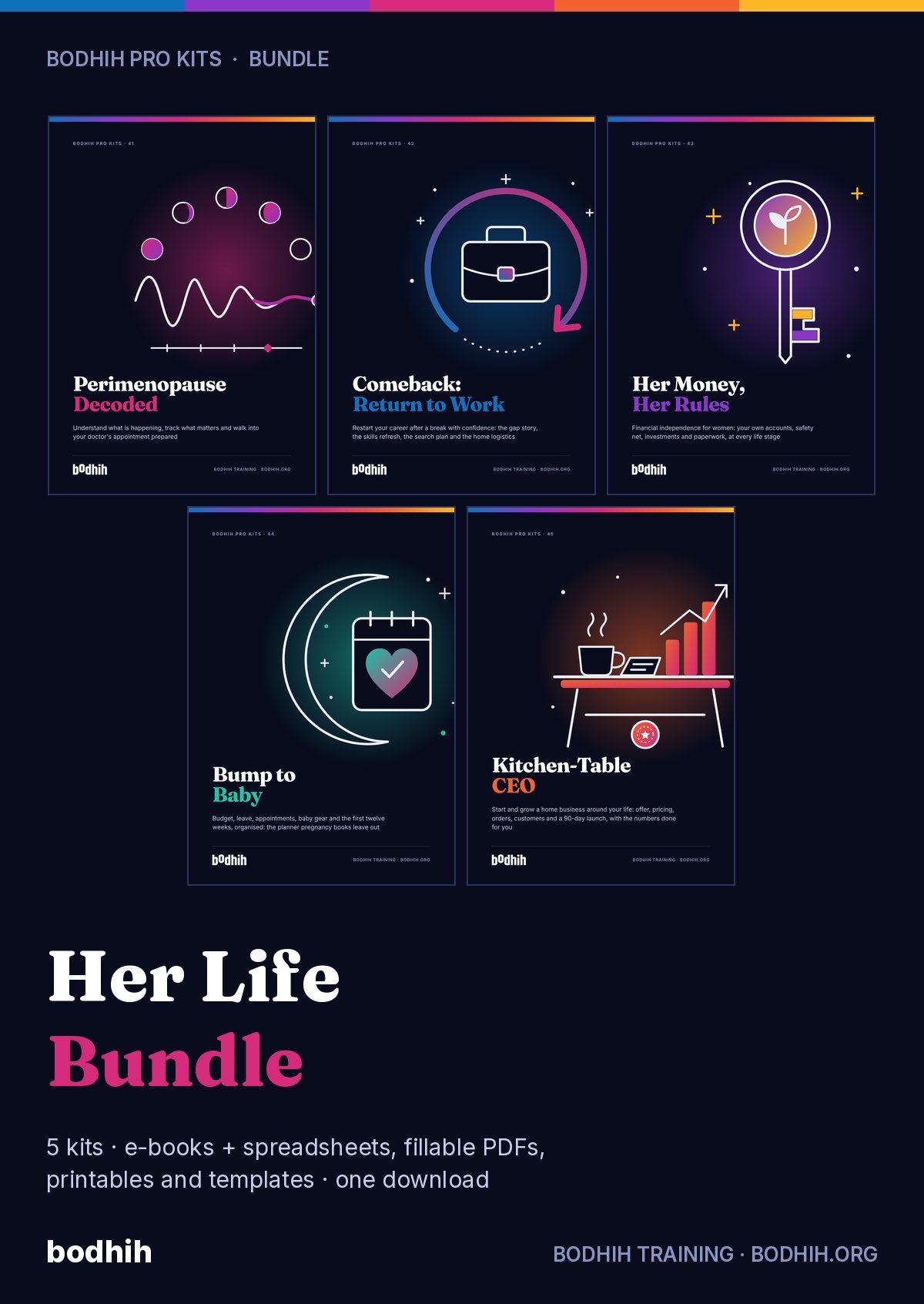
Most pregnancy products are keepsake journals. Bump to Baby is the practical planner: budget, leave, appointments, baby gear and the first twelve weeks, organised in one kit for mothers and partners, in any country and any currency.
Bump to Baby: The Practical Planner · Bodhih Pro Kits · 44 by Bodhih Training, trainers to 2,000+ companies since 2008.
Split the work into three lanes: care, money and work, and home. Put your due date on a timeline, write three questions for every appointment, budget one-off gear separately from monthly costs, model your leave pay month by month, and plan the weeks after the birth. The Bump to Baby kit from Bodhih Training gives you the tools for each step.
Want the full free guide first? Read How to Prepare for a Baby: A Trimester-by-Trimester Checklist.
The medical side of pregnancy comes with professionals and scheduled appointments. The logistics side comes with you, a search engine and a growing suspicion that everybody else got a handbook.
Every baby product is sold as the responsible choice. Without a rule for what is a need and what is nice, you either overspend or lie awake wondering what you missed.
Leave rules differ by country and employer, and few couples do the sums until late. The surprise usually arrives in month four, when one salary meets a full set of bills.
The bag gets packed and the preferences get written. Then you come home, sore and astonished, to an empty fridge and a queue of visitors. The first twelve weeks deserve a plan of their own.
Picture a quiet Sunday evening. You open the workbook, type your due date into one cell, and watch forty weeks arrange themselves into a dated list. Three tasks say This week. You do the smallest one before bed, and something in your shoulders lets go.
A few weeks later you sit down together with the gear sheet. As you mark each item Need, Nice or Skip, the total shrinks, and you notice how good it feels to skip the wipe warmer. Then you open the leave planner, enter your real take-home figures, and for the first time you can see exactly which month is tight and what would fix it.
Imagine walking into your next appointment with three questions already written, and walking out with the answers logged. Imagine telling your manager in four calm sentences, with a handover plan that means your phone stays quiet on leave.
And picture the first week at home. The door sign is up, the freezer is full, the visitor message went out a fortnight ago, and whoever is on the night shift reads one handover line and knows where things stand. You didn't control everything. You simply took the admin out of your head, and left more room for the baby.
The e-book shows you how. The tools make it happen. Here is exactly what you download.
The guide: methods, worked examples, scripts and exercises
One workbook for the whole stretch: a due-date timeline, appointments log, Need/Nice/Skip gear budget, monthly costs, month-by-month leave and pay planner, a leave scenario lab, a baby log with daily totals, contacts and a live dashboard.
A one-read fillable sheet for your care team: essentials, environment, comfort, what you'd like if plans change, and the first hours, each with a 'most important to me' line.
Tick-box packing lists in four parts plus a last-minute strip and a 2 am route plan. Ask your hospital what it provides, then cross off what you don't need.
Three fillable pages covering rest, food, visitors, help and mood for the first twelve weeks, including each adult's own early warning signs and who to call.
A starter bank of more than 40 questions across four stages, with tick boxes to choose yours and space for three questions and answers per visit.
A ready-to-send visitor message, a two-week visiting grid, a meal rota and a list of jobs to hand to anyone who offers help.
Nine editable templates: telling your manager, the four HR questions, formal leave notice, partner's leave request, a full handover plan, contact rules, out-of-office, and a return-to-work request.
A forty-minute conversation on paper: thirty whole tasks with one owner each, minimum standards, a fortnightly check-in script, and a page for grandparents and boundaries.
A one-page antidote to baby-shop marketing: the short list for the first twelve weeks, with quantities, what can wait and what to skip.
A fridge-door card for weeks 1 to 12: the daily minimum, shift handover lines, the visitor script, a paper log and what 'good enough' looks like.
A general, clearly sourced summary of commonly published warning signs in pregnancy, after birth and in young babies, with space for your own local numbers.
A two-page guide for partners: what to own in each trimester, at the birth and in the first twelve weeks, without waiting to be asked.
Thirty-one weekly admin nudges titled by pregnancy week (10 to 40) for Google, Outlook or Apple Calendar. Dated from a sample start: drag each one to the date your Timeline sheet gives.
Three colour printables: a two-part door sign (baby resting / welcome rules), a fridge card for numbers, jobs and shifts, and a one-day paper baby log to photocopy.
Each chapter opens with a real situation, gives you a method and ends with something to do today, using the tools in your kit.
Why pregnancy logistics deserve their own plan, and how to use the kit in the order you need it.
Three lanes across three trimesters, and a twenty-minute method to turn your due date into a dated task list.
The three-question method, the BRAIN prompts and a log that makes every visit count.
Split one-off from monthly costs and sort every item into Need, Nice or Skip.
What a newborn really uses, what to borrow freely and the two items where safety guidance decides.
The three dials of any leave system, four questions for HR and a planner that shows your lowest savings point.
When and how to tell your manager, plus a three-pass handover that protects your leave.
A one-page preferences sheet that flexes, and a bag packed in the order you will use it.
Rest, food, visitors, help and mood: the five-part plan for the weeks most people forget to plan.
A light feeding, sleep and nappy log that replaces memory and speeds up every health visit.
Dividing whole tasks, giving grandparents a role, and planning the return to work.
Why preparation buys attention, not control.
The whole timeline as four tick lists.
Which tool to open for which worry.
Every outcome is practised with a worked example and a tool, not just described.
People who measure before and after improve faster and can show it. AssessAll, our sister assessment platform, has AI-graded assessments that pair with this kit. Take one now, work through the kit, then re-take it.
The baby industry is very good at one thing: converting love and nervousness into a shopping list. Every item is presented as the responsible choice. The honest truth is that a newborn's needs are few, and most of the cost of a baby is not gear at all. The single most useful move is to split baby money into two separate budgets, because they behave differently. One-off costs are the things you acquire once, mostly before the birth: somewhere to sleep, a car seat, a way to carry the baby, clothes, feeding equipment. You control this budget almost entirely. You can shrink it by borrowing, buying second-hand, accepting gifts or simply deciding to skip things. Monthly running costs are what changes in your household spending every month from now on: nappies, formula if you use it, more laundry and heating, health costs, and later childcare, which in many countries is the biggest number by a distance. You control this budget much less, and it matters far more over a year.
| Free templates and typical advice | This kit | |
|---|---|---|
| Purpose | A keepsake journal or a blank weekly planner | A logistics kit: dates, money, leave, gear, people and the weeks after |
| Budget | A static shopping checklist, often written by retailers | Need/Nice/Skip decisions with a counted budget that ignores borrowed, gifted and skipped items |
| Leave and pay | Usually missing, or built for one country | A month-by-month planner and scenario lab that work with any country's rules and any currency |
| Partner | A page of tips | A playbook, a roles agreement with whole-task ownership and their own columns in the planner |
| After the birth | A feeding tracker at most | Postpartum plan, visitor plan, door sign, fridge card, baby log with daily totals and a mood check |
| Instructions | None | An e-book that teaches the method, a Start here sheet and realistic sample rows in every tab |
Bodhih Training has designed and delivered corporate programmes since 2008. Bodhih Pro Kits package what works in those workshops into a guide plus the exact tools we use, so you can apply it the same day without a facilitator in the room.
Name, email and country. UPI, card or netbanking in India; international cards everywhere else. No account to create.
Your download page opens at once, with every file and a one-click ZIP. A permanent link lands in your inbox too.
Start with the quick-start chapter, then the main spreadsheet or planner. Most buyers use something from the kit the same day.
As you download Bump to Baby, type your due date into the workbook and let the timeline show you the next small step. Whether you begin with the budget tonight or the three questions before your next appointment, you will be taking the admin out of your head and making room for the part that matters.
Personal licence for the buyer's own use (and use with your own team or clients where the kit says so). Please don't share or resell the files. Team and company licences: solutions@bodhih.com.
Change direction with a 90-day plan.
Scripts and planners for raises and offers.
250+ AI-graded assessments to measure skills and earn verified credentials.
Individual development plans that start from evidence and stay yours.
Run this topic as a live workshop for your team, in person or online.
Book a vetted coach for career, leadership or communication. Pay per session.
Certification pathways in Applied AI, Workplace English and management.
No. Bump to Baby is educational content about organisation: dates, money, leave, gear and plans. It is not medical, legal or financial advice. Your midwife, doctor and local health service guide your care, and where we mention general care facts we name the public source, such as the WHO or the NHS.
Any time. In the first trimester you will use the timeline, the appointment log and the contract checklist. If you are already in the third trimester, go straight to the birth preferences, the hospital bag and the postpartum plan. If the baby is here, start with the Fourth-Trimester Survival Card and the baby log.
Yes, because it does not assume any country's rules. You enter the take-home pay you expect in each month from your own contract, HR team and local law, and the planner shows the gap and your running savings. The e-book explains how India, the UK and the US differ in general terms and tells you what to ask HR.
Split it in two. One-off costs are gear you acquire once, and you can shrink them by borrowing, buying second-hand and skipping. Monthly running costs, such as nappies and later childcare, matter more over a year. The workbook has a sheet for each, with sample rows you overwrite with local prices.
Less than the shops suggest: a safe sleep space, a way to feed, nappies, a way to carry the baby, a car seat that meets local regulations if you use a car, and a few clothes. The What Babies Actually Need cheat sheet lists quantities and what can wait. For car seats and mattresses, follow official safety guidance where you live.
Book a private conversation and keep it to four parts: the news, the due date, what you know about your leave so far, and your plan for a handover. Confirm by email the same day. The kit includes the script, the follow-up email, a formal leave notice and a handover plan.
Very. Partners get a Partner Playbook, their own columns in the leave planner and a roles agreement built on whole-task ownership. Solo parents can use the same agreement and the Visitors and Help Plan to organise the friends and family who have offered support.
Yes. AssessAll offers a Plan Strength Assessment with an Eight-Week Re-Measure, which suits a pregnancy plan well, as well as a Family & Elder Caregiving Judgment assessment and an Early Years & Childcare Practice Judgment assessment at assessall.com. They are optional companions, separate from this kit.
Pair each task with a time and place. Jobulary's article on if-then plans explains the idea well: 'If it is Sunday evening, then we open the Timeline together.' The reminder calendar in the kit gives you a weekly slot to attach it to.
You get a PDF e-book and 14 tools in Excel, fillable PDF, Word, printable PDF and calendar formats. Digital kits are non-refundable once downloaded, except for corrupted files not fixed within 3 working days, duplicate charges or failed delivery.
₹699 including 18% GST for buyers in India, or $19 for buyers outside India. One-time payment, no subscription, with an automatic invoice.
Instantly. Your download page opens the moment payment succeeds, and a permanent download link is emailed to you. Download each file separately or everything in one ZIP.
Any of the usual tools: Excel or Google Sheets for spreadsheets, Word or Google Docs for templates, Adobe Acrobat Reader, Preview, Xodo or GoodNotes for the fillable PDFs, and Google, Outlook or Apple Calendar for the calendar plan.
Because it is a digital download, kits are not refundable once downloaded. We always refund a duplicate charge or a failed delivery, and if a file is corrupted and we cannot fix it within 3 working days. Full terms: bodhih.org/refunds.
Yes. Team and company licences, and workshops on this topic run by Bodhih Training, are available. Write to solutions@bodhih.com or call +91 99000 11601.