Show what your training changed, and what it was worth, in a report leaders trust
A complete training evaluation toolkit for L&D teams and training providers: the method, the workbook, the surveys, the follow-up forms, the ROI calculations and the exact words, from planning with the sponsor to the one-page scorecard.
- A 10-chapter e-book teaching five levels of evidence, with one composite programme evaluated all the way to ROI
- The Evaluation and ROI Workbook: 17 Excel sheets for the plan, reaction survey, pre and post tests with normalised gain, 30/60/90-day behaviour follow-ups, business metrics with a comparison group, estimates, money, fully loaded costs, ROI with sensitivity and a dashboard
- 4 fillable PDF forms and 6 Word templates, including 41 messages and scripts, 56 survey and test items, an impact report with a one-page scorecard and 32 AI prompts
- A Start Here map, 3 cheat sheets including dated data and AI rules, a 7-sheet quick ROI calculator, a 29-event 90-day calendar and a 48-task CSV
The Training Evaluation and ROI Kit · Bodhih Pro Kits · 83 by Bodhih Training, trainers to 2,000+ companies since 2008.
How do you measure the effectiveness and ROI of a training programme?
Plan with the sponsor before design, starting from the business result. Then measure reaction with performance-focused questions, learning with scenario tests, behaviour at 30, 60 and 90 days, and business results against a comparison group. Convert the isolated change to money, subtract fully loaded costs and show sensitivity. The Training Evaluation and ROI Kit from Bodhih Training gives you a file for every step.
Want the full free guide first? Read How to Evaluate Training Effectiveness and Measure Training ROI.
You already feel the problem. Here is what it is costing you.
Smile sheets are all you have
Satisfaction averages 4.3 and completion is 96%, and the finance director still asks what the business got for the money. ATD's 2019 Effective Evaluation research found that only 38% of organisations evaluated business results and 16% ROI.
Evaluation starts too late
Someone asks for impact after the programme has finished. By then the baseline has gone, everyone has been trained and there is nothing to compare with.
Training gets all the credit, or none
Business numbers moved, but so did everything else: new systems, new managers, the season. In the same ATD survey, difficulty isolating a programme's effect was the barrier named most often, by 41%.
ROI figures that will not survive finance
Participants' time left out, benefits projected over five years, estimates passed off as facts. One question from a finance partner and the number collapses, taking L&D's credibility with it.
Reports nobody acts on
Eleven pages of charts, the recommendation on page nine and no decision at the end. Findings are filed and the programme runs again unchanged.
Picture the next few weeks with the kit open beside you.
Picture the corridor conversation where a director asks for 'leadership training for the spring'. Instead of opening a catalogue, you book 45 minutes and open the evaluation plan form. By the end of the meeting you have two business results with baselines, five critical behaviours, a comparison group and a value per unit that finance has already agreed.
Now it is the last afternoon of the programme. As you run the six-question survey before people leave, one number stands out: expected manager support is low. You log it on the Actions sheet that week. At 30 days the behaviour follow-up confirms the barrier, and because you saw it early, the 60-day picture is already better.
Imagine the September data arriving. The comparison sites improved too, and you are glad, because the Business Metrics sheet takes their improvement off yours. What remains is the training's share, converted to money with values finance trusts and set against costs that include everyone's time. The ROI sheet shows the result, and what it would be if only half of it were real.
And then the meeting. The sponsor reads a one-page scorecard, asks how you know it was the training, and you show the comparison. Whether you start with the e-book tonight or the workbook tomorrow morning, the next evaluation starts from everything this one taught you.
19 files that do the work for you
The e-book shows you how. The tools make it happen. Here is exactly what you download.
The Training Evaluation and ROI Kit (e-book, PDF)
The guide: methods, worked examples, scripts and exercises
Start here: evaluation map
The whole evaluation job in eleven steps with the file to open at each, your first hour, a 30/60/90 day use plan and links to measure your starting point.
Evaluation and ROI Workbook
17-sheet workbook for one programme: settings, evaluation plan by level, participants and comparison group, reaction survey with net score, pre and post tests with normalised gain, 30/60/90-day behaviour follow-ups, business metrics with isolation, confidence-adjusted estimates, conversion to money, fully loaded costs, ROI with sensitivity, intangibles, LMS portfolio, improvement log, results by level and a dashboard with a chart.
Quick ROI Calculator
Seven-sheet calculator to forecast or check ROI for a smaller programme: fully loaded cost, benefit after isolation and confidence, sensitivity, break-even benefit per participant and a summary with a chart.
Evaluation plan form
Three-page fillable plan completed with the sponsor before design: the business need and Level 4 measures first, then behaviours, learning, reaction, isolation method, costs to capture, reporting dates and sign-off.
Performance-focused reaction survey
Two-page fillable end-of-programme survey with descriptive answer choices instead of agree-disagree scales: relevance, readiness, practice, plan, manager support, a recommend question, open comments and a mapping key for the workbook.
Behaviour observation and manager follow-up form
Three-page fillable form for Level 3: an observation checklist for up to five critical behaviours with a 1-5 frequency scale, a 30/60/90-day record, and the manager's 60-day follow-up conversation with barriers and support agreed.
Success case interview guide
Three-page fillable guide for Brinkerhoff's Success Case Method: a short screening survey, a 30-minute interview for high-success cases with evidence checks, a version for low-success cases, and a story summary with verification.
Survey and test question bank
56 ready-to-adapt items in six parts: performance-focused reaction questions with descriptive answer choices, common survey items rewritten, test items by level of thinking with item-writing rules, behaviour rating items, manager follow-up questions and success case questions.
Evaluation message and script library
41 ready-to-edit emails, chat messages and spoken scripts in 5 groups: sponsor planning and data requests, survey and test invitations, manager follow-ups, data owners, consultation notes and words for hard moments.
Training impact report and programme scorecard templates
Two ready-to-send documents: an executive impact report in seven short sections with tables for results by level, isolation, money, ROI and sensitivity, and a one-page programme scorecard for leaders.
Training evaluation policy one-pager
A one-page evaluation policy your organisation can adopt: which programmes get which depth of evaluation, planning before design, standards for surveys, tests and ROI claims, data ethics, AI use and reporting.
Worked example pack: one programme evaluated to ROI
The main forms and calculations completed for one composite programme, Team Leader Essentials, from the sponsor planning meeting to ROI, sensitivity, success cases and the scorecard, so you can see what good looks like.
AI prompt pack for training evaluation
32 tool-agnostic prompts grouped by step of the evaluation, from planning to reporting and analytics, each with what to paste in and what to check before you use the output.
Evaluation decision card
Which level of evaluation for which kind of programme, and twenty if-this-then-that rules for the decisions that come up during an evaluation.
Evaluation mistakes and data rules (October 2026)
Mistakes-to-avoid card: twelve evaluation mistakes with what to do instead, plus dated data, AI and privacy rules by region and the standards worth knowing.
ROI and evaluation formulas card
Every formula in one place with a worked example: ROI, BCR, payback, break-even, isolation methods, normalised gain, net recommend score, conversion to money and the fully loaded cost checklist.
90-day evaluation calendar
29 calendar events for the 90 days after a programme ends: reaction and learning data, spaced retrieval quizzes, 30/60/90-day behaviour checks, success case interviews, business data requests and an interim scorecard, each naming the file to open.
Evaluation task board import
48 evaluation tasks from planning eight weeks before the programme to the decision six months after, as a CSV for Trello, Asana, Notion, Planner or Jira, with phase, level, owner, file to open and due date.
Chapter by chapter
Each chapter opens with a real situation, gives you a method and ends with something to do today, using the tools in your kit.
- Format
- PDF e-book + XLSX + fillable PDF + DOCX + printable PDF + ICS + CSV
- Files
- 19 files plus a one-click ZIP
- E-book
- 58 pages
- Works with
- Excel, Google Sheets, LibreOffice, Word, Google Docs, Acrobat Reader, Google Calendar, Outlook, Apple Calendar, Trello, Asana, Notion, Planner, Jira
- Best for
- L&D managers, training coordinators, HR-L&D generalists, academy leads and training providers
- Currency
- Any: type your currency code on the Settings sheet
Beyond the Smile Sheet
Why most evaluation stops at the smile sheet, and the five levels of evidence this kit uses, planned from the top and measured from the bottom.
Choosing an Evaluation Approach That Fits
Kirkpatrick, Phillips, Brinkerhoff and LTEM in plain words, and four questions that decide how deeply to evaluate each programme.
Plan the Evaluation Before You Design the Training
The sponsor planning meeting that agrees business results, critical behaviours, isolation method, values and the ROI hurdle before design starts.
Reaction Surveys That Tell You Something
Performance-focused questions with descriptive answers, a net recommend score, comment coding and why reaction data is an early warning, not proof.
Testing Knowledge and Skill
Scenario items that test decisions, pre and post forms from one blueprint, practical observation and normalised gain.
Measuring Behaviour Change on the Job
Critical behaviours, 30/60/90-day checks from several sources, the 60-day manager conversation and acting on barriers early.
Business Impact and Isolating the Effect of Training
Comparison groups, trend lines and confidence-adjusted estimates for separating the effect of training from everything else.
Money, Fully Loaded Costs and ROI
Converting results to money with values finance accepts, fully loaded costs, ROI, BCR, payback and the sensitivity line.
Success Cases, Intangibles and Stories Leaders Believe
Brinkerhoff's Success Case Method, verified stories, interviews with low cases and an intangibles log.
The Impact Report and the One-Page Scorecard
A seven-section impact report and a one-page scorecard written for the decision a sponsor has to make.
Learning Analytics, AI and the Ethics of Evaluation Data
LMS and xAPI data, where AI helps and where people must decide, five rules for evaluation data ethics and closing the improvement loop.
An Evaluation Habit, Not an Evaluation Project
From one heroic study to a repeatable evaluation habit, and where to start this month.
Formulas with Worked Calculations
Every formula with a worked calculation from the case.
Evaluating E-learning, Coaching and On-the-Job Programmes
How the evidence differs for e-learning, virtual sessions, coaching, on-the-job training and blended programmes.
Not just reading. Tools you will actually open again.
E-book
- The Training Evaluation and ROI Kit: 10 chapters, 2 appendices and 6 hand-drawn figures (PDF)
Start here
- 00-Start-Here-Evaluation-Map: the job in eleven steps with the file to open at each, your first hour and a 30/60/90 day use plan
Spreadsheets
- Evaluation and ROI Workbook (17 sheets): Start here, Settings, Evaluation Plan, Participants, Reaction Survey, Tests, Behaviour Follow-up, Business Metrics, Estimates, Monetary Benefits, Costs, ROI and Sensitivity, Intangibles, Portfolio, Actions, Level Summary and a Dashboard with 24 live measures and a chart
- Quick ROI Calculator (7 sheets): fully loaded cost, benefit after isolation and confidence, sensitivity, break-even benefit per participant and a summary chart
Fillable PDF forms
- Evaluation plan form: business need, Level 4 measures, behaviours, learning, reaction, isolation, money, reporting and sign-off
- Performance-focused reaction survey: descriptive answer choices, a recommend question and a workbook mapping key
- Behaviour observation and manager follow-up form: observation checklist, 30/60/90-day record and the 60-day conversation
- Success case interview guide: screening survey, high and low case interviews, story summary and verification
Word templates
- Survey and test question bank: 56 items across reaction, rewritten survey items, test items by level of thinking, behaviour ratings, manager follow-up and success case questions
- Evaluation message and script library: 41 emails, chat messages and spoken scripts
- Training impact report and programme scorecard templates: a seven-section executive report and a one-page scorecard
- Training evaluation policy one-pager your organisation can adopt
- Worked example pack: one programme evaluated from planning to ROI, every figure matching the workbook
- AI prompt pack for training evaluation: 32 prompts, each with what to paste in and what to check
Cheat sheets
- Evaluation decision card: which level for which programme, plus twenty if-this-then-that rules
- Evaluation mistakes and data rules, dated October 2026
- ROI and evaluation formulas card with worked examples
Calendar and import
- 90-day evaluation calendar (ICS): 29 events for Google Calendar, Outlook or Apple Calendar
- Evaluation task board import (CSV): 48 tasks for Trello, Asana, Notion, Planner or Jira
When you have worked through it, you will be able to…
Every outcome is practised with a worked example and a tool, not just described.
- Decide how deeply to evaluate each programme from its cost, importance and reach
- Run a sponsor planning meeting that agrees business results, behaviours, isolation method and values before design
- Write reaction surveys with descriptive answers that flag problems while there is still time to act
- Build pre and post tests from one blueprint and report normalised gain
- Track behaviour at 30, 60 and 90 days from managers, participants and system data
- Separate the effect of training with a comparison group, a trend line or confidence-adjusted estimates
- Calculate ROI, BCR and payback on fully loaded costs, with a sensitivity line that answers the sceptics
- Present results in a seven-section report and a one-page scorecard that lead with the decision
Know your starting point. Prove your progress.
People who measure before and after improve faster and can show it. AssessAll, our sister assessment platform, has AI-graded assessments that pair with this kit. Take one now, work through the kit, then re-take it.
Training Evaluation and Programme Effectiveness Assessment for L&D and HR Teams
Take the assessment →AssessAll assessmentPost-Training Application and Workplace Support Check for Workshop Participants at 30, 60 and 90 Days
Take the assessment →AssessAll assessmentSurvey and Questionnaire Design Assessment for Research, HR and Customer Insight Teams
Take the assessment →JobularyHow a Jobulary development plan works
Make it a growth plan →A taste of Chapter 3
Agree-disagree scales have two problems. Most answers cluster at "agree", so averages bunch together around 4 and differences between programmes disappear. And the answer does not mean anything specific: if 70% "agree" the course was relevant, what do you change? The alternative, developed in Will Thalheimer's work on performance-focused learner surveys, is to ask a direct question and offer descriptive answers that each mean something. Instead of "The course was relevant", ask "How relevant was this programme to the work you do?" and offer five answers running from "not relevant to my current work" to "directly relevant to work I will do this week". Each answer tells you something, and the order gives you a score from 1 to 5 for the workbook.
The honest comparison
| Free templates and typical advice | This kit | |
|---|---|---|
| When evaluation starts | After delivery, when someone asks for impact | A signed plan with the sponsor before design, starting at Level 4 |
| Reaction survey | Agree-disagree items about the venue and the trainer | Six performance-focused questions with descriptive answers, a net recommend score and comment coding |
| Tests | Recall questions, the same test before and after | Scenario items from one blueprint, two forms, normalised gain and a practical observation |
| Behaviour | Rarely checked | 30/60/90-day follow-ups from several sources, a manager conversation guide and a barrier log |
| Isolation | The whole improvement claimed for training | Comparison group, trend line or confidence-adjusted estimates, calculated in the workbook |
| ROI | A single number with missing costs | Fully loaded costs, first-year benefits, BCR, payback and a sensitivity table |
| Reporting | Long decks of survey charts | A seven-section impact report and a one-page scorecard written for the decision |
Made for you if…
- L&D managers and heads of learning who are asked what training returns
- Training coordinators and academy leads who run surveys, tests and follow-ups
- HR generalists and HR business partners who look after learning alongside everything else
- Internal trainers and instructional designers who want evidence their programmes change behaviour
- Training providers and consultants who need to show clients the impact of their work
- Teams in India, the UK, the US, the Gulf, Singapore, the Philippines, Africa and Australia working across sites and countries
Probably not for you if…
- Anyone looking for legal advice: the kit teaches good practice on evaluation data and keeps country specifics in one sheet dated October 2026
- Readers who want general facilitation and coaching templates: The Facilitator's Workbook Kit covers that ground; this kit goes deep on evaluation
- Teams that want a statistics course: the kit uses practical methods any L&D team can run in a spreadsheet
Built by trainers, tested in real rooms.
Bodhih Training has designed and delivered corporate programmes since 2008. Bodhih Pro Kits package what works in those workshops into a guide plus the exact tools we use, so you can apply it the same day without a facilitator in the room.
From here to using it in three steps
- STEP 1
Tap Get the kit
Name, email and country. UPI, card or netbanking in India; international cards everywhere else. No account to create.
- STEP 2
Download instantly
Your download page opens at once, with every file and a one-click ZIP. A permanent link lands in your inbox too.
- STEP 3
Open the first tool
Start with the quick-start chapter, then the main spreadsheet or planner. Most buyers use something from the kit the same day.
Your next programme is already being planned. Plan its evaluation first.
Open the Start Here map, type your settings into the workbook and book the planning meeting with your next sponsor. Whether you begin with the e-book this evening or the evaluation plan form tomorrow, the first hour is already mapped out.
Personal licence for the buyer's own use (and use with your own team or clients where the kit says so). Please don't share or resell the files. Team and company licences: solutions@bodhih.com.
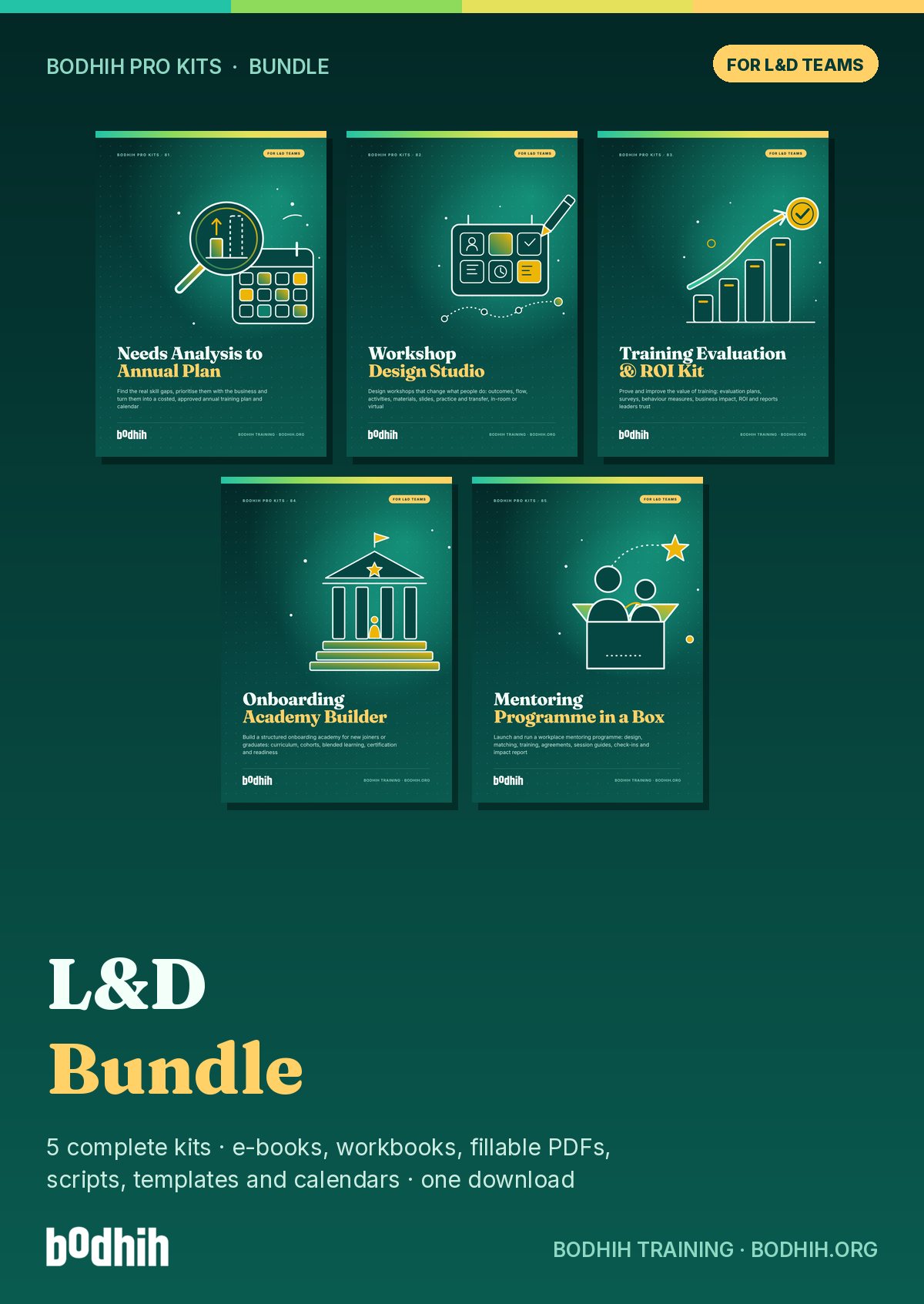
The Bodhih family, when you are ready for more
The Facilitator's Workbook Kit
Facilitation and coaching templates for trainers.
Trainer Toolkits
Ready-to-deliver training programmes with slides and handouts.
AssessAll
250+ AI-graded assessments to measure skills and earn verified credentials.
Jobulary
Individual development plans that start from evidence and stay yours.
Bodhih Training
Run this topic as a live workshop for your team, in person or online.
Pewple
Book a vetted coach for career, leadership or communication. Pay per session.
Bodhih.org pathways
Certification pathways in Applied AI, Workplace English and management.
The Training Evaluation and ROI Kit: FAQs
Read the free guideAlready bought? Resend my linkWhat is the best model for evaluating training?
There is no single best model. Kirkpatrick's four levels give you the backbone, the Phillips ROI Methodology adds isolation, money and ROI, Brinkerhoff's Success Case Method explains why results happened, and Will Thalheimer's LTEM checks whether your evidence is strong enough. The kit shows how to combine them and how deeply to go for each programme.
How do I calculate the ROI of a training programme?
Isolate the change in a business result that is due to the training, convert it to money with a value finance accepts, and subtract fully loaded costs including participants' time. ROI is net benefits divided by costs, times 100. The workbook does the arithmetic and adds a sensitivity table showing ROI if only part of the benefits are real.
How can I separate the effect of training from other factors?
Use a comparison group of similar people not yet trained where you can, a trend line where you have steady historical data, or estimates from people close to the work adjusted for their confidence. Chapter 6 explains each and the Business Metrics and Estimates sheets calculate them.
What questions should a post-training survey ask?
Ask what you will act on: relevance to the job, readiness to apply, practice, the plan to apply and expected manager support, with descriptive answers rather than agree-disagree scales, plus a 0 to 10 recommend question. The question bank has twelve reaction items to choose from.
Does it work for e-learning, coaching and on-the-job training?
Yes. Appendix B sets out how the evidence differs for e-learning, virtual sessions, coaching, on-the-job training and blended programmes, and the Portfolio sheet compares them using your LMS data.
How can I measure my starting point?
AssessAll offers related assessments, sold separately: the Training Evaluation and Programme Effectiveness Assessment for L&D and HR Teams, the Post-Training Application and Workplace Support Check for Workshop Participants at 30, 60 and 90 Days and the Survey and Questionnaire Design Assessment for Research, HR and Customer Insight Teams. Links are on the Start Here map.
How do I turn this into a development plan for my team?
Pick the two or three evaluation skills your team most needs, such as survey design or isolating effects, and build them into individual goals. Jobulary explains how a development plan built around specific skills works, and the Start Here map links to it.
Is this legal advice on employee data?
No. The kit teaches good practice and keeps country specifics in one cheat sheet dated October 2026, covering the EU, UK, US, India, Singapore, the Gulf and other markets. Rules on employee data, monitoring, consultation and AI change often, so check your data protection lead, company policy and local law.
Which software do I need?
The workbooks open in Excel, Google Sheets or LibreOffice and use no macros. The forms are fillable in Acrobat Reader and most PDF apps, the templates open in Word or Google Docs, the calendar imports into Google Calendar, Outlook or Apple Calendar, and the CSV imports into Trello, Asana, Notion, Planner or Jira.
What is the refund policy?
Digital kits are non-refundable once downloaded. The exceptions are corrupted files that are not fixed within 3 working days, duplicate charges, or failed delivery.
How much does The Training Evaluation and ROI Kit cost?
₹999 including 18% GST for buyers in India, or $29 for buyers outside India. One-time payment, no subscription, with an automatic invoice.
How do I get the files after paying?
Instantly. Your download page opens the moment payment succeeds, and a permanent download link is emailed to you. Download each file separately or everything in one ZIP.
What software do I need?
Any of the usual tools: Excel or Google Sheets for spreadsheets, Word or Google Docs for templates, Adobe Acrobat Reader, Preview, Xodo or GoodNotes for the fillable PDFs, and Google, Outlook or Apple Calendar for the calendar plan.
Can I get a refund?
Because it is a digital download, kits are not refundable once downloaded. We always refund a duplicate charge or a failed delivery, and if a file is corrupted and we cannot fix it within 3 working days. Full terms: bodhih.org/refunds.
Can my company buy this for a team?
Yes. Team and company licences, and workshops on this topic run by Bodhih Training, are available. Write to solutions@bodhih.com or call +91 99000 11601.