Run every hire from request to signed offer with one fair, repeatable process
A complete recruitment toolkit for HR teams, founders and hiring managers: the method, the workbook, the forms, the questions and the exact words, for one senior role or forty seats.
- A 10-chapter e-book teaching an eight-stage hiring method, with one composite hire running through every chapter
- The Recruitment Command Centre: a 15-sheet Excel workbook with requisitions, pipeline with stage SLAs and contact alerts, weighted scorecards, offers, funnel, source and agency analysis, quality of hire and a dashboard
- 5 fillable PDF forms and 7 Word templates, including 50 candidate messages and scripts, 50 interview questions with anchored scales and 30 AI prompts
- A Start Here map, 3 more cheat sheets including dated law and AI notes by country, a 7-sheet cost and time calculator, a 41-event calendar and a 30-task CSV
The Recruitment End-to-End Kit · Bodhih Pro Kits · 76 by Bodhih Training, trainers to 2,000+ companies since 2008.
What are the steps in a good recruitment process?
A good recruitment process runs in eight steps: approve the hiring request, agree a success profile with the hiring manager, write a skills-based advert with a pay range, source from planned channels, screen against written criteria, assess with work samples and structured interviews, decide in an independent debrief, then make the offer and hand over to onboarding. The Recruitment End-to-End Kit from Bodhih Training gives you a file for each step.
Want the full free guide first? Read The Recruitment Process, Step by Step: How to Hire the Right Person.
You already feel the problem. Here is what it is costing you.
Every vacancy is an emergency
A resignation arrives on Friday, the old job description comes out of the drawer and the advert goes up on Monday. Nobody asks what has changed, so the same mismatched role gets filled again.
Interviewers looking for different people
Without an agreed success profile, each panel member has their own picture of the ideal candidate. The debrief turns into a debate about impressions, and the loudest voice usually wins.
A pile of CVs and no criteria
Applications are up and quality is down. The CIPD's Resourcing and talent planning report 2026 found 58% of recruiting organisations saw more applications from unsuitable candidates. Screening by instinct is slow and leaves bias unchecked.
Good candidates disappear
A silent fortnight between stages, a missing scorecard, a late offer. Strong candidates have options, and they accept the employer who replied first.
AI tools you are not sure about
Your applicant tracking system offers to rank the pile, candidates are writing applications with AI, and rules on automated hiring tools are changing in the EU, US and elsewhere. It is hard to know what is safe.
No idea whether hiring is improving
Leadership asks how long roles take to fill, what hiring costs and whether new joiners stay. The numbers live in five inboxes and nobody's spreadsheet.
Picture the next few weeks with the kit open beside you.
Picture the Monday after a resignation. Instead of opening the old job description, you open the hiring request form and work through five questions with the hiring manager. By lunchtime the alternatives line has reshaped the role, the cost of leaving it empty is on the page, and the request has a Req ID in the Command Centre.
Now it is day nine and the applications are flowing in. As you score each CV against criteria and anchors you wrote before reading the first one, the Pipeline sheet tracks every candidate's days in stage. On Monday morning the Dashboard shows two SLA breaches and three candidates waiting for contact. Ten minutes and three messages from the library later, both lists are empty.
Imagine the debrief. Every scorecard is already in. The scores appear together on screen, the most junior interviewer speaks first, and a comment about 'presence' is set aside because nobody can tie it to a criterion. The decision takes forty minutes and comes with two sentences of evidence you would be happy to show anyone.
And then the quarterly review. Someone asks whether hiring is getting better or just busier. You open the Dashboard: time to fill, offer acceptance, source of hire, quality of hire. Whether you start with the e-book tonight or the workbook tomorrow morning, the next hire starts from everything this one taught you.
21 files that do the work for you
The e-book shows you how. The tools make it happen. Here is exactly what you download.
The Recruitment End-to-End Kit (e-book, PDF)
The guide: methods, worked examples, scripts and exercises
Start here: recruitment map
The whole hiring job as eight stages with the file to open at each, your first hour, a 30/60/90 day use plan and links to measure your starting point.
Recruitment Command Centre workbook
15-sheet workbook: settings, stage SLAs, requisition log, candidate pipeline with SLA and contact alerts, interviews, weighted scorecards, debrief summary, offers, funnel, source and agency analysis, metrics by role, quality of hire and a dashboard with a funnel chart.
Hiring Cost and Time Calculator
Seven-sheet calculator: cost per hire (internal and external), the cost of an empty role, channel comparison on total cost, and a time planner that works back from your target start date.
Hiring request and role intake form
Three-page fillable form: the one-page hiring request and business case with approvals, then the 45-minute intake meeting that produces the success profile, pay range, panel, timetable and service levels.
CV screening scorecard
Two-page fillable scorecard: knockouts, three to five criteria with 0-1-2 anchors written before reading any CV, a threshold, a consistency check and a scoring table for twelve applicants.
Structured interview guide and scoring sheet
Four-page fillable guide: a phone-screen page, the panel briefing, four question blocks with anchors, evidence and a 1-5 score, and the overall recommendation to submit before the debrief.
Panel debrief and decision form
Two-page fillable form for a 45-minute debrief that resists groupthink: independent scores first, discussion by competency with junior voices first, a bias check and a recorded decision.
Reference check form
Two-page fillable form: candidate consent, referee details, the same evidence-based questions for every referee, and a checklist for right-to-work and other checks as offer conditions.
Candidate message and script library
50 ready-to-edit messages and scripts in 8 groups: hiring manager nudges, outreach, invitations, reschedules, rejections at every stage, offer calls, counter-offers, ghosting follow-ups and pre-boarding.
Skills-based job description and advert template
Three-part template: an internal skills-based job description built from the success profile, a six-block advert, and a completed example for a Customer Success Manager, plus an inclusive wording check.
Offer and rejection letter templates
Ready-to-adapt letters: a conditional offer letter (sample, not legal advice), an offer summary for the candidate, and four rejection letters for after interview, after final interview, internal candidates and talent pool.
Recruitment policy one-pager
A one-page recruitment policy your organisation can adopt: principles, approvals, fair selection, AI use, candidate experience, data, offers and checks, with a review date.
Interview question bank with anchored scales
50 structured interview questions across 10 competencies, each past-behaviour or situational, with written anchors for scores of 1, 3 and 5.
Worked example pack: hiring a Customer Success Manager
The main forms and decisions shown completed for one composite hire, from hiring request to onboarding handover, with the numbers, so you can see what good looks like.
AI prompt pack for recruitment
30 tool-agnostic prompts grouped by the eight stages of a hire, each with what to paste in and what to check before you use the output.
Hiring decision card
If-this-then-that card for twenty common moments in a hire, plus three checks before any decision about a person.
Bias traps and hiring mistakes to avoid
Mistakes-to-avoid card: twelve bias traps with what to do instead, and ten process mistakes with the file that prevents each.
Hiring law and AI notes by country (October 2026)
Dated quick reference to recruitment rules and AI-in-hiring rules across the EU, UK, US, India, Singapore, the Gulf and other markets, with what to check.
6-week hiring cycle calendar
41 calendar events for one hire over six weeks, from hiring request to onboarding handover, each naming the file to open. Import into a new calendar and move to your dates.
Hiring task board import
30 hiring tasks as a CSV ready to import into Trello, Asana, Notion, Planner or Jira, with stage, week, owner, file to open and due date.
Chapter by chapter
Each chapter opens with a real situation, gives you a method and ends with something to do today, using the tools in your kit.
- Format
- PDF e-book + XLSX + fillable PDF + DOCX + printable PDF + ICS + CSV
- Files
- 21 files plus a one-click ZIP
- E-book
- 62 pages
- Workbooks
- 15-sheet command centre and 7-sheet calculator, with sample data, formulas and dashboards
- Works with
- Excel, Google Sheets, LibreOffice, Word, Google Docs, Acrobat Reader, GoodNotes, Google Calendar, Outlook, Apple Calendar, Trello, Asana, Notion, Planner, Jira
- Best for
- Organisations of roughly 20 to 2,000 people hiring one role at a time or in volume, in any country and currency
Hiring as a Process, Not a Panic
Why hiring works better as a process than as a series of emergencies, and the eight-stage method in one page.
Should We Hire at All?
A one-page hiring request that tests alternatives, prices the hire and the empty role, and gets a clear approval.
The Intake Meeting and the Success Profile
A 45-minute intake meeting that turns 'you know the kind of person' into outcomes, weighted competencies and agreed service levels.
The Job Description and the Advert
Skills-based job descriptions, six-block adverts with the pay range up front, and an inclusive wording check.
Sourcing and Agencies
Choosing channels before the advert goes live, measuring source of hire, and briefing and tracking agencies.
Screening Fairly, with AI in Its Place
Knockouts, anchored CV scorecards, a short phone screen, and clear rules for where AI helps and where a human decides.
Work Samples and Structured Interviews
Past-behaviour and situational questions, anchored rating scales, panel roles and work samples, with the research behind them.
Candidate Experience and Communication
Two promises to candidates, stage service levels, and a message for every moment including rejections and ghosting.
The Debrief, References and Checks
Independent scorecards, a debrief that resists groupthink, evidence-based references and consistent checks.
Offers, Negotiation and Pre-boarding
Designing the offer before the call, negotiating within agreed limits, counter-offers and the handover to onboarding.
Metrics, Volume Hiring and Hiring Across Borders
The metrics that matter, quality of hire, volume versus senior hiring, and how practice differs across countries.
The Hiring Machine You Now Own
What you now have, what to keep doing, and the first hour.
Recruitment Metrics Definitions
Plain definitions for twelve recruitment metrics, matched to the workbook.
Using AI in Recruitment Safely
Six rules for using AI in recruitment safely, with a prompt that summarises a CV against criteria.
Not just reading. Tools you will actually open again.
E-book
- The Recruitment End-to-End Kit: 10 chapters, 2 appendices and 6 hand-drawn figures (PDF)
Start here
- 00-Start-Here-Recruitment-Map: the job as eight stages with the file to open at each, your first hour and a 30/60/90 day use plan
Spreadsheets
- Recruitment Command Centre workbook (15 sheets): Start here, Settings, Stages and SLAs, Requisitions, Pipeline, Interviews, Scorecards, Candidate Summary, Offers, Funnel, Source Analysis, Agencies, Req Metrics, Quality of Hire and a Dashboard with 22 live measures and a funnel chart
- Hiring Cost and Time Calculator (7 sheets): cost per hire, vacancy cost, channel comparison and a time planner that works back from your start date
Fillable PDF forms
- Hiring request and role intake form: business case, approvals, success profile, pay range, panel and service levels
- CV screening scorecard: knockouts, anchored criteria, threshold and consistency check
- Structured interview guide and scoring sheet: phone screen, panel briefing, four question blocks with anchors and a recommendation
- Panel debrief and decision form: independent scores, evidence by competency, bias check and sign-off
- Reference check form: consent, the same questions for every referee and an offer-conditions log
Word templates
- Candidate message and script library: 50 messages and scripts from outreach to pre-boarding
- Skills-based job description and advert template, with a completed example and an inclusive wording check
- Offer and rejection letter templates: a sample conditional offer letter, an offer summary, three rejection letters and a talent pool letter
- Recruitment policy one-pager your organisation can adopt
- Interview question bank: 50 questions across 10 competencies with anchors for 1, 3 and 5
- Worked example pack: one composite hire shown from request to onboarding handover
- AI prompt pack for recruitment: 30 prompts, each with what to paste in and what to check
Cheat sheets
- Hiring decision card: twenty if-this-then-that moments
- Bias traps and hiring mistakes to avoid
- Hiring law and AI notes by country, dated October 2026
Calendar and import
- 6-week hiring cycle calendar (ICS): 41 events for Google Calendar, Outlook or Apple Calendar
- Hiring task board import (CSV): 30 tasks for Trello, Asana, Notion, Planner or Jira
When you have worked through it, you will be able to…
Every outcome is practised with a worked example and a tool, not just described.
- Test whether a vacancy needs a hire, price it, and get a clear approval on one page
- Run a 45-minute intake meeting that produces outcomes, weighted competencies, a pay range and agreed service levels
- Write a skills-based job description and an advert that leads with pay, purpose and location
- Screen applications against written criteria and anchors, with AI kept to drafting and summarising
- Design structured interviews and work samples with anchored rating scales and clear panel roles
- Hold a debrief that collects independent judgements first and records decisions with evidence
- Make, negotiate and confirm offers within agreed limits, and hand over cleanly to onboarding
- Track time to fill, time to hire, conversion, source of hire, offer acceptance, cost and quality of hire on one dashboard
Know your starting point. Prove your progress.
People who measure before and after improve faster and can show it. AssessAll, our sister assessment platform, has AI-graded assessments that pair with this kit. Take one now, work through the kit, then re-take it.
Interviewer Judgment & Hiring Bias
Take the assessment →AssessAll assessmentInterview Evidence and Answer Quality Assessment for Job Seekers and Career Changers
Take the assessment →AssessAll assessmentApplication Screening Judgment: Reading a CV Without Fooling Yourself
Take the assessment →JobularyHow a Jobulary development plan works
Make it a growth plan →A taste of Chapter 3
The job description and the advert are different documents. The job description is an internal record. It states the purpose of the role, the main outcomes, the skills and their levels, reporting lines, location and working pattern, and the pay grade. HR, the manager and later the employee use it. The advert is marketing to a busy person on a phone. It must answer, in roughly this order: what is the job, what will I do, what will I get, can I do it, and how do I apply? Open the Skills-Based-Job-Description-and-Advert-Template. Part 1 is the description, Part 2 the advert, and Part 3 a worked version for the Customer Success Manager role. Most of the trouble with adverts comes from treating one document as if it were the other, so keep the two readers apart.
The honest comparison
| Free templates and typical advice | This kit | |
|---|---|---|
| Starting a hire | Reuse last year's job description | Hiring request with alternatives and cost, then a structured intake meeting and success profile |
| Screening | Read CVs and go with your gut | Knockouts, criteria with 0-1-2 anchors written first, a threshold and a consistency check |
| Interviews | A list of popular questions | 50 questions with anchored scales, panel roles, a briefing script and a work sample method |
| Decisions | Open discussion led by the most senior person | Scorecards in first, scores revealed together, junior voices first, a written bias check |
| Candidate communication | A rejection template or two | 50 messages and scripts, stage SLAs and a contact window the workbook monitors |
| AI and law | Not mentioned, or assumes one country | Human review rules, an AI prompt pack, and dated notes for the EU, UK, US, India, Singapore, the Gulf and more |
| Measurement | A blank tracker | Live funnel, source of hire, offer acceptance, time to fill and to hire, cost and quality of hire |
Made for you if…
- HR generalists and HR business partners who run recruitment alongside everything else
- Talent acquisition and people-ops teams in small and mid-size organisations that want one consistent process
- Founders and line managers who hire without a recruiter
- Hiring managers who sit on interview panels and want to judge fairly
- Teams hiring across countries, including India, the UK, the US, the Gulf, Singapore, Africa and Australia
- Organisations moving from ad hoc hiring to tracked metrics such as time to fill and quality of hire
Probably not for you if…
- Anyone looking for legal advice: the kit teaches good practice and points you to your HR team, company policy and local law, with country notes dated October 2026
- Teams that need applicant tracking software: the workbook runs the process alongside your email or ATS, it does not replace a system
- Readers wanting a broad set of HR templates on many topics: The People-Ops Starter Kit covers that ground; this kit goes deep on recruitment
Built by trainers, tested in real rooms.
Bodhih Training has designed and delivered corporate programmes since 2008. Bodhih Pro Kits package what works in those workshops into a guide plus the exact tools we use, so you can apply it the same day without a facilitator in the room.
From here to using it in three steps
- STEP 1
Tap Get the kit
Name, email and country. UPI, card or netbanking in India; international cards everywhere else. No account to create.
- STEP 2
Download instantly
Your download page opens at once, with every file and a one-click ZIP. A permanent link lands in your inbox too.
- STEP 3
Open the first tool
Start with the quick-start chapter, then the main spreadsheet or planner. Most buyers use something from the kit the same day.
Your next vacancy is coming. Have the whole process ready before it arrives.
Open the Start Here map, type your settings into the Command Centre and log the roles you are filling now. Whether you begin with the e-book this evening or the intake form with your next hiring manager, the first hour is already planned.
Personal licence for the buyer's own use (and use with your own team or clients where the kit says so). Please don't share or resell the files. Team and company licences: solutions@bodhih.com.
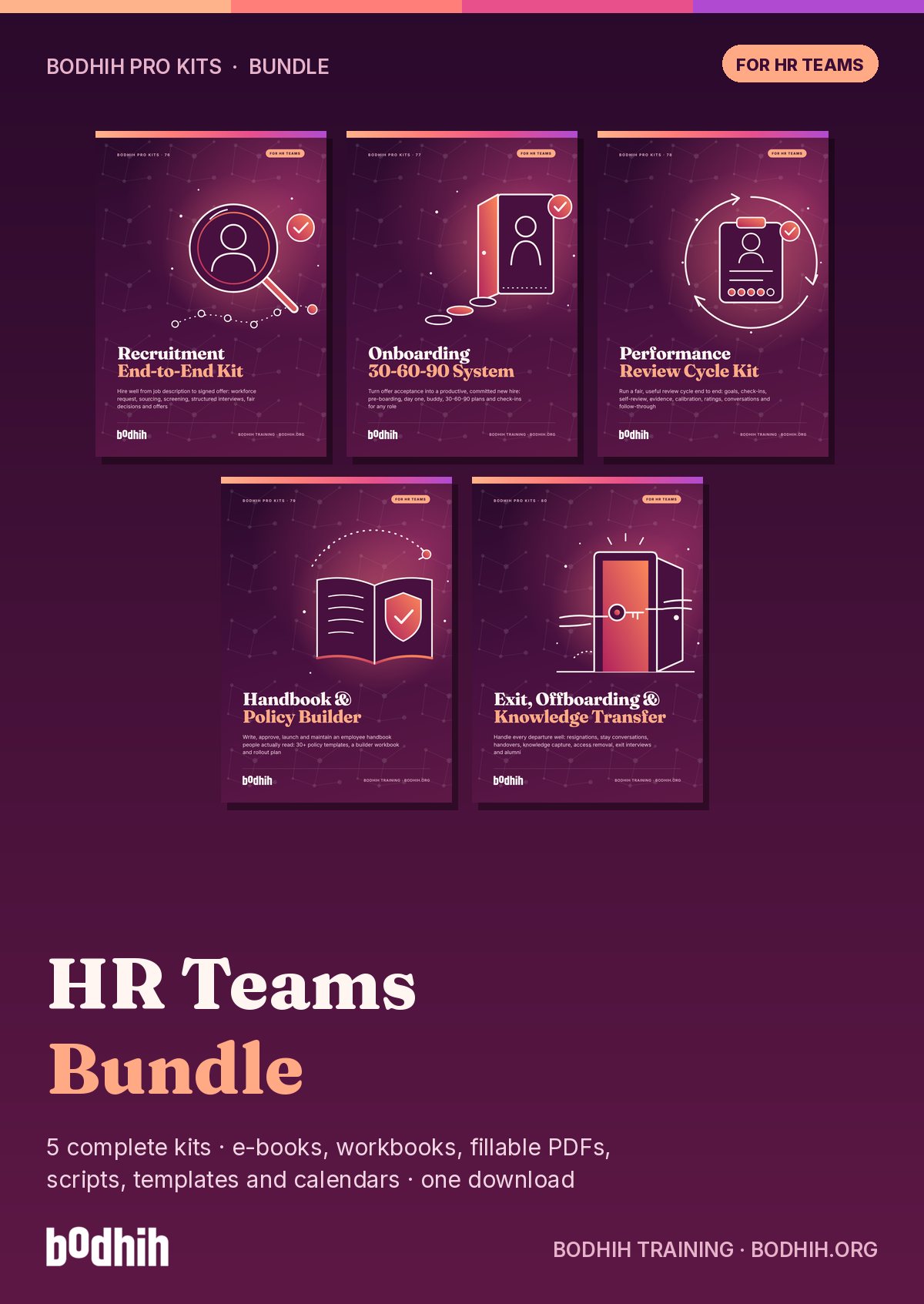
The Bodhih family, when you are ready for more
The People-Ops Starter Kit
One template for each HR basic, for a first HR hire.
First 90 Days as a Manager
For the managers your HR team supports.
AssessAll
250+ AI-graded assessments to measure skills and earn verified credentials.
Jobulary
Individual development plans that start from evidence and stay yours.
Bodhih Training
Run this topic as a live workshop for your team, in person or online.
Pewple
Book a vetted coach for career, leadership or communication. Pay per session.
Bodhih.org pathways
Certification pathways in Applied AI, Workplace English and management.
The Recruitment End-to-End Kit: FAQs
Read the free guideAlready bought? Resend my linkWhat are the main steps in the recruitment process?
Request and approval, an intake meeting to define success, the job description and advert, sourcing, screening, assessment through work samples and structured interviews, the decision with references and checks, then the offer and handover to onboarding. The kit gives each step its own chapter and files, and the workbook tracks a hire from start to finish.
How do I run a structured interview?
Agree the competencies first, then ask every candidate the same questions in the same order, mixing past-behaviour and situational questions. Score each answer against written anchors for 1, 3 and 5, give each interviewer specific competencies, and have everyone submit scores before the debrief. The question bank and interview guide in the kit are built for exactly this.
How can we reduce bias in hiring?
Write criteria before you read CVs, hide names and photos for the scored screen where you can, use structured interviews with anchored scales, and collect independent scores before any discussion. Check debrief reasons against the written criteria. The bias traps card lists twelve common traps and what to do instead.
Can we use AI to screen CVs?
AI can help summarise CVs against your written criteria, draft messages and schedule interviews, but a person should review every progression and rejection decision. Tell candidates when automated tools are used, check tools for bias, and follow local rules, which are changing in the EU, several US states and elsewhere. The kit's dated law notes and prompt pack cover this.
What recruitment metrics should we track?
Time to fill, time to hire, stage conversion, source of hire, offer acceptance rate, cost per hire and quality of hire. The Recruitment Command Centre calculates them from the sheets you already fill in, and Appendix A gives plain definitions you can adopt.
How do I measure my own starting point as an interviewer or screener?
AssessAll offers assessments that match this kit: Interviewer Judgment & Hiring Bias, and Application Screening Judgment: Reading a CV Without Fooling Yourself. Take one before your next hire and again after a few hires to see what has changed. Links are on the Start Here map; the assessments are separate products and not included in the kit.
How do I turn this into a development plan for our hiring managers?
Use the bias traps card and the question bank to pick one or two skills each hiring manager will practise, then build them into a plan. Jobulary explains how its development plans work, and the link is on the Start Here map.
Does it work for high-volume hiring as well as single roles?
Yes. The requisition log handles headcount per role, the funnel and source sheets show where volume drops out, and Chapter 10 compares high-volume and senior hiring designs. The calculator also handles several hires in one campaign.
Is this legal advice for my country?
No. The kit teaches good practice and keeps country specifics in one cheat sheet dated October 2026, covering the EU, UK, US, India, Singapore, the Gulf and other markets. Laws on pay transparency, right to work, data protection and AI in hiring change often, so check your HR team, company policy and local law, and have offer letters reviewed.
Which software do I need?
The workbooks open in Excel, Google Sheets or LibreOffice and use no macros. The forms are fillable in Acrobat Reader and most PDF apps, the templates open in Word or Google Docs, the calendar imports into Google Calendar, Outlook or Apple Calendar, and the CSV imports into Trello, Asana, Notion, Planner or Jira.
What is the refund policy?
Digital kits are non-refundable once downloaded. The exceptions are corrupted files that are not fixed within 3 working days, duplicate charges, or failed delivery.
How much does The Recruitment End-to-End Kit cost?
₹1,299 including 18% GST for buyers in India, or $34 for buyers outside India. One-time payment, no subscription, with an automatic invoice.
How do I get the files after paying?
Instantly. Your download page opens the moment payment succeeds, and a permanent download link is emailed to you. Download each file separately or everything in one ZIP.
What software do I need?
Any of the usual tools: Excel or Google Sheets for spreadsheets, Word or Google Docs for templates, Adobe Acrobat Reader, Preview, Xodo or GoodNotes for the fillable PDFs, and Google, Outlook or Apple Calendar for the calendar plan.
Can I get a refund?
Because it is a digital download, kits are not refundable once downloaded. We always refund a duplicate charge or a failed delivery, and if a file is corrupted and we cannot fix it within 3 working days. Full terms: bodhih.org/refunds.
Can my company buy this for a team?
Yes. Team and company licences, and workshops on this topic run by Bodhih Training, are available. Write to solutions@bodhih.com or call +91 99000 11601.