Design workshops that change what people do at work, from brief to ready-to-run
A complete workshop design studio for L&D teams and trainers: the method, the workbook, the forms, the templates and the exact words, for a half-day session or a two-day programme, in person, virtual or hybrid.
- A 10-chapter e-book teaching an eight-stage design method, with one composite one-day workshop designed in full across every chapter
- The Workshop Design Workbook: 13 Excel sheets with a Bloom's verb check, content triage, a minute-by-minute session plan with running clock and break checks, method mix, a 68-activity library, materials, pilot log, transfer plan, version log and a dashboard
- 4 fillable PDF forms and 7 Word templates, including a facilitator guide, a participant workbook, role-play and case templates, 42 messages and scripts and 31 AI prompts
- A Start Here map, 3 more cheat sheets including dated accessibility and AI notes, a 34-event design calendar and a 34-task CSV for your project board
The Workshop Design Studio · Bodhih Pro Kits · 82 by Bodhih Training, trainers to 2,000+ companies since 2008.
How do you design a training workshop?
Design a training workshop in eight stages: agree a business goal with the sponsor, analyse the audience, write observable objectives, triage the content, build a timed plan built around practice, write the facilitator guide and workbook, pilot it, then plan transfer and handover. The Workshop Design Studio from Bodhih Training gives you a file for each stage.
Want the full free guide first? Read How to Design a Training Workshop That Changes What People Do.
You already feel the problem. Here is what it is costing you.
The request is a topic, not a problem
A sponsor asks for 'customer service training, two days' and an agenda by Friday. Nobody says what should be different at work afterwards, so nobody can tell whether it worked.
The expert wants everything in
Sixty slides arrive from the subject expert, all of them important. The practice gets squeezed into the last hour, and people leave having heard a lot and practised little.
The agenda does not survive the clock
The plan looked fine on paper and runs forty minutes over on the day. The facilitator cuts the role play, which was the only part likely to change behaviour.
The design lives in one head
Files called FINAL-v3-new, no facilitator guide, and a workshop nobody else can run. When the designer moves on, so does the quality.
Nothing happens after the day
Managers were never briefed, there is no follow-up practice, and three months later the evaluation forms say 4.3 out of 5 while the business measure has not moved.
Picture the next few weeks with the kit open beside you.
Picture the next request landing in your inbox. Instead of reaching for an old deck, you open the brief form and book 45 minutes with the sponsor. By the end of the call there is a measure on the page, two problems no workshop could fix have owners, and the two-day request has become a sharper one-day design.
Now imagine building the plan. As you type each block into the Session Plan sheet, the running clock fills in, the break check stays green and the Dashboard shows lecture at 7% of contact time and practice above half. When the expert sends sixty slides, you open Content Triage together and decide, item by item, what belongs in the room and what belongs on a job aid.
Then the pilot. The observer's form shows exactly where energy dipped and which instructions needed repeating. Every finding goes on the Pilot Log with an owner and a version number, and on launch day the Dashboard says Ready to run.
And afterwards, managers already know what to ask at day seven, spaced practice goes out on schedule, and a second facilitator runs the session from your guide. Whether you start with the e-book tonight or the workbook tomorrow morning, your next workshop starts from everything this one taught you.
19 files that do the work for you
The e-book shows you how. The tools make it happen. Here is exactly what you download.
The Workshop Design Studio (e-book, PDF)
The guide: methods, worked examples, scripts and exercises
Start here: workshop design map
The whole job as eight stages with the file to open at each, your first hour and a 30/60/90 day use plan.
Workshop Design Workbook
13-sheet master workbook: objectives with a Bloom's verb check, content triage, minute-by-minute session plan with running clock and break checks, method mix, a 68-activity library filtered by mode and group size, materials, pilot log, transfer plan, version log and a dashboard.
Workshop brief and stakeholder interview form
Three-page fillable brief: the business goal and measure, the performance gap, the 'is training the answer?' test, scope and constraints, success measures at four levels and sign-off.
Audience analysis sheet
Two-page fillable profile of the people in the room: role context, prior knowledge, motivation, constraints, access and inclusion needs, plus three learner snapshots that keep the design honest.
Activity design card
Two-page fillable card for designing one activity properly: objective, purpose, set-up, exact instructions, minute-by-minute timing, debrief questions, virtual version, access and risks.
Dry-run checklist and workshop observation form
Four-page fillable form: the facilitator's dry-run checklist, an observer's block-by-block record of timing, energy and evidence of learning during a pilot or live run, and the decisions after it.
Facilitator guide template
A complete facilitator guide structure with one block fully written as an example: at-a-glance page, preparation, room and virtual set-up, block-by-block script with timings, cut options, troubleshooting and after-session tasks.
Participant workbook template
A participant workbook structure that people actually use: objectives, pre-work, one page per practice block with space to work, a job aid, an if-then action plan and a spaced practice tracker.
Role-play and case study templates
Templates for role plays, case studies, decision scenarios and branching scenarios, each with a complete worked example and a bank of debrief questions.
Workshop message and script library
42 ready-to-edit messages and spoken scripts in 7 groups: sponsor and expert emails, joining instructions, pre-work, manager briefings, spaced practice nudges, pilot and logistics, handover and hard moments in the room.
Workshop design standards one-pager
A one-page set of twelve design standards an L&D team can adopt, from business goal and practice share to accessibility, AI review, piloting, transfer and version control.
Worked example pack: Escalations That Stay Solved
One complete one-day workshop designed end to end: the brief, audience analysis, objectives, triage, minute-by-minute plan, an activity design card, the virtual version, pilot changes and the transfer plan.
AI prompt pack for workshop design
31 tool-agnostic prompts grouped by the eight stages of workshop design, each with what to paste in and what to check before you use the output.
Workshop design decision card
Twenty if-this-then-that moments in workshop design, plus three checks before you sign off a design.
Workshop design mistakes to avoid
Fifteen common design mistakes, what they look like and what to do instead, with a note on learning myths.
Virtual, hybrid and accessible design card (October 2026)
Design rules for virtual and hybrid sessions, an accessibility and inclusion checklist, and dated notes on accessibility, AI literacy and data rules.
4-week workshop design calendar
34 calendar events for a four-week design project, from the sponsor brief to pilot, sign-off and handover, each naming the file to open. Import into a new calendar and move to your dates.
Workshop design task board import
34 design tasks as a CSV ready to import into Trello, Asana, Notion, Planner or Jira, with stage, week, owner, file to open and due date.
Chapter by chapter
Each chapter opens with a real situation, gives you a method and ends with something to do today, using the tools in your kit.
- Format
- PDF e-book + XLSX + fillable PDF + DOCX + printable PDF + ICS + CSV
- Files
- 19 files plus a one-click ZIP
- E-book
- 63 pages
- Workbook
- 13 sheets with sample data, formulas, a 68-activity library and a dashboard
- Works with
- Excel, Google Sheets, LibreOffice, Word, Google Docs, Acrobat Reader, GoodNotes, Google Calendar, Outlook, Apple Calendar, Trello, Asana, Notion, Planner, Jira
- Best for
- Half-day to two-day workshops, in person, virtual or hybrid, in any country, currency and industry
From Request to Room
Why design matters more than delivery, and the eight-stage method from request to ready-to-run.
The Brief: Start With the Business Goal
A 45-minute brief that turns a topic into a business goal and tests whether training is the answer at all.
Know Your Audience
Five audience conversations, misconceptions in their own words, constraints, access needs and designing across countries.
From Actions to Objectives
Turning on-the-job actions into observable objectives, with Bloom's revised taxonomy and an automatic verb check.
Content Triage
Rating content by frequency, consequence of error and difficulty, and moving should-know material to job aids and pre-work.
Session Architecture, Timing and Energy
The shape of a good workshop, the research on retrieval, spacing and worked examples, and a minute-by-minute plan with a running clock.
Activities That Make People Practise
Choosing activities by purpose from a 68-activity library, building realistic role plays and cases, and designing each one on a card.
Facilitator Guides, Workbooks and Slides
Facilitator guides someone else can run from, workbooks people use, if-then action plans and slides built for learning.
Virtual, Hybrid and Inclusive Design
Redesigning for virtual and hybrid delivery, and building accessibility and inclusion in from the start.
Designing with AI, and Checking Its Work
Where AI speeds up design, where a person must decide, and how to check AI drafts for accuracy, realism and bias.
Test, Transfer and Hand Over
Dry runs, observed pilots, manager-led transfer, spaced practice, evaluation models, version control and handover.
The Studio You Now Own
What the case shows, and how the kit makes the second design faster than the first.
The Research in Plain Words
The research and models behind the method, in plain words, with two myths to leave out.
Design Review Questions
Twelve questions for reviewing any workshop design, matched to the design standards.
Not just reading. Tools you will actually open again.
E-book
- The Workshop Design Studio: 10 chapters, 2 appendices and 6 hand-drawn figures, about 9,900 words (PDF)
Start here
- 00-Start-Here-Workshop-Design-Map: the job as eight stages with the file to open at each, your first hour and a 30/60/90 day use plan
Spreadsheet
- Workshop Design Workbook (13 sheets): Start here, Settings, Objectives with a Bloom's verb check, Verb Bank, Content Triage, Session Plan with running clock, break and input checks, Method Mix, Activity Library (68 activities filtered by mode and group size), Materials, Pilot Log, Transfer Plan, Version Log and a Dashboard with 28 live measures and a minutes-by-method chart
Fillable PDF forms
- Workshop brief and stakeholder interview form: business goal, the 'is training the answer?' test, scope, measures and sign-off
- Audience analysis sheet: prior knowledge, motivation, constraints, access and inclusion checks and learner snapshots
- Activity design card: objective, exact instructions, timing, debrief questions, virtual version and risks
- Dry-run checklist and workshop observation form: facilitator dry run, block-by-block observer record and launch decisions
Word templates
- Facilitator guide template, with one block written in full as a model
- Participant workbook template, with an if-then action plan and a spaced practice tracker
- Role-play and case study templates: role plays, cases, decision scenarios and branching scenarios, each with a worked example, plus a debrief question bank
- Workshop message and script library: 42 messages and scripts from the sponsor brief to handover and hard moments in the room
- Workshop design standards one-pager: 12 standards your team can adopt
- Worked example pack: Escalations That Stay Solved, one composite one-day workshop designed end to end
- AI prompt pack for workshop design: 31 prompts, each with what to paste in and what to check
Cheat sheets
- Workshop design decision card: 20 if-this-then-that moments and three sign-off checks
- Workshop design mistakes to avoid: 15 mistakes and what to do instead
- Virtual, hybrid and accessible design card, with rules and standards notes dated October 2026
Calendar and import
- 4-week workshop design calendar (ICS): 34 events for Google Calendar, Outlook or Apple Calendar
- Workshop design task board import (CSV): 34 tasks for Trello, Asana, Notion, Planner or Jira
When you have worked through it, you will be able to…
Every outcome is practised with a worked example and a tool, not just described.
- Turn a workshop request into a business goal with a measure, and test whether training is the answer
- Profile your audience from real conversations, including access and inclusion needs
- Write three to six observable objectives at the right level of Bloom's revised taxonomy
- Triage expert content into the room, pre-work, job aids or the bin
- Build a minute-by-minute plan with practice for every objective, short inputs and sensible breaks
- Design realistic role plays, cases and scenarios, and write a facilitator guide another trainer can run from
- Convert an in-room workshop into a virtual programme, and use AI for drafts with human checks
- Pilot, version and hand over a workshop, with managers and spaced practice supporting transfer
Know your starting point. Prove your progress.
People who measure before and after improve faster and can show it. AssessAll, our sister assessment platform, has AI-graded assessments that pair with this kit. Take one now, work through the kit, then re-take it.
Instructional Design Work Sample for Trainers, Instructional Designers and Subject-Matter Experts
Take the assessment →AssessAll assessmentTraining Facilitation and Group Handling Assessment for Trainers and Facilitators
Take the assessment →AssessAll assessmentLesson Design and Questioning Technique Assessment for Teachers and Trainers
Take the assessment →JobularyIf-then plans that make habits stick (Jobulary)
Make it a growth plan →A taste of Chapter 3
In 2001 Lorin Anderson and David Krathwohl, with colleagues, published a revision of Benjamin Bloom's 1956 taxonomy of educational objectives. The revised version names six levels of thinking as verbs: remember, understand, apply, analyse, evaluate and create. It is a useful check on ambition. If your sponsor wants people to make judgement calls on refunds, an objective at the "remember" level (list the refund rules) will not get you there. You need "evaluate" (choose the right option and justify it). The word "understand" appears as a level in the taxonomy, which confuses people. The taxonomy uses it as a category of thinking; your objective still needs an observable verb within that category, such as explain, classify, compare or summarise. That is why the Verb Bank sheet marks "understand", "know", "appreciate" and "be aware of" as not observable.
The honest comparison
| Free templates and typical advice | This kit | |
|---|---|---|
| Starting point | An agenda by Friday based on last year's deck | A 45-minute brief with a business goal, a measure and the 'is training the answer?' test |
| Objectives | 'Understand' and 'be aware of' | Observable verbs checked against Bloom's revised taxonomy in the workbook |
| Content | Everything the expert sends | Content triage by frequency, consequence and difficulty, with job aids for detail |
| Session plan | A list of topics with rough times | A running clock, break and input checks, method mix and practice share per objective |
| Activities | A few favourite icebreakers | 68 activities by purpose, filtered by mode and group size, plus design cards |
| Virtual | The same day on a video call | A redesign into short sessions with a producer, interaction rules and work between sessions |
| After the day | A feedback form | Manager briefings, check-ins, spaced practice, observation and a business measure review |
Made for you if…
- L&D managers who design programmes for their organisation and brief other trainers
- Training coordinators and HR and L&D generalists who turn requests into workshops
- Internal trainers and subject-matter experts asked to build their first workshop
- Academy leads standardising how a team designs, versions and hands over sessions
- Training providers designing workshops for clients in different industries and countries
- Teams moving sessions online who need a real virtual and hybrid design method
Probably not for you if…
- Anyone looking for a library of ready-made workshop content on a specific topic: the kit teaches you to design your own, with one complete example
- Readers wanting general facilitation and coaching templates: The Facilitator's Workbook Kit covers that ground; this kit goes deep on design
- Anyone needing legal advice on accessibility, data or AI rules: the kit teaches good practice, with dated notes and a reminder to check your HR team, company policy and local law
Built by trainers, tested in real rooms.
Bodhih Training has designed and delivered corporate programmes since 2008. Bodhih Pro Kits package what works in those workshops into a guide plus the exact tools we use, so you can apply it the same day without a facilitator in the room.
From here to using it in three steps
- STEP 1
Tap Get the kit
Name, email and country. UPI, card or netbanking in India; international cards everywhere else. No account to create.
- STEP 2
Download instantly
Your download page opens at once, with every file and a one-click ZIP. A permanent link lands in your inbox too.
- STEP 3
Open the first tool
Start with the quick-start chapter, then the main spreadsheet or planner. Most buyers use something from the kit the same day.
Your next workshop request is on its way. Have the studio ready before it arrives.
Open the Start Here map, type your settings into the workbook and book the brief with your sponsor. Whether you begin with the e-book this evening or the brief form with your next sponsor, the first hour is already planned.
Personal licence for the buyer's own use (and use with your own team or clients where the kit says so). Please don't share or resell the files. Team and company licences: solutions@bodhih.com.
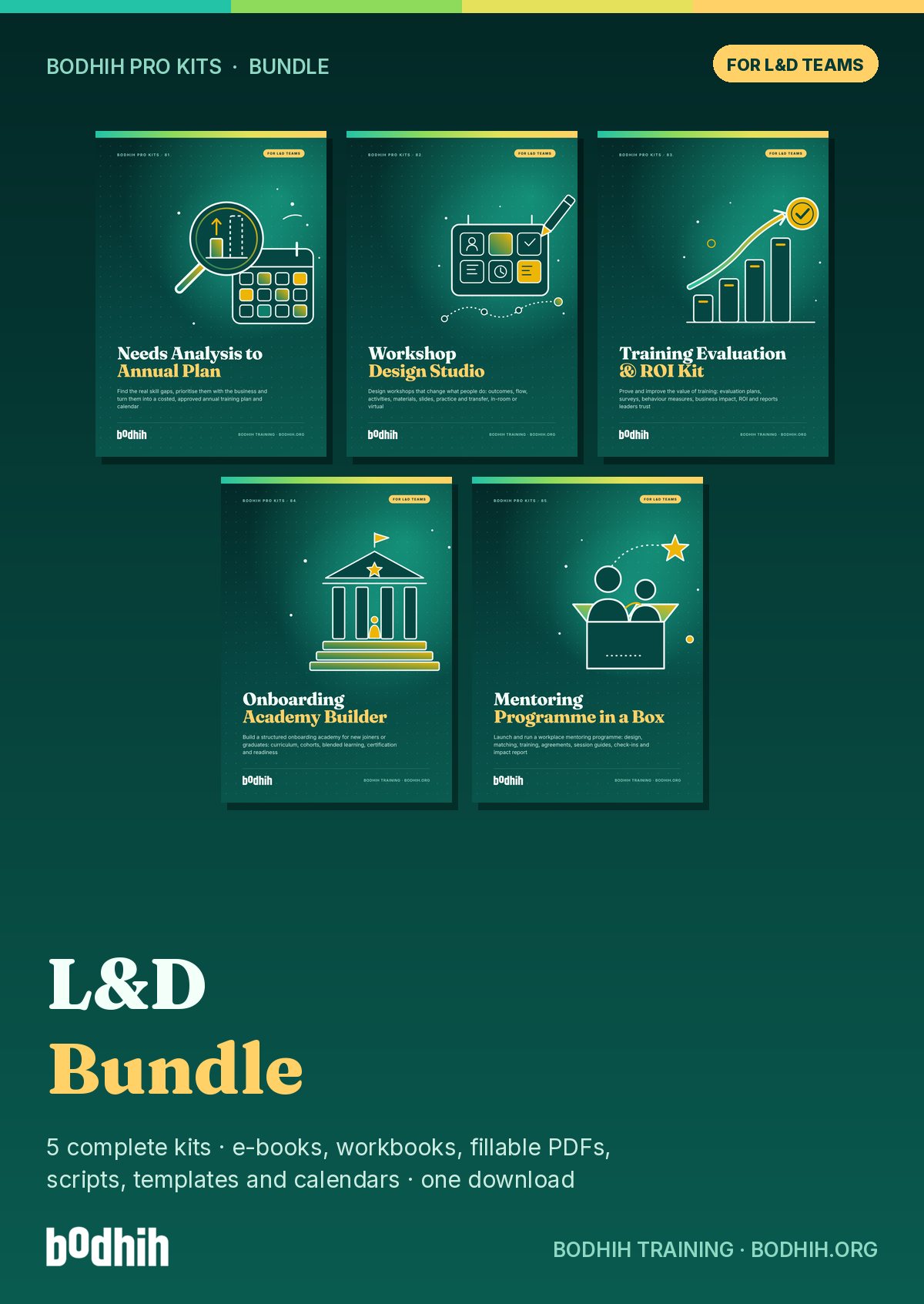
The Bodhih family, when you are ready for more
The Facilitator's Workbook Kit
Facilitation and coaching templates for trainers.
Trainer Toolkits
Ready-to-deliver training programmes with slides and handouts.
AssessAll
250+ AI-graded assessments to measure skills and earn verified credentials.
Jobulary
Individual development plans that start from evidence and stay yours.
Bodhih Training
Run this topic as a live workshop for your team, in person or online.
Pewple
Book a vetted coach for career, leadership or communication. Pay per session.
Bodhih.org pathways
Certification pathways in Applied AI, Workplace English and management.
The Workshop Design Studio: FAQs
Read the free guideAlready bought? Resend my linkWhat are the steps to design a training workshop?
Agree a business goal with the sponsor and test whether training is the answer, analyse the audience, write observable objectives, triage the content, build a timed plan around practice, write the materials, pilot it, then plan transfer and handover. The kit has a file for each of the eight stages.
How do I write learning objectives for a workshop?
Start from what people must do at work, then write what they will be able to do by the end of the session, with an observable verb, a condition and a standard. The workbook's Objectives sheet checks each verb against Bloom's revised taxonomy and flags vague verbs such as understand or be aware of.
How much of a workshop should be practice?
There is no universal number, so the kit asks your team to set its own rules: a maximum lecture share, a target practice share and a longest input block. The Session Plan and Dashboard check every design against them. The worked example runs at 7% lecture and 56% practice and application.
How do I design a virtual or hybrid workshop?
Redesign rather than transfer: split the day into sessions of two hours or less with work between them, add a producer, give people something to do every few minutes and make breakouts produce a shared output. The virtual design card and Chapter 8 cover virtual, hybrid and accessibility in detail.
Can I use AI to design training?
Yes, for drafts, conversions and summaries, with a person deciding what goes in. The prompt pack has 31 tool-agnostic prompts, each with what to paste in and what to check. Follow your organisation's AI policy and keep personal and confidential data out of unapproved tools.
How do I measure my starting point as a designer or facilitator?
AssessAll offers three matched assessments, sold separately: the Instructional Design Work Sample for Trainers, Instructional Designers and Subject-Matter Experts, the Training Facilitation and Group Handling Assessment for Trainers and Facilitators, and the Lesson Design and Questioning Technique Assessment for Teachers and Trainers. Take one before you start and again after your first design.
How do I turn this into a development plan?
Pick two skills from the design review questions in Appendix B and write them as if-then plans, the same method the participant workbook uses. Jobulary's guide to if-then plans at work explains the method, and Jobulary can help you turn those plans into a development plan.
Does it include ready-made workshop content?
It includes one complete one-day workshop design as a worked example, with its objectives, plan, activity card, virtual version and transfer plan, plus 68 activities you can adapt. It does not include topic content for your organisation: the kit teaches you to design that from your own brief.
Which software do I need?
The workbook opens in Excel, Google Sheets or LibreOffice and uses no macros. The forms are fillable in Acrobat Reader and most PDF apps, the templates open in Word or Google Docs, the calendar imports into Google Calendar, Outlook or Apple Calendar, and the CSV imports into Trello, Asana, Notion, Planner or Jira.
Is this legal advice on accessibility, data or AI rules?
No. The kit teaches good practice and keeps country and regulation specifics in one card dated October 2026. Rules on accessibility, equality, data protection and AI change, so check your HR team, company policy and local law.
What is the refund policy?
Digital kits are non-refundable once downloaded. The exceptions are corrupted files that are not fixed within 3 working days, duplicate charges, or failed delivery.
How much does The Workshop Design Studio cost?
₹999 including 18% GST for buyers in India, or $29 for buyers outside India. One-time payment, no subscription, with an automatic invoice.
How do I get the files after paying?
Instantly. Your download page opens the moment payment succeeds, and a permanent download link is emailed to you. Download each file separately or everything in one ZIP.
What software do I need?
Any of the usual tools: Excel or Google Sheets for spreadsheets, Word or Google Docs for templates, Adobe Acrobat Reader, Preview, Xodo or GoodNotes for the fillable PDFs, and Google, Outlook or Apple Calendar for the calendar plan.
Can I get a refund?
Because it is a digital download, kits are not refundable once downloaded. We always refund a duplicate charge or a failed delivery, and if a file is corrupted and we cannot fix it within 3 working days. Full terms: bodhih.org/refunds.
Can my company buy this for a team?
Yes. Team and company licences, and workshops on this topic run by Bodhih Training, are available. Write to solutions@bodhih.com or call +91 99000 11601.