Turn business goals into a costed, approved annual training plan
A complete training needs analysis toolkit for L&D managers, training coordinators and academy leads: the method, the workbook, the surveys, the forms, the exact words and the plan templates, for organisations of 50 people or 10,000.
- A 10-chapter e-book teaching a nine-step method from strategy interviews to the quarterly re-plan, with one composite organisation running through every chapter
- The TNA and Annual Plan Workbook: 15 sheets with goals map, skills matrix and gap heat map, survey roll-up, needs register, weighted prioritisation, solutions, budget, 12-month calendar, delivery tracker and dashboard
- 5 fillable PDF forms and 6 Word templates, including 45 messages and scripts, 55 survey questions, the TNA report and board-ready plan templates, and 30 AI prompts
- A Start Here map, 4 cheat sheets including dated compliance, levy and AI notes by country, a 6-sheet build-buy calculator, a 46-event calendar and a 38-task CSV
Training Needs Analysis to Annual Plan · Bodhih Pro Kits · 81 by Bodhih Training, trainers to 2,000+ companies since 2008.
How do you do a training needs analysis and turn it into an annual training plan?
Start with the goals and measures leaders own, test whether each gap is really about skill, gather evidence from data, surveys and skills ratings, and score needs with the business. Then cost solutions, write the plan as a decision document and review it quarterly. The Training Needs Analysis to Annual Plan Kit from Bodhih Training covers each step.
Want the full free guide first? Read How to Do a Training Needs Analysis and Build an Annual Training Plan.
You already feel the problem. Here is what it is costing you.
A plan made of requests
Every year the same spreadsheet of course requests arrives, gets costed and goes up for approval. Nobody can say which business goal each line serves, so nobody can say whether it worked.
Training asked to fix what training cannot
Errors, complaints and attrition get handed to L&D as training problems. Often the cause is a process, a tool or a target, and a course changes nothing except the budget.
Surveys that measure wishes
Long surveys produce long lists of popular topics and polite self-ratings. Without manager views, calibration and business data, the loudest wishes rise to the top.
Leaders who each want their programme first
Every sponsor believes their need is urgent. Without a shared way to score needs, priorities follow influence, and the plan pleases nobody.
A budget finance does not believe
Costs that leave out internal trainer time, learner time or vendor extras get spotted in the first minute of the budget meeting, and the whole plan loses credibility.
No way to show impact
Completion rates and feedback scores are all you have when the CFO asks what changed. By then it is too late to agree a measure.
Picture the next few weeks with the kit open beside you.
Picture the first week of planning season. Instead of opening last year's request list, you open the Start Here map, type your settings into the workbook and send two messages: one to your sponsor, one to the first leader on your interview list. By Friday, three strategy interviews are booked and the Goals Map has its first measures.
Now it is week four. As you work through the performance analysis worksheet with a manager who asked for a refresher course, the real cause comes out: a refund limit, a broken search tool, a layout that makes the wrong item easy to pick. You record a non-training fix with an owner and a date, and the training that remains is smaller, cheaper and aimed precisely.
By week seven the survey is rolled up, the heat map shows where the gaps really are, and business owners are scoring needs together in one room. When a leader pushes a favourite programme, you score it on the same criteria and let the numbers do the talking. The line is drawn, the parked needs have review dates, and nobody is surprised.
Imagine the approval meeting. Each leader has read a one-page summary linking every programme to a goal they gave you. When someone asks for a cut, you already know what would drop below the line and what it would cost. Whether you start with the e-book tonight or the interview guide on Monday, the first hour is already planned.
21 files that do the work for you
The e-book shows you how. The tools make it happen. Here is exactly what you download.
Training Needs Analysis to Annual Plan (e-book, PDF)
The guide: methods, worked examples, scripts and exercises
Start here: TNA to annual plan map
The whole job as nine steps with the file to open at each, your first hour, a 30/60/90 day use plan and links to measure your starting point.
TNA and Annual Plan Workbook
15-sheet workbook: settings, goals-to-capability map, data sources, skills matrix with gap and calibration flags, gap heat map, survey roll-up, needs register, weighted prioritisation, solution design, budget against target, 12-month calendar, delivery tracker, quarterly re-plan and a dashboard with a budget chart.
Training Cost and Build-Buy Calculator
Six-sheet calculator: compares build, buy off-the-shelf, buy custom, borrow and blend on total cost, cost per learner and cost per learner hour; compares vendor quotes on value; and estimates ROI and payback in the Phillips style.
Stakeholder interview and focus group guide
Three-page fillable guide: a 40-minute strategy interview with a leader (goals, measures, behaviours, risks, constraints), a closing page that turns notes into Goals Map rows, and a 60-minute focus group plan with capture grid.
Performance analysis worksheet: is it training?
Two-page fillable worksheet that tests every request before it becomes a course: the gap in numbers, a root-cause check across the person and the environment, an action map from goal to practice, and a verdict.
Manager training needs survey
Two-page fillable survey for line managers: team goals, team capability ratings on the priority skills, top three needs with evidence, obstacles that are not about skill, release windows and nominations.
Individual skills self-assessment
Two-page fillable self-assessment: rate yourself 1 to 4 against required levels with evidence, choose two development goals, say what support helps, then a manager review and agreed ratings for the Skills Matrix.
Programme brief and design canvas
Three-page fillable brief for each programme in the plan: need and goal, audience, on-the-job actions and objectives, modality and build-buy-borrow choice, schedule and cost, measures at each level, risks and sign-off.
TNA survey question bank
55 tested survey questions in 9 groups (role, skills self-rating, obstacles, access, AI and digital, managers, leaders, open questions, admin), each with a response format and a note on what it feeds.
TNA message and script library
45 ready-to-edit emails, chat messages and spoken scripts in 7 groups: sponsor kick-off, interview and data requests, survey launch and reminders, focus groups, saying no to course requests, vendor RFQs, plan approval, launch and quarterly review.
TNA report and annual L&D plan templates
Three ready-to-send documents: a TNA findings report for stakeholders, a board-ready annual L&D plan with portfolio, calendar, budget, measures and governance, and a one-page summary for the approval meeting.
L&D policy one-pager
A one-page learning and development policy to adapt and adopt: purpose, how needs are identified and prioritised, approval, mandatory training, time for learning, study support and agreements, AI tools, evaluation and records.
Worked example pack: Tidewell Logistics annual plan
The main forms and outputs completed for one composite case: strategy interview notes, goals map, a performance analysis that splits training from non-training fixes, survey and heat map findings, scored priorities, a programme brief, the build-buy decision, budget, approval paper and first quarterly review.
AI prompt pack for TNA and annual planning
30 tool-agnostic prompts grouped by the eight steps of the job, from strategy interviews to the quarterly re-plan, each with what to paste in and what to check before you use the output.
TNA decision card
If-this-then-that card for twenty common moments in a needs analysis and annual plan, plus three checks before any plan decision.
TNA mistakes to avoid
Mistakes-to-avoid card: twelve planning mistakes with what to do instead and the file that prevents each, plus five traps in using AI for TNA.
Modality chooser
Nine delivery modalities compared on when they fit, when to avoid them and their cost profile, plus five design rules and build, buy or borrow in one line each.
L&D compliance, funding and AI notes by country (October 2026)
Dated quick reference to training levies, mandatory training and AI literacy rules across the EU, UK, India, US, Singapore, the Gulf, the Philippines, Africa and Australia, with questions to ask.
8-week TNA project calendar
46 calendar events for an eight-week needs analysis, from sponsor kick-off to plan approval and manager briefing, each naming the file to open. Import into a new calendar and move to your dates.
TNA project task board import
38 TNA project tasks as a CSV ready to import into Trello, Asana, Notion, Planner or Jira, with phase, week, owner, file to open and due date.
Chapter by chapter
Each chapter opens with a real situation, gives you a method and ends with something to do today, using the tools in your kit.
- Format
- PDF e-book + XLSX + fillable PDF + DOCX + printable PDF + ICS + CSV
- Files
- 21 files plus a one-click ZIP
- E-book
- 59 pages
- Workbooks
- 15-sheet planning workbook and 6-sheet calculator, with sample data, formulas and dashboards
- Works with
- Excel, Google Sheets, LibreOffice, Word, Google Docs, Acrobat Reader, GoodNotes, Google Calendar, Outlook, Apple Calendar, Trello, Asana, Notion, Planner, Jira
- Best for
- Organisations of roughly 50 to 10,000 people planning learning for the year ahead, in any country and currency
From Wish Lists to a Plan the Business Signs
Why plans built from course requests fail, and the nine-step method from business goals to an approved, measured plan.
Start From the Business, Not the Course Catalogue
Scoping with a sponsor, 40-minute strategy interviews with the leaders who own results, and a goals-to-capability map.
Is It a Training Problem at All?
Performance consulting in practice: test every request for its real cause, build an action map and record a verdict.
Three Levels of Analysis and a Skills Framework
Organisation, role and individual analysis, and a short, rateable skills framework with behavioural levels.
Gathering the Evidence: Data, Surveys and Skills Audits
Existing data first, then short surveys, self and manager skills ratings, calibration and AI help with comments.
Interviews and Focus Groups That Surface the Real Need
Focus groups and expert interviews that explain why gaps exist, with ground rules that protect honest answers.
Prioritising With the Business
Weighted scoring on impact, reach, urgency, risk and evidence with business owners, and how to park needs gracefully.
Designing Solutions: Build, Buy or Borrow, and the Right Modality
From on-the-job actions to objectives, the right modality, evidence-based design and the build, buy or borrow decision.
Costing the Plan
Full costing including internal time, cost per learner hour, vendor quotes, levies and grants, and contingency.
Writing the Annual Plan and Getting Sign-off
The findings report, the plan as a decision document, mandatory training, the calendar and the approval meeting.
Measuring Delivery and Impact, and the Quarterly Re-plan
Kirkpatrick, Phillips, Brinkerhoff and LTEM in practice, monthly delivery tracking, the quarterly re-plan and country differences.
The Plan as a Living Agreement
What changes when the plan becomes an agreement with the business, and your first hour.
TNA Glossary and Workbook Formulas
Plain definitions of the terms used in the kit, matched to the workbook.
Using AI in TNA and Planning Safely
Six rules for using AI in a needs analysis safely, with a prompt for the plan on a page.
Not just reading. Tools you will actually open again.
E-book
- Training Needs Analysis to Annual Plan: 10 chapters, 2 appendices and 6 hand-drawn figures (PDF)
Start here
- Start Here map: the whole job in nine steps with the file to open at each, your first hour and a 30/60/90 day use plan
Spreadsheets
- TNA and Annual Plan Workbook: 15 sheets covering settings, goals-to-capability map, data sources, skills matrix with gap and calibration flags, gap heat map, survey roll-up, needs register, weighted prioritisation, solution design, budget, 12-month calendar, delivery tracker, quarterly review and dashboard
- Training Cost and Build-Buy Calculator: 6 sheets comparing build, buy, borrow and blend on total cost, a vendor quote comparison and a Phillips-style ROI estimate
Fillable PDF forms
- Stakeholder interview and focus group guide (3 pages)
- Performance analysis worksheet: is it training? (2 pages)
- Manager training needs survey (2 pages)
- Individual skills self-assessment (2 pages)
- Programme brief and design canvas (3 pages)
Word templates
- TNA survey question bank: 55 questions in 9 groups with response formats
- TNA message and script library: 45 emails, chat messages and spoken scripts
- TNA report and annual L&D plan templates: findings report, board-ready plan and one-page summary
- L&D policy one-pager
- Worked example pack: Tidewell Logistics annual plan, with the main forms completed
- AI prompt pack: 30 prompts grouped by the eight steps of the job
Cheat sheets
- TNA decision card: 20 if-this-then-that moments
- TNA mistakes to avoid: 12 planning mistakes and 5 AI traps
- Modality chooser: 9 delivery modalities compared
- L&D compliance, funding and AI notes by country (October 2026)
Calendar and import
- 8-week TNA project calendar: 46 events for Google, Outlook or Apple Calendar
- TNA project task board: 38 tasks as a CSV for Trello, Asana, Notion, Planner or Jira
When you have worked through it, you will be able to…
Every outcome is practised with a worked example and a tool, not just described.
- Scope a needs analysis with a sponsor and run strategy interviews that start from results and measures
- Test every training request for its real cause and route non-training fixes to the right owners
- Build a short skills framework, run self and manager ratings, calibrate them and read a gap heat map
- Design short surveys and focus groups that produce evidence rather than wish lists
- Score and rank needs with business owners on impact, reach, urgency, risk and evidence
- Choose modalities and decide whether to build, buy, borrow or blend, with full costs compared
- Write a findings report, a board-ready plan and a one-page summary, and run the approval meeting
- Track delivery, spend and results on one dashboard and re-plan every quarter
Know your starting point. Prove your progress.
People who measure before and after improve faster and can show it. AssessAll, our sister assessment platform, has AI-graded assessments that pair with this kit. Take one now, work through the kit, then re-take it.
Training Needs Analysis Work Sample for Learning and Development Teams and Human Resource Business Partners
Take the assessment →AssessAll assessmentStrategic Workforce & Talent Planning
Take the assessment →AssessAll assessmentBudget & Resource Allocation Reasoning
Take the assessment →JobularyLearn by doing: the 70-20-10 model explained (Jobulary)
Make it a growth plan →A taste of Chapter 5
The Chennai night shift focus group almost did not happen. The site manager suggested Meera "just talk to the supervisors, they know what the pickers think". She held her ground, politely, and on a Tuesday at 11.30 pm she sat in the canteen with seven pickers, a flask of tea and a note-taker from HR. For the first twenty minutes they talked about scanners. Two of the three handhelds on the night shift had batteries that died before break. The charging station was in a locked office. Nobody had told the day shift, because nobody asked the night shift anything. Then one picker, Lakshmi, said the thing Meera wrote at the top of her notes: "When we make a mistake, the supervisor shouts. When we pick perfectly all night, nobody says anything."
The honest comparison
| Free templates and typical advice | This kit | |
|---|---|---|
| Starting point | Collect course requests from managers | Strategy interviews with the leaders who own next year's results, captured on a goals map |
| Is it training? | Assume every gap needs a course | A performance analysis worksheet that separates skill gaps from environment, tools and incentives |
| Skills evidence | A long self-rating survey | Priority skills with behavioural levels, self and manager ratings, calibration flags and a heat map |
| Priorities | Whoever asks loudest | Weighted scoring on five criteria with business owners, a rank and a suggested decision |
| Budget | External fees only | Full cost including internal trainer time, optional learner time, cost per learner hour and contingency |
| Approval | A long document nobody reads | Findings report, a ten-section plan and a one-page summary with the decisions requested |
| Measurement | Attendance and feedback forms | A measure agreed per programme, monthly delivery tracking and a quarterly re-plan |
Made for you if…
- L&D managers and heads of learning who own the annual training plan and budget
- Training coordinators and HR generalists who carry the L&D brief alongside other work
- Internal trainers and academy leads asked to show what training changed
- Training providers and consultants who run needs analyses for clients
- HR business partners who want development spend tied to business goals
- Teams planning across countries, including India, the UK, the US, the Gulf, Singapore, the Philippines, Africa and Australia
Probably not for you if…
- Anyone looking for legal or tax advice: the kit teaches good practice and points you to HR, legal and official sources, with country notes dated October 2026
- Readers wanting general facilitation and coaching templates: the Facilitator's Workbook Kit covers that ground; this kit goes deep on needs analysis and planning
- Teams that need a learning management system: the workbook plans and tracks alongside your LMS, it does not replace one
Built by trainers, tested in real rooms.
Bodhih Training has designed and delivered corporate programmes since 2008. Bodhih Pro Kits package what works in those workshops into a guide plus the exact tools we use, so you can apply it the same day without a facilitator in the room.
From here to using it in three steps
- STEP 1
Tap Get the kit
Name, email and country. UPI, card or netbanking in India; international cards everywhere else. No account to create.
- STEP 2
Download instantly
Your download page opens at once, with every file and a one-click ZIP. A permanent link lands in your inbox too.
- STEP 3
Open the first tool
Start with the quick-start chapter, then the main spreadsheet or planner. Most buyers use something from the kit the same day.
Planning season comes round every year. This time, start from the business.
Open the Start Here map, type your settings into the workbook and write your interview list. Whether you begin with the e-book this evening or the interview guide on Monday, your first hour is already planned. Digital kits are non-refundable once downloaded, except for corrupted files not fixed within 3 working days, duplicate charges or failed delivery.
Personal licence for the buyer's own use (and use with your own team or clients where the kit says so). Please don't share or resell the files. Team and company licences: solutions@bodhih.com.
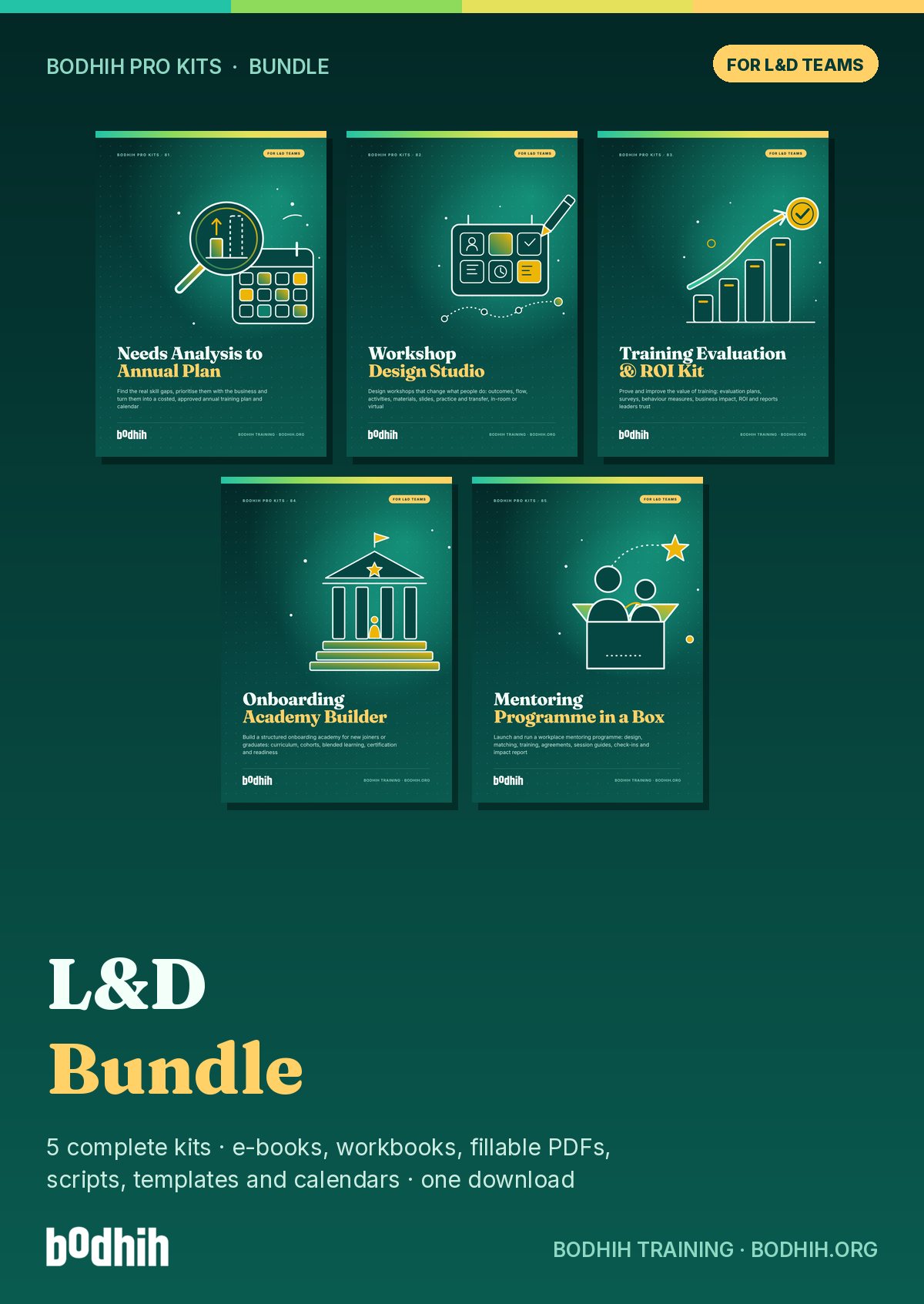
The Bodhih family, when you are ready for more
The Facilitator's Workbook Kit
Facilitation and coaching templates for trainers.
Trainer Toolkits
Ready-to-deliver training programmes with slides and handouts.
AssessAll
250+ AI-graded assessments to measure skills and earn verified credentials.
Jobulary
Individual development plans that start from evidence and stay yours.
Bodhih Training
Run this topic as a live workshop for your team, in person or online.
Pewple
Book a vetted coach for career, leadership or communication. Pay per session.
Bodhih.org pathways
Certification pathways in Applied AI, Workplace English and management.
Training Needs Analysis to Annual Plan: FAQs
Read the free guideAlready bought? Resend my linkWhat is a training needs analysis?
A training needs analysis (TNA) is a structured way to find the gaps between what people can do and what the business needs them to do, and to decide which gaps training should close. A good one works at three levels, organisation, role and individual, and tests whether each gap is really about skill before anyone designs a course.
How long does a training needs analysis take?
For most organisations, about eight working weeks from sponsor kick-off to plan approval, which is how the kit's calendar is laid out. Smaller teams can compress it; large or multi-country organisations may run it in waves by function or region.
How do I know whether a problem is really a training problem?
Describe the gap in observable terms, price it, then check the environment (expectations, feedback, tools, process, incentives) and the person (could they do it if they had to?). The Performance Analysis Worksheet in the kit walks you through this and records a verdict: training, partly training, or not training.
How should we prioritise training needs?
Score every need on the same criteria with the business owners: business impact, number of people affected, urgency, risk or compliance, and strength of evidence. The workbook weights these, ranks the needs and suggests a decision, with mandatory training placed first and non-training needs sent to their owners.
How do I measure my own starting point in needs analysis and planning?
AssessAll offers assessments matched to this kit (separate products, not included): Training Needs Analysis Work Sample for Learning and Development Teams and Human Resource Business Partners; Strategic Workforce & Talent Planning; and Budget & Resource Allocation Reasoning. They help you see where your own skills are strong and where to focus first.
How do I turn this into a development plan for my L&D team?
Use the skills framework method in Chapter 3 on your own team's skills, then plan development that mixes experience, people and formal learning. Jobulary's article 'Learn by doing: the 70-20-10 model explained' is a helpful starting point for turning gaps into a practical development plan.
Can we use AI to analyse survey comments?
Yes, for a first pass. Remove names and identifying details, use only tools your organisation has approved, and check a sample of comments yourself to confirm the themes, counts and quotes. The kit's prompt pack and Appendix B set out where AI helps and where a person must decide.
Does it work in my country and currency?
Yes. The workbooks take any currency code, and the method works anywhere. The dated country notes cover the EU, UK, India, the US, Singapore, the UAE, Saudi Arabia, the Philippines, South Africa, Nigeria, Kenya and Australia, with questions to check locally.
Is this legal or tax advice?
No. The kit is educational and teaches good practice. Mandatory training, levies, paid training time and data rules differ by country, state and sector, so check your HR team, company policy, local law and the official sources named in the country notes.
Which software do I need?
Excel, Google Sheets or LibreOffice for the workbooks; Word or Google Docs for the templates; any PDF reader that supports forms, such as Acrobat Reader, for the fillable PDFs; and any calendar or task tool that imports ICS or CSV files.
How much does Training Needs Analysis to Annual Plan cost?
₹1,299 including 18% GST for buyers in India, or $34 for buyers outside India. One-time payment, no subscription, with an automatic invoice.
How do I get the files after paying?
Instantly. Your download page opens the moment payment succeeds, and a permanent download link is emailed to you. Download each file separately or everything in one ZIP.
What software do I need?
Any of the usual tools: Excel or Google Sheets for spreadsheets, Word or Google Docs for templates, Adobe Acrobat Reader, Preview, Xodo or GoodNotes for the fillable PDFs, and Google, Outlook or Apple Calendar for the calendar plan.
Can I get a refund?
Because it is a digital download, kits are not refundable once downloaded. We always refund a duplicate charge or a failed delivery, and if a file is corrupted and we cannot fix it within 3 working days. Full terms: bodhih.org/refunds.
Can my company buy this for a team?
Yes. Team and company licences, and workshops on this topic run by Bodhih Training, are available. Write to solutions@bodhih.com or call +91 99000 11601.