Build an onboarding academy that makes new joiners ready, with a file for every step
For L&D teams building an induction, graduate, sales, service or frontline academy. Define ready, map the curriculum, run cohorts, certify fairly and measure time to proficiency, starting in the first hour.
- A 10-chapter e-book teaching the Ready-Back method, with one composite academy running through every chapter
- The Academy Builder Workbook: 15 sheets covering readiness criteria, curriculum map, timetable builder, cohort roster, gradebook, faculty schedule, budget, cohort comparison and two dashboards
- 5 fillable PDF forms (charter, module design, sign-off, capstone rubric, progress review) and a cost and capacity calculator
- 7 Word templates with 38 messages and 29 AI prompts, 4 printable references, a 69-event calendar and a 46-task board import
The Onboarding Academy Builder · Bodhih Pro Kits · 84 by Bodhih Training, trainers to 2,000+ companies since 2008.
How do you design an onboarding academy?
Define what ready means for each role as observable tasks with a standard, then work backwards: map modules to those tasks, sequence weeks so practice grows, set knowledge checks, sign-offs and a capstone, brief faculty and managers, and track time to proficiency. The Onboarding Academy Builder from Bodhih Training gives you the files for each step.
Want the full free guide first? Read How to Design an Onboarding Training Programme for New Hires.
You already feel the problem. Here is what it is costing you.
Busy but not designed
Every department wants a slot, so week one fills with presentations. Nobody wrote down what new joiners must be able to do on their first morning on the job, so nobody can tell whether the induction works.
Ready on paper, lost on the floor
Everyone passes the quiz, then freezes at the first real customer. Without practical sign-offs and a capstone, certification means attendance.
Onboarding rarely impresses
Gallup reports that only 12% of employees strongly agree their organisation does a great job of onboarding new employees. The gap between what companies intend and what new joiners experience is wide.
SMEs who overrun
Your experts know everything and try to say all of it. Learners leave with ninety slides in their heads and no practice in their hands.
Managers left out
Team leaders do not know what graduates covered, so they say forget what the academy told you. The learning stops at the classroom door.
No number that matters
Your report is a satisfaction score. The sponsor wants to know whether new joiners are faster, and you have no time-to-proficiency baseline to show them.
Picture the next few weeks with the kit open beside you.
Picture the end of your first build week. The charter is signed, and the Readiness Criteria sheet holds fourteen tasks your best performers actually do, each with a standard. When you open the Curriculum Map, every module points back to one of them, and the one that does not is flagged in red.
Now it is week three of your first cohort. As you record an attempt in the Gradebook, the Cohort Roster updates and one learner turns amber: attendance. You open the Learner Progress Review, have a twenty-minute conversation, and a support plan exists before lunch. The sponsor's Friday update takes five minutes because the Dashboard already holds the numbers.
Imagine certification day. Team leaders come to collect their new colleagues with a handover email already in their inbox. A learner who scored 'not yet' a week earlier passes her re-sit, because the extension plan was specific and someone reviewed her practice every day.
Then the cohort review. You put time to proficiency, early leavers and cost per certified learner on one slide, honestly, and log four changes for the next group. Whether you start with the e-book tonight or the workbook on Monday morning, the next cohort starts better than the last.
21 files that do the work for you
The e-book shows you how. The tools make it happen. Here is exactly what you download.
The Onboarding Academy Builder (e-book, PDF)
The guide: methods, worked examples, scripts and exercises
Start here map
The whole academy job as twelve steps with the file to open at each, your first hour, and a 30/60/90 day use plan.
Academy Builder Workbook
15-sheet workbook: settings, readiness criteria, curriculum map, timetable builder, hours and blend checks, cohort roster, gradebook, faculty schedule, budget, cohort comparison, improvement log and two dashboards.
Academy Cost and Capacity Calculator
Five-sheet simulator: compare cohort models on cohorts per year, trainers needed, cost per hire and waiting time, and estimate what a faster ramp to proficiency might be worth.
Academy charter
Three-page fillable charter that a sponsor signs before design starts: purpose, scope, definition of ready, measures, roles, constraints and review dates.
Module design sheet
Two-page fillable sheet for designing one module backwards from a readiness criterion: action map, Bloom level, method, practice, retrieval and assessment.
Practical sign-off checklist
Two-page fillable checklist for observing a learner perform a real task to standard, with critical items, attempts, feedback and assessor declaration.
Capstone assessment rubric
Three-page fillable rubric for a multi-contact capstone: six criteria on four levels, scores per contact, evidence notes, decision and feedback.
Learner progress review
Two-page fillable review for the mid-point or any at-risk learner: data, learner's view, buddy and trainer input, support plan and extension decision.
Academy programme guide template
The design document for your academy: purpose, readiness, curriculum, timetable, assessment, roles, measures and governance, with prompts in brackets.
Learner welcome handbook template
A friendly handbook for new joiners: what the academy is, the weeks ahead, how assessment works, who helps, daily practicalities and how to ask for adjustments.
SME and faculty briefing pack
Everything a subject-matter expert or guest trainer needs: their session in context, the readiness task it builds, a 20-minute rule, practice-first session plan, assessment role and a checklist.
Academy message library
38 ready-to-edit messages: joining instructions, daily and weekly updates, manager updates, faculty and SME notes, assessment and certification emails, hard moments and after-academy follow-ups.
Academy standards one-pager
A one-page set of standards your academy team, faculty and sponsor can adopt: design, delivery, assessment, fairness, AI use, data and improvement.
Worked example pack: a 4-week customer support academy
The charter, readiness criteria, a module design sheet, a sign-off, a capstone, a progress review, timetable, budget and cohort review, completed for one composite academy.
AI prompt pack for academy builders
29 tool-agnostic prompts grouped by step of building and running an academy, each with what to paste in and what to check, plus a safe set-up for AI practice partners.
Decision card: academy design choices
If-this-then-that rules for the decisions academy builders face, plus quick guides to choosing methods and evaluation models.
Twelve academy mistakes to avoid
Mistakes-to-avoid card: twelve common academy mistakes, the early sign of each, what to do instead, a Friday self-check and a launch check.
Rules, standards and tools (October 2026)
Dated reference: AI regulation dates, learner data protection, UK levy changes, SCORM, xAPI and cmi5, and academy tool categories.
Academy build and first cohort calendar
69 events: a six-week build plan, the first four-week cohort with daily rhythm and weekly updates, the cohort review and day 30, 60 and 90 checks. Import into a new calendar and move to your dates.
Academy build task board import
46 build and first-cohort tasks as a CSV ready for Trello, Asana, Notion, Planner or Jira, with phase, week, owner and due date.
Chapter by chapter
Each chapter opens with a real situation, gives you a method and ends with something to do today, using the tools in your kit.
- Format
- PDF e-book + XLSX + fillable PDF + DOCX + printable PDF + ICS + CSV
- Files
- 21 files plus a one-click ZIP
- E-book
- 60 pages
- Workbook
- 15 sheets with sample data, formulas and two dashboards
- Works with
- Excel, Google Sheets, LibreOffice, Word, Google Docs, Acrobat Reader, GoodNotes, Google Calendar, Outlook, Apple Calendar, Trello, Asana, Notion, Planner, Jira
- Best for
- L&D teams building academies of 2 to 12 weeks for new joiners, graduates or frontline hires
Ready Is the Whole Point
Why most inductions are busy but not designed, and the seven-step Ready-Back method in one page.
Define Ready Before You Design Anything
Readiness criteria as observable tasks with standards and evidence, and time to proficiency as the number that matters.
The Curriculum Architecture
Six layers from company to behaviours, Bloom levels, and a curriculum map where every module earns its place.
Sequencing the Weeks
Simple to complex, real problems first, retrieval and spaced practice, and a timetable that passes the capacity check.
Blended by Design
Choosing classroom, virtual, e-learning, shadowing, simulation, on-the-job and AI practice for each part of the job.
Gates, Sign-offs and Certification
Knowledge checks, practical sign-offs and a double-marked capstone, with calibration and a fair rule for not yet.
Faculty, SMEs, Buddies and Managers
Six roles around every learner, briefing SMEs, choosing buddies and keeping team leaders involved.
Cohorts, Calendars and the Learner Experience
Cohort models, joining instructions to certification day, and tracking in an LMS, a spreadsheet or both.
Graduate, Frontline and Global Academies
How the method adapts for freshers and graduate schemes, shift-based frontline teams and multi-country academies.
Measuring Academy Impact
Kirkpatrick, Phillips ROI, Success Case Method and LTEM in plain words, and the measures to track for every cohort.
Budget, Scale and Improve Every Cohort
Cost per cohort and per learner, scaling with the calculator, AI rules and the ten-day cohort review.
The Academy That Gets Better Every Time
What changes when ready comes first, and the smallest useful first step.
The Six-Week Build Plan
The build and first cohort as a week-by-week table matching the calendar and task board.
Using AI Safely in Your Academy
Five rules for using AI to draft, simulate and analyse without letting it decide.
Not just reading. Tools you will actually open again.
E-book
- The Onboarding Academy Builder: 10 chapters, 2 appendices and 6 hand-drawn figures (PDF)
Start here
- 00-Start-Here-Map: the academy job as 12 steps with the file to open at each, your first hour and a 30/60/90 day use plan
Spreadsheets
- Academy Builder Workbook (15 sheets): Start here, Settings, Readiness Criteria, Curriculum Map, Timetable Builder, Hours by Week, Blend Mix, Cohort Roster, Gradebook, Faculty Schedule, Budget, Cohort Comparison, Improvement Log, Cohort Progress dashboard and an academy Dashboard with 18 live measures and a time-to-proficiency chart
- Academy Cost and Capacity Calculator (5 sheets): compare cohort models on cost per hire, trainers needed and waiting time, and estimate the value of a faster ramp
Fillable PDF forms
- Academy charter: purpose, scope, definition of ready, measures, roles and constraints
- Module design sheet: action map, Bloom level, method, sequence, retrieval and assessment
- Practical sign-off checklist: observed items, critical items, attempts and feedback
- Capstone assessment rubric: six criteria on four levels, decision and extension plan
- Learner progress review: data, learner's view, support plan and decision
Word templates
- Academy programme guide template
- Learner welcome handbook template
- SME and faculty briefing pack
- Academy message library: 38 messages from joining instructions to certification and after
- Academy standards one-pager your team and sponsor can adopt
- Worked example pack: a 4-week customer support academy, completed end to end
- AI prompt pack for academy builders: 29 prompts, each with what to paste in and what to check
Cheat sheets
- Decision card: academy design choices, methods and evaluation models
- Twelve academy mistakes to avoid, with a Friday self-check and launch check
- Rules, standards and tools, correct at October 2026: AI regulation dates, learner data, SCORM, xAPI and cmi5
Calendar and import
- Academy build and first cohort calendar (ICS): 69 events for Google Calendar, Outlook or Apple Calendar
- Academy build task board import (CSV): 46 tasks for Trello, Asana, Notion, Planner or Jira
When you have worked through it, you will be able to…
Every outcome is practised with a worked example and a tool, not just described.
- Write readiness criteria as observable tasks with standards, evidence and deadlines, agreed with your sponsor
- Build a curriculum map where every module serves a readiness task and practice reaches the right Bloom level
- Sequence a week-by-week timetable with growing practice, daily retrieval and capacity checks
- Design knowledge checks, practical sign-offs and a calibrated capstone with a fair rule for not yet
- Brief SMEs, buddies and team leaders so each knows their part and has a backup
- Run cohorts with joining instructions, daily rhythm, Friday updates, progress reviews and handover
- Track time to proficiency, certification rate, early leavers and cost per certified learner
- Compare cohort models and improve the academy after every cohort
Know your starting point. Prove your progress.
People who measure before and after improve faster and can show it. AssessAll, our sister assessment platform, has AI-graded assessments that pair with this kit. Take one now, work through the kit, then re-take it.
Your First Ninety Days: Onboarding Readiness
Take the assessment →AssessAll assessmentInstructional Design Work Sample for Trainers, Instructional Designers and Subject-Matter Experts
Take the assessment →AssessAll assessmentPost-Training Application and Workplace Support Check for Workshop Participants at 30, 60 and 90 Days
Take the assessment →JobularyLearn by doing: the 70-20-10 model explained (Jobulary)
Make it a growth plan →A taste of Chapter 1
Most onboarding programmes are designed from the content outwards. Someone lists the topics, each department asks for a slot, and the timetable fills up. The result is busy and comprehensive, and nobody can say whether it works, because nobody wrote down what "works" means. When you define ready first, three things change. You can cut content with a clear conscience, because a topic that serves no readiness task has to justify itself. You can assess fairly, because learners know what they are being judged against. And you can measure the academy, because "ready" and "proficient" become dates you can record. The idea is old. Cathy Moore's Action Mapping, a widely used approach in workplace learning, starts with the business goal and the actions people must take to reach it, designs practice for those actions, and only then adds the information the practice needs. Ready-Back applies the same thinking to a whole academy rather than one course.
The honest comparison
| Free templates and typical advice | This kit | |
|---|---|---|
| Starting point | A list of topics and a blank timetable | A readiness criteria sheet that every module must point back to |
| Timetable | Static agenda in a document | Timetable builder with dates, day totals, capacity and practice-share checks |
| Assessment | An end-of-course quiz everyone passes | Knowledge checks, practical sign-off checklists and a double-marked capstone rubric |
| Tracking | Attendance lists | Roster and gradebook that calculate certification status and at-risk flags |
| Faculty | SMEs asked to 'do a session' | Briefing pack, 20-minute rule, faculty schedule with readiness and backups |
| Impact | Satisfaction scores | Time to proficiency, early leavers, cost per certified learner and cohort comparison |
| Seeing what good looks like | Empty templates | Sample rows in every sheet and a worked example pack for one composite academy |
| Where it works | Assumes one office in one country | Graduate, frontline, shift-based and multi-country academies, with a dated rules sheet |
Made for you if…
- L&D managers and academy leads designing or rebuilding an onboarding academy
- Training coordinators who run cohorts, timetables, faculty and assessments
- HR and L&D generalists asked to turn a slide-heavy induction into a real programme
- Internal trainers building sales, service, technical or frontline new-hire academies
- Early-careers teams running graduate schemes and freshers academies
- Training providers who design academies for client organisations
Probably not for you if…
- Anyone looking for HR onboarding paperwork such as contracts, payroll and policy sign-offs: see Bodhih's Employee Onboarding 30-60-90 System
- Readers who want general facilitation games and coaching templates: the Facilitator's Workbook Kit goes deeper there
- Anyone seeking legal advice on probation, apprenticeship funding or data protection: the kit teaches good practice and points you to HR and local law
Built by trainers, tested in real rooms.
Bodhih Training has designed and delivered corporate programmes since 2008. Bodhih Pro Kits package what works in those workshops into a guide plus the exact tools we use, so you can apply it the same day without a facilitator in the room.
From here to using it in three steps
- STEP 1
Tap Get the kit
Name, email and country. UPI, card or netbanking in India; international cards everywhere else. No account to create.
- STEP 2
Download instantly
Your download page opens at once, with every file and a one-click ZIP. A permanent link lands in your inbox too.
- STEP 3
Open the first tool
Start with the quick-start chapter, then the main spreadsheet or planner. Most buyers use something from the kit the same day.
Your next cohort starts either way. Give it a definition of ready first.
Open the Start Here map, type your start date into Settings and write five readiness criteria with your best performer. Whether you begin with the charter this afternoon or the timetable on Monday, the first hour is already planned.
Personal licence for the buyer's own use (and use with your own team or clients where the kit says so). Please don't share or resell the files. Team and company licences: solutions@bodhih.com.
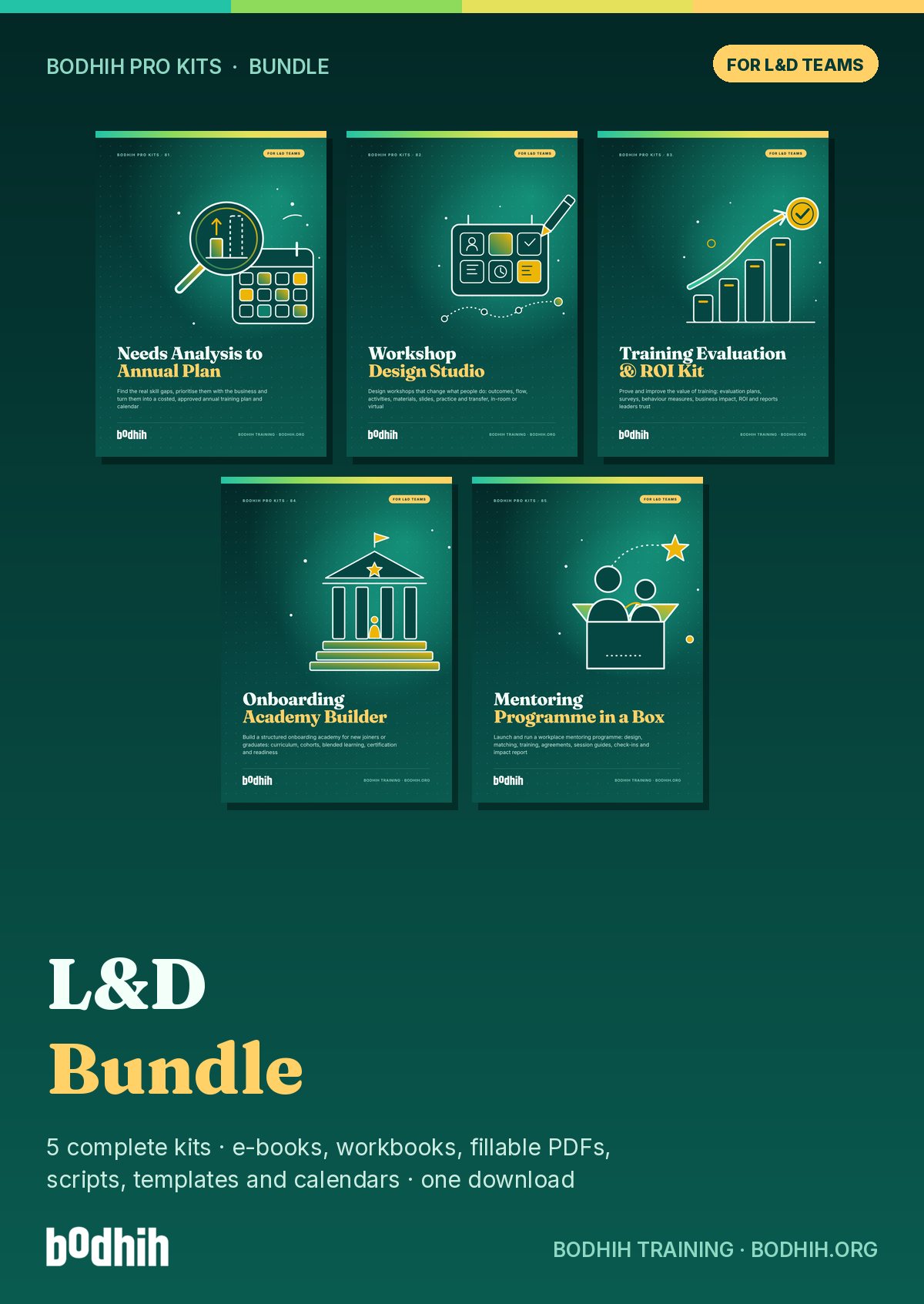
The Bodhih family, when you are ready for more
The Facilitator's Workbook Kit
Facilitation and coaching templates for trainers.
Trainer Toolkits
Ready-to-deliver training programmes with slides and handouts.
AssessAll
250+ AI-graded assessments to measure skills and earn verified credentials.
Jobulary
Individual development plans that start from evidence and stay yours.
Bodhih Training
Run this topic as a live workshop for your team, in person or online.
Pewple
Book a vetted coach for career, leadership or communication. Pay per session.
Bodhih.org pathways
Certification pathways in Applied AI, Workplace English and management.
The Onboarding Academy Builder: FAQs
Read the free guideAlready bought? Resend my linkHow long should an onboarding academy be?
As long as it takes to reach your definition of ready, and no longer. Many role academies run two to six weeks before supervised work on the job, and graduate academies run longer. The kit's calculator compares shorter academies with longer nesting so you can see the trade-offs in cost, trainer time and ramp-up before you decide.
What is time to proficiency and how do I measure it?
It is the number of calendar days from a new joiner's first day to the point where they perform at the standard of an experienced colleague without extra support. Agree the standard with operations, use data the team already collects, and keep the definition fixed across cohorts. The Cohort Roster calculates it for each learner.
Is this the same as an HR onboarding checklist?
No. This kit is the learning programme: curriculum, cohorts, assessment and certification. Contracts, payroll, equipment and policy sign-offs belong to HR onboarding, which Bodhih's Employee Onboarding 30-60-90 System covers.
Do I need an LMS to use the kit?
No. The workbook runs an academy on its own. If you have an LMS, use it as the official record for enrolment, e-learning and certificates, and use the workbook for readiness mapping, timetabling, certification logic and cohort comparison. The dated cheat sheet explains SCORM, xAPI and cmi5.
How do I measure my learners' and designers' starting point?
AssessAll offers assessments that fit this kit: Your First Ninety Days: Onboarding Readiness for new joiners, the Instructional Design Work Sample for Trainers, Instructional Designers and Subject-Matter Experts, and the Post-Training Application and Workplace Support Check for Workshop Participants at 30, 60 and 90 Days. They are separate products, not included in the kit, and the links are on the Start Here map.
How do I turn on-the-job learning into a development plan?
The kit treats shadowing, buddies and nesting as designed parts of the academy, not extras. For the thinking behind learning by doing, the Jobulary guide 'Learn by doing: the 70-20-10 model explained', linked on the Start Here map, shows managers how to turn everyday work into a development plan.
Does it work for graduate schemes, freshers academies and frontline teams?
Yes. Chapter 8 covers graduate and campus academies in India, the UK and the GCC, shift-based frontline academies with nesting pods, and multi-country academies. The templates include shift-based joining instructions and graduate keep-warm messages.
How does the kit handle AI?
It shows where AI helps, such as drafting scenarios, generating practice and summarising feedback, and where people must decide, such as certification and extensions. The prompt pack has 29 tool-agnostic prompts with checks, and the standards one-pager includes AI rules your team can adopt.
Does the kit give legal advice?
No. It teaches good practice. Employment, apprenticeship, data protection and AI rules differ by country, so the kit tells you to check your HR team, company policy and local law, and puts fast-changing specifics in a dated cheat sheet.
Which software do I need?
The workbooks open in Excel, Google Sheets or LibreOffice with no macros. The forms are fillable in Acrobat Reader and most PDF apps. The Word templates open in Word or Google Docs, the calendar imports into Google Calendar, Outlook or Apple Calendar, and the CSV into Trello, Asana, Notion, Planner or Jira.
Can I use the kit for client academies or across my company?
The personal licence covers your own use, including running academies for your own organisation or your own clients where the kit says so. For company-wide or multi-site use, email solutions@bodhih.com for a team or company licence.
What is the refund policy?
Digital kits are non-refundable once downloaded. The exceptions are corrupted files that are not fixed within 3 working days, duplicate charges, or failed delivery.
How much does The Onboarding Academy Builder cost?
₹999 including 18% GST for buyers in India, or $29 for buyers outside India. One-time payment, no subscription, with an automatic invoice.
How do I get the files after paying?
Instantly. Your download page opens the moment payment succeeds, and a permanent download link is emailed to you. Download each file separately or everything in one ZIP.
What software do I need?
Any of the usual tools: Excel or Google Sheets for spreadsheets, Word or Google Docs for templates, Adobe Acrobat Reader, Preview, Xodo or GoodNotes for the fillable PDFs, and Google, Outlook or Apple Calendar for the calendar plan.
Can I get a refund?
Because it is a digital download, kits are not refundable once downloaded. We always refund a duplicate charge or a failed delivery, and if a file is corrupted and we cannot fix it within 3 working days. Full terms: bodhih.org/refunds.
Can my company buy this for a team?
Yes. Team and company licences, and workshops on this topic run by Bodhih Training, are available. Write to solutions@bodhih.com or call +91 99000 11601.