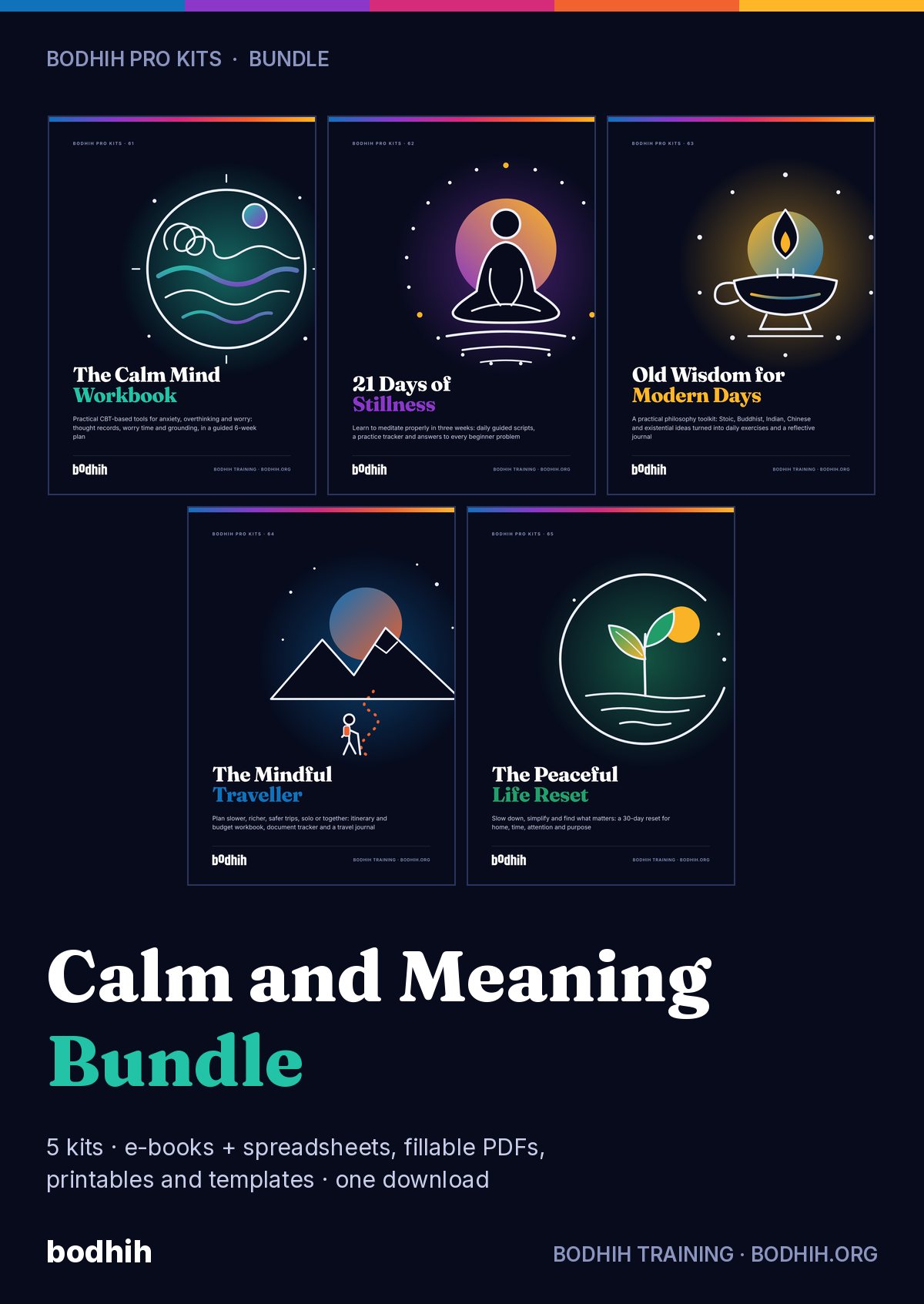
Old Wisdom for Modern Days turns Stoic, Buddhist, Indian, Chinese, Greek, African, existentialist and Japanese ideas into short daily exercises, a reflective journal and tools you will still be using next year. Secular, respectful and practical.
Old Wisdom for Modern Days · Bodhih Pro Kits · 63 by Bodhih Training, trainers to 2,000+ companies since 2008.
Pick one idea a week and attach it to a short daily practice: a two-minute morning intention and a three-minute evening review. Sort worries into what is yours and what is not, do the work and release the result, and review your day as a friend. The Old Wisdom for Modern Days kit from Bodhih Training supplies the exercises and tools.
Want the full free guide first? Read How to Apply Ancient Philosophy to Everyday Life: 7 Practices.
The weather, the client's mood, what a colleague thinks of you. You know worrying does not help, and you do it anyway, usually at 2 a.m. Then you are too tired for the one phone call that would have helped.
You underlined half of a famous Stoic paperback three years ago. It felt profound on the train. By Wednesday you were back to drafting furious replies in your head, because reading is not practising.
Social media philosophy is a sunset photo and a line somebody never said. You would like the real ideas, credited to the people who had them, explained without the fog.
There is always another upgrade, another title, another diagram telling you your purpose must also be your salary. You suspect the answer is simpler and closer, and you would like help finding it.
Imagine a Monday ten weeks from now. Before you open your inbox you take two minutes with your Daily Ledger: what is likely to test me today, which idea will I carry, what would a good version of me do at the hard moment? You write three lines, prop this week's Idea Card against your monitor, and notice that the day already feels a size smaller.
At 11.40 the awkward email arrives, as awkward emails do. As you sort it into what is yours and what is not, you find that only two parts are yours, and both are things you can do before lunch. You do them. The rest you let be what it is, on paper, where it cannot follow you home.
On Thursday you face a real decision. When you type your options into the decision lab and rate each one through six lenses, the workbook ranks them and names the weakest lens of each. It does not decide for you. It shows you what you already half knew, and you choose with your eyes open.
And on Sunday evening you open the Philosopher's Tracker and see ten weeks of your own practice: which ideas you return to, which virtue you keep dodging, how your days rate when you write the bookends. Whether you begin with tonight's three evening questions or with Chapter 1 tomorrow morning, the first step takes five minutes.
The e-book shows you how. The tools make it happen. Here is exactly what you download.
The guide: methods, worked examples, scripts and exercises
Daily practice log, weekly summary, ten-week programme, effort scorecard and a decision lab that ranks your options through six old-wisdom lenses, with a live dashboard.
An undated one-week set: seven morning intentions, seven evening reviews and a Sunday look-back. Fill on screen or print a fresh set each week.
The Stoic two-column sort for any worry: separate what is yours from what is not, commit to actions, and let the rest be.
Choose your top five values, map the roles you play and what each owes, and find your usual tilt on twelve virtues using Aristotle's mean.
A one-minute Stoic rehearsal of what could go wrong, paired with the gratitude it produces and a small-pleasures menu from Epicurus.
A guided five-part page that turns ten weeks of practice into a signed, one-page philosophy of your own, with a drafting page first.
Seven reflective prompts for each of the ten weeks, one per day, editable so you can type under each prompt or print and write by hand.
Ten ready-to-run 60-minute sessions for a philosophy circle, book club, team or family, with opening rounds, discussion questions and one exercise each.
All ten ideas with their tradition, plain meaning, question and exercise, plus the two daily bookends and a which-idea-for-which-mistake finder.
A reference table and timeline of the ten traditions: places, dates, key figures, texts and central concerns, checked against scholarly encyclopedias.
A pocket guide to seven difficult states with the first 60 seconds, the question to ask, first-minute scripts and clear signs of when to seek professional help.
Primary texts and reputable modern guides for each tradition, advice on choosing translations, free scholarly references and a reading plan. Dated October 2026.
Ten idea cards and ten matching practice cards to print, cut and carry: one tradition, one plain meaning, one question and one three-step exercise each.
Forty short prompts over ten weeks (Monday, Wednesday, Friday and a Sunday look-back) that import into Google Calendar, Outlook or Apple Calendar.
Each chapter opens with a real situation, gives you a method and ends with something to do today, using the tools in your kit.
Why philosophy began as practice, and the two-minute morning and three-minute evening habit that holds the kit together.
The Stoic dichotomy of control, plus rehearsing difficulty and the view from above.
Impermanence and non-attachment as ideas: care fully, grip loosely, in three sentences.
Karma yoga as philosophy: give the work everything and judge yourself on an effort scorecard.
Confucian ritual and roles: build character and relationships through one small, repeated ceremony.
Wu wei: effort without strain, and four questions for finding the gap when you are forcing.
Aristotle's doctrine of the mean: know your tilt and lean gently against it.
Ubuntu: a person is a person through other persons, with three questions for any room.
Epicurus on enough: sort your wants and build a small-pleasures menu.
Existentialist freedom and responsibility: rewrite your have-tos as choices and see which ring hollow.
Ikigai in its everyday Japanese sense, the truth about the four-circle diagram, and a pillars audit.
Turn ten weeks into a signed, one-page personal philosophy statement.
A field guide to anger, envy, fear, loss and ambition, with clear signs of when to seek professional help.
The week-by-week plan and reliable, free places to read further.
Every outcome is practised with a worked example and a tool, not just described.
People who measure before and after improve faster and can show it. AssessAll, our sister assessment platform, has AI-graded assessments that pair with this kit. Take one now, work through the kit, then re-take it.
Water is the favourite Taoist image. It is soft, it takes the low route, it goes round the rock, and given time it shapes the valley. Wu wei is the skill of the experienced sailor who reads the wind instead of rowing against it, or the good teacher who waits for the question instead of delivering the answer early. Modern life rewards pushing. More hours, more follow-ups, more force. Sometimes that is right. Often the pushing is the problem: the over-edited email, the micromanaged project, the conversation you keep steering until the other person stops talking. Wu wei is not laziness, and it is not passivity. The cook in the story is highly skilled; his ease is earned. Think of it as effort without strain.
| Free templates and typical advice | This kit | |
|---|---|---|
| Content | A blank journal with a quote on each page, often misattributed | Ten ideas explained in original words, with attributions checked against scholarly encyclopedias and no invented quotations |
| Range | Stoicism only, usually three Roman men | Stoic, Buddhist, Indian, Confucian, Taoist, Aristotelian, Ubuntu, Epicurean, existentialist and Japanese ideas, treated with respect |
| Method | Read, feel inspired, forget by Wednesday | One idea a week, two daily bookends, one ten-minute exercise per chapter and a calendar that prompts you |
| Tools | A PDF tracker with tick boxes | A workbook with working formulas, weekly summary, charts, effort scorecard and a decision lab that ranks options |
| Ikigai | The four-circle diagram presented as ancient Japanese wisdom | The honest history: a modern Western adaptation, plus the everyday Japanese sense and a pillars audit |
| Care | No mention of limits | Clear on what self-help cannot do, with signs of when to seek professional help and crisis signposting |
Bodhih Training has designed and delivered corporate programmes since 2008. Bodhih Pro Kits package what works in those workshops into a guide plus the exact tools we use, so you can apply it the same day without a facilitator in the room.
Name, email and country. UPI, card or netbanking in India; international cards everywhere else. No account to create.
Your download page opens at once, with every file and a one-click ZIP. A permanent link lands in your inbox too.
Start with the quick-start chapter, then the main spreadsheet or planner. Most buyers use something from the kit the same day.
You have already read more about wisdom than most people practise in a year. Open the Daily Ledger this evening, answer three questions, and let that be day one. Whether you begin with the bookends tonight or the Stoic sort tomorrow morning, an ordinary Tuesday is about to get a little wiser.
Personal licence for the buyer's own use (and use with your own team or clients where the kit says so). Please don't share or resell the files. Team and company licences: solutions@bodhih.com.
Recover energy and set limits at work.
Reduce screen time and reclaim attention.
250+ AI-graded assessments to measure skills and earn verified credentials.
Individual development plans that start from evidence and stay yours.
Run this topic as a live workshop for your team, in person or online.
Book a vetted coach for career, leadership or communication. Pay per session.
Certification pathways in Applied AI, Workplace English and management.
None. Each chapter starts with an everyday scene, explains where the idea comes from in a few paragraphs and moves straight to an exercise. If you can spare five minutes a day and twenty minutes a week, you can do the whole programme.
Start with the dichotomy of control. Write a worry in one sentence, split it into what is yours (your judgements, effort and next action) and what is not, then act on the first group and let the second be. Chapter 1 and the Dichotomy of Control Worksheet walk you through it, along with a one-minute rehearsal of difficulty and the view from above.
No. Several of the ideas come from living religious and cultural traditions, including Buddhism, Hinduism and Confucianism, and the kit treats them respectfully as ideas about how to live. It gives no religious instruction and makes no supernatural claims, and it contains no astrology or tarot. People of any faith or none can use it.
No. Old Wisdom for Modern Days is educational self-help. It is not therapy, counselling or medical advice and cannot replace professional care. If low mood, anxiety, anger or grief is seriously affecting your life, please speak to a doctor or qualified mental health professional, and in an emergency call your local emergency number or a local crisis helpline.
Keep it short and regular. Two minutes in the morning to name what may test you and the one idea you will carry, and three minutes at night to note what went well, where you fell short and one thing you are grateful for. The Daily Ledger gives you a reusable week, and the 70 Journal Prompts file is there for days when you want to write longer.
We deliberately avoid quotations and explain every idea in original wording, with credit to the thinker or tradition. Attributions and dates were checked against the Stanford Encyclopedia of Philosophy and the Internet Encyclopedia of Philosophy. Where scholars disagree, for example on the dates of the Buddha or the authorship of the Daodejing, the book says so.
Before week one, you may like to take the Decision-Making Style Assessment for Work and Personal Choices, the Critical Reasoning Assessment or Ethical Leadership and Judgment on AssessAll (assessall.com). They give you a baseline for how you decide and reason, which you can revisit after ten weeks of practice alongside your Philosopher's Tracker dashboard.
Use the Conclusion to write your one-page personal philosophy, then pick one behaviour to build. The Jobulary guide, Set goals you actually reach with the WOOP method, pairs well with the Stoic rehearsal exercise: you name the wish, the best outcome, the inner obstacle and an if-then plan.
Yes. The Philosophy Circle Discussion Guide contains ten complete 60-minute sessions, and you may run them with your own circle, team or clients under the personal licence. Each participant who wants their own copy of the files needs their own kit; for team and company licences write to solutions@bodhih.com.
Digital kits are non-refundable once downloaded. The exceptions are a corrupted file we cannot fix within 3 working days, a duplicate charge or a failed delivery. If anything will not open, write to us and we will put it right.
₹599 including 18% GST for buyers in India, or $17 for buyers outside India. One-time payment, no subscription, with an automatic invoice.
Instantly. Your download page opens the moment payment succeeds, and a permanent download link is emailed to you. Download each file separately or everything in one ZIP.
Any of the usual tools: Excel or Google Sheets for spreadsheets, Word or Google Docs for templates, Adobe Acrobat Reader, Preview, Xodo or GoodNotes for the fillable PDFs, and Google, Outlook or Apple Calendar for the calendar plan.
Because it is a digital download, kits are not refundable once downloaded. We always refund a duplicate charge or a failed delivery, and if a file is corrupted and we cannot fix it within 3 working days. Full terms: bodhih.org/refunds.
Yes. Team and company licences, and workshops on this topic run by Bodhih Training, are available. Write to solutions@bodhih.com or call +91 99000 11601.