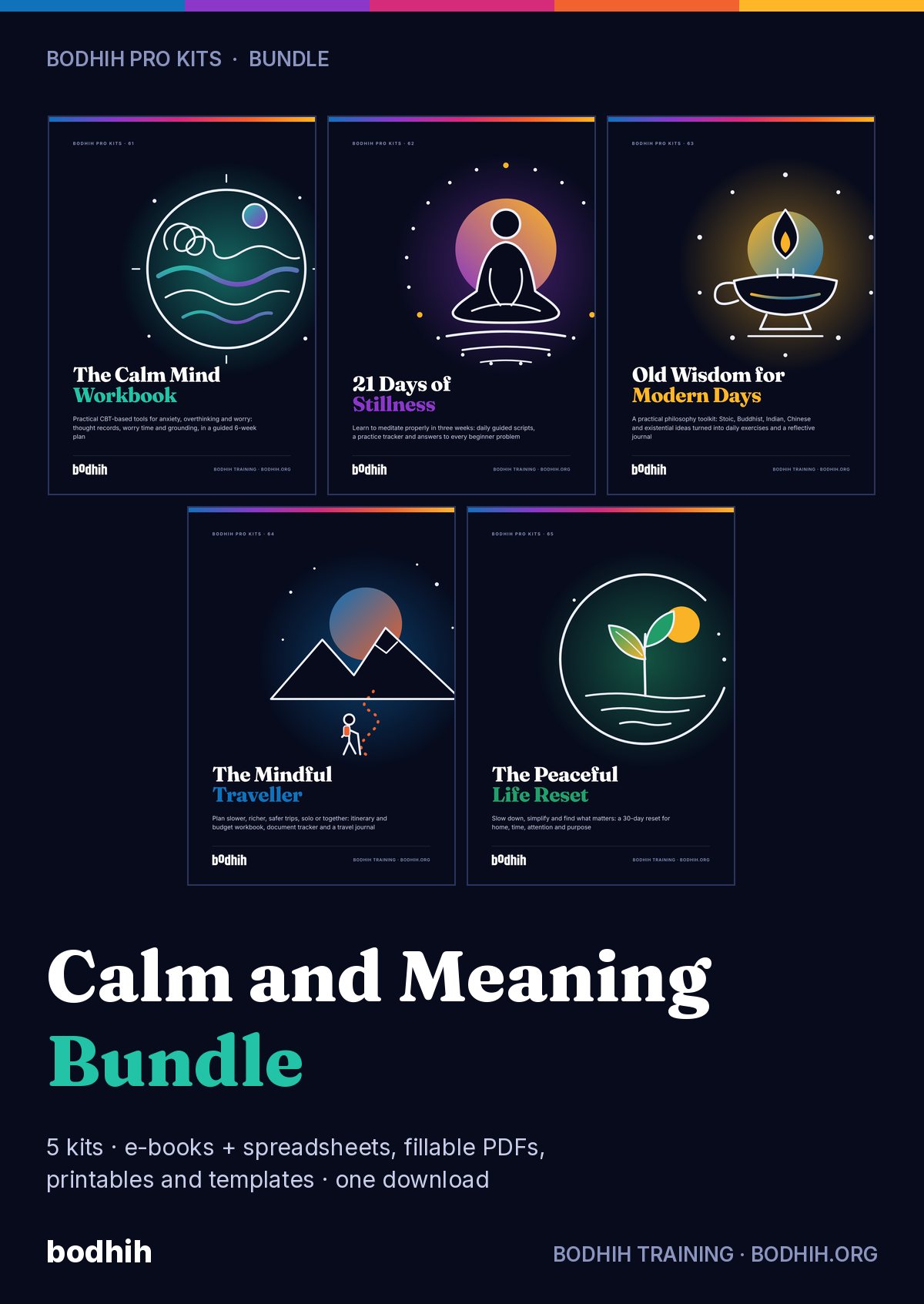
The Calm Mind Workbook teaches the core skills of cognitive behavioural therapy for everyday anxiety, worry and rumination, then hands you the worksheets, tracker, cards and six-week plan to practise them ten minutes a day.
The Calm Mind Workbook · Bodhih Pro Kits · 61 by Bodhih Training, trainers to 2,000+ companies since 2008.
Write the thought down and test it with a thought record, sort worries with the worry tree, postpone the rest to a daily 15-minute worry time, face avoided situations in small steps and calm the body with slow breathing. The Calm Mind Workbook kit from Bodhih Training teaches each skill and supplies the worksheets and tracker to practise them.
Want the full free guide first? Read How to Stop Overthinking and Worrying: 7 CBT Techniques That Help.
You wake in the small hours and your mind convenes a meeting about money, health, work and that thing you said on Tuesday. By morning you are tired and a little ashamed of how much time you spent on things that mostly won't happen.
You have tried a thought record. Seven empty boxes, no example, no idea what counts as evidence or what a balanced thought should sound like. So it went in a folder with the others.
You can spend eleven evenings going over the same decision without making a list or a phone call. It feels responsible. It leaves you exactly where you started, only more tired.
You text when you could ring, stay quiet when you have a question, and say no to things you would enjoy. Each small avoidance brings relief today and makes tomorrow's version harder.
Imagine a Monday three weeks from now. An email lands that says only 'Can we talk later?' and you feel the familiar drop in your stomach. This time you notice the thought, name the trap, and as you open the thought record and fill in the evidence columns, the certainty of disaster loosens into something closer to the truth: probably routine, manageable either way.
Picture the evening. A what-if arrives while you are cooking, and you note it in four words and tell it, 'Not now. 6.30.' When your worry time comes, you find that half the list has gone flat by itself. You run the rest through the worry tree, book the one thing that needs booking, and close the log.
Now it is week five. You are standing outside a meeting room with a pocket card in your hand, breathing out for a count of six. You ask the question you would normally swallow. Nobody minds. That night you log the experiment in your tracker and watch the Tool results sheet quietly tell you which three tools work best for you.
Nobody can promise the committee will stop meeting, and results differ from person to person. What you will have is a Weekly trend chart built from your own numbers, so you can see for yourself what is shifting, and a plan for what to do the next time it wobbles.
The e-book shows you how. The tools make it happen. Here is exactly what you download.
The guide: methods, worked examples, scripts and exercises
Daily anxiety log with thinking-trap and tool dropdowns, a Tool results sheet that ranks what lowers your anxiety most, weekly trend, worry log, exposure ladder, sleep and caffeine experiment, Decision lab and dashboard.
The classic CBT thought record with a fully worked example, coaching notes for each column and three blank records to fill in on screen or print.
Sort each worry with three questions, park the rest until a daily 15-minute worry time, and record how many still mattered when you got there.
Turn an anxious belief into a testable prediction, run a small real-world test and record what you learned, with a planner for your next three experiments.
Build an 8 to 10 rung ladder towards something you have been avoiding, rate each rung from 0 to 100 and log every climb.
The six-step problem-solving routine on two pages, with a two-minute rumination check and an options table for stuck decisions.
A three-zone relapse-prevention plan: what keeps you steady, your early warning signs with if-then responses, and who you will contact if you need more help.
Every trap on one reference: what it is, how it sounds and a fair reply you can borrow.
Five body-first techniques for when the alarm is loud, with exact steps, timings and three rules for using them well.
A one-page test that tells you in two minutes whether you are thinking usefully or going in circles, and what to do next in each case.
Clear signs that self-help is not enough, where to start in any country, questions to ask a therapist and what to do in a crisis.
118 honest coping statements sorted into twelve situations, plus the three-step pause and a rewrite-the-critic table, all editable in Word or Google Docs.
24 illustrated cards to print and cut: six each for breathing, grounding, body and mind, with exact steps and timings.
36 daily ten-minute practices and six weekly reviews (42 prompts in all) that import into Google, Outlook or Apple Calendar, following the six-week plan in Appendix A.
Each chapter opens with a real situation, gives you a method and ends with something to do today, using the tools in your kit.
See how thoughts, feelings, body sensations and actions feed each other, and map your own loop in seven steps.
Learn the dozen predictable ways an anxious mind bends the facts, and the catch, name, reply routine that loosens them.
Put a sticky thought on trial with the seven-column record, a full worked example and fixes for the five common mistakes.
Sort every worry with three questions and park the rest until a daily 15-minute appointment.
Tell circular thinking from useful thinking in two minutes, work the six problem-solving steps and get a stuck decision moving.
Turn anxious beliefs into predictions and test them in the real world with direct tests, surveys and dropped safety behaviours.
Understand why avoidance grows fear, then build and climb a graded exposure ladder one repeatable rung at a time.
Five body-first techniques for loud moments: slow breathing, the longer exhale, 5-4-3-2-1, muscle relaxation, cool water and movement.
Run a simple two-week experiment on caffeine and sleep, and steady the everyday basics that turn the alarm up or down.
Replace the inner critic with a coach using the three-step self-compassion pause and honest coping statements.
Every outcome is practised with a worked example and a tool, not just described.
People who measure before and after improve faster and can show it. AssessAll, our sister assessment platform, has AI-graded assessments that pair with this kit. Take one now, work through the kit, then re-take it.
Maria works in customer support in Manila and hasn't made a phone call she could avoid in two years. She texts, emails, uses the app, asks her sister to ring the dentist. Each avoided call brings a small wash of relief. And each one makes the next call a little more unthinkable. Avoidance is the engine of anxiety. It works in the short term, which is the problem. Relief is a reward, and whatever gets rewarded gets repeated. Meanwhile your alarm system draws the only conclusion available: "We escaped, so it must have been dangerous." The feared thing grows and life shrinks around it. The way out is the oldest finding in the field: approach the feared thing gradually, on purpose, and stay long enough to learn that you can handle it. This is graded exposure.
| Free templates and typical advice | This kit | |
|---|---|---|
| Guidance | Blank worksheets with a one-line description | A full method for every tool, worked examples and the common mistakes to avoid |
| Tracking | A mood tracker that records how you feel | A tracker that works out which tools lower your anxiety most and ranks them |
| Structure | A pile of printables and no starting point | A six-week plan in your calendar, ten minutes a day, with weekly reviews |
| In the moment | A paragraph telling you to breathe | 24 pocket cards with exact steps and timings, plus a one-page technique card |
| Safety | Little or nothing on limits | Clear guidance on when to seek professional help, crisis signposting and when not to work alone |
| Where it works | Often assumes one country's services | Globally neutral: no local assumptions, with space for your own numbers and services |
Bodhih Training has designed and delivered corporate programmes since 2008. Bodhih Pro Kits package what works in those workshops into a guide plus the exact tools we use, so you can apply it the same day without a facilitator in the room.
Name, email and country. UPI, card or netbanking in India; international cards everywhere else. No account to create.
Your download page opens at once, with every file and a one-click ZIP. A permanent link lands in your inbox too.
Start with the quick-start chapter, then the main spreadsheet or planner. Most buyers use something from the kit the same day.
Whether you begin with one row in the tracker tonight or your first thought record tomorrow morning, you can start practising a calmer way of thinking today. Download the kit, open the Start here sheet, and give it ten minutes a day.
Personal licence for the buyer's own use (and use with your own team or clients where the kit says so). Please don't share or resell the files. Team and company licences: solutions@bodhih.com.
Recover energy and set limits at work.
Reduce screen time and reclaim attention.
250+ AI-graded assessments to measure skills and earn verified credentials.
Individual development plans that start from evidence and stay yours.
Run this topic as a live workshop for your team, in person or online.
Book a vetted coach for career, leadership or communication. Pay per session.
Certification pathways in Applied AI, Workplace English and management.
No. The Calm Mind Workbook is educational self-help based on widely taught CBT skills. It does not diagnose or treat any condition, and Bodhih is a training company, not a clinic. If anxiety is seriously affecting your life, please speak to a doctor or qualified mental health professional, and in a crisis contact your local emergency number or a local helpline.
Keep a notepad by the bed and give any thought four words on paper, then leave it for daylight. Move your worrying to a 15-minute worry time earlier in the evening, and if you have been awake for a while, get up and sit somewhere dim until you feel sleepy. Chapters 4 and 9 walk you through each step.
A thought record is a CBT worksheet that tests an upsetting thought against evidence. You write the situation, your feelings, the hot thought, evidence for, evidence against, a balanced thought and the outcome. The kit includes a fully worked example, coaching notes for every column and three blank records.
It is a short decision flow from the CBT tradition. You name the worry, ask whether you can do anything about it, and then either act now, plan when you will act, or let it go and refocus. The kit gives you a fillable worry tree, a worry-time log and a Worry log sheet in the tracker.
That varies from person to person and no result can be promised. The plan asks for about ten minutes a day over six weeks, and the tracker lets you see your own numbers week by week so you can judge for yourself what is helping.
Yes. Your Daily log gives you a personal baseline in the first week. If you also want a structured outside view, AssessAll offers the Resilience & Stress Management assessment, the Emotional Judgment Assessment with Confidence Calibration and the Behaviour Under Pressure Assessment for Working Professionals at assessall.com. They are optional and separate from this kit.
Use My Staying-Well Plan to write if-then responses for your early warning signs and book a monthly review. For more on making if-then plans stick at work, Jobulary has a useful guide to implementation intentions at jobulary.com.
Only the Pocket Grounding Cards benefit from printing, on A4 or US Letter with fit to page. The worksheets are fillable PDFs you can complete on screen, and the tracker opens in Excel, Google Sheets or LibreOffice.
No. It is secular and inclusive. A few ideas from world wisdom traditions, such as the Stoic distinction between what is and isn't up to us, appear as ideas to think with, with no religious instruction and no supernatural claims.
Digital kits are non-refundable once downloaded. The exceptions are corrupted files that are not fixed within 3 working days, duplicate charges or failed delivery. Write to solutions@bodhih.com and the team will help.
₹599 including 18% GST for buyers in India, or $17 for buyers outside India. One-time payment, no subscription, with an automatic invoice.
Instantly. Your download page opens the moment payment succeeds, and a permanent download link is emailed to you. Download each file separately or everything in one ZIP.
Any of the usual tools: Excel or Google Sheets for spreadsheets, Word or Google Docs for templates, Adobe Acrobat Reader, Preview, Xodo or GoodNotes for the fillable PDFs, and Google, Outlook or Apple Calendar for the calendar plan.
Because it is a digital download, kits are not refundable once downloaded. We always refund a duplicate charge or a failed delivery, and if a file is corrupted and we cannot fix it within 3 working days. Full terms: bodhih.org/refunds.
Yes. Team and company licences, and workshops on this topic run by Bodhih Training, are available. Write to solutions@bodhih.com or call +91 99000 11601.