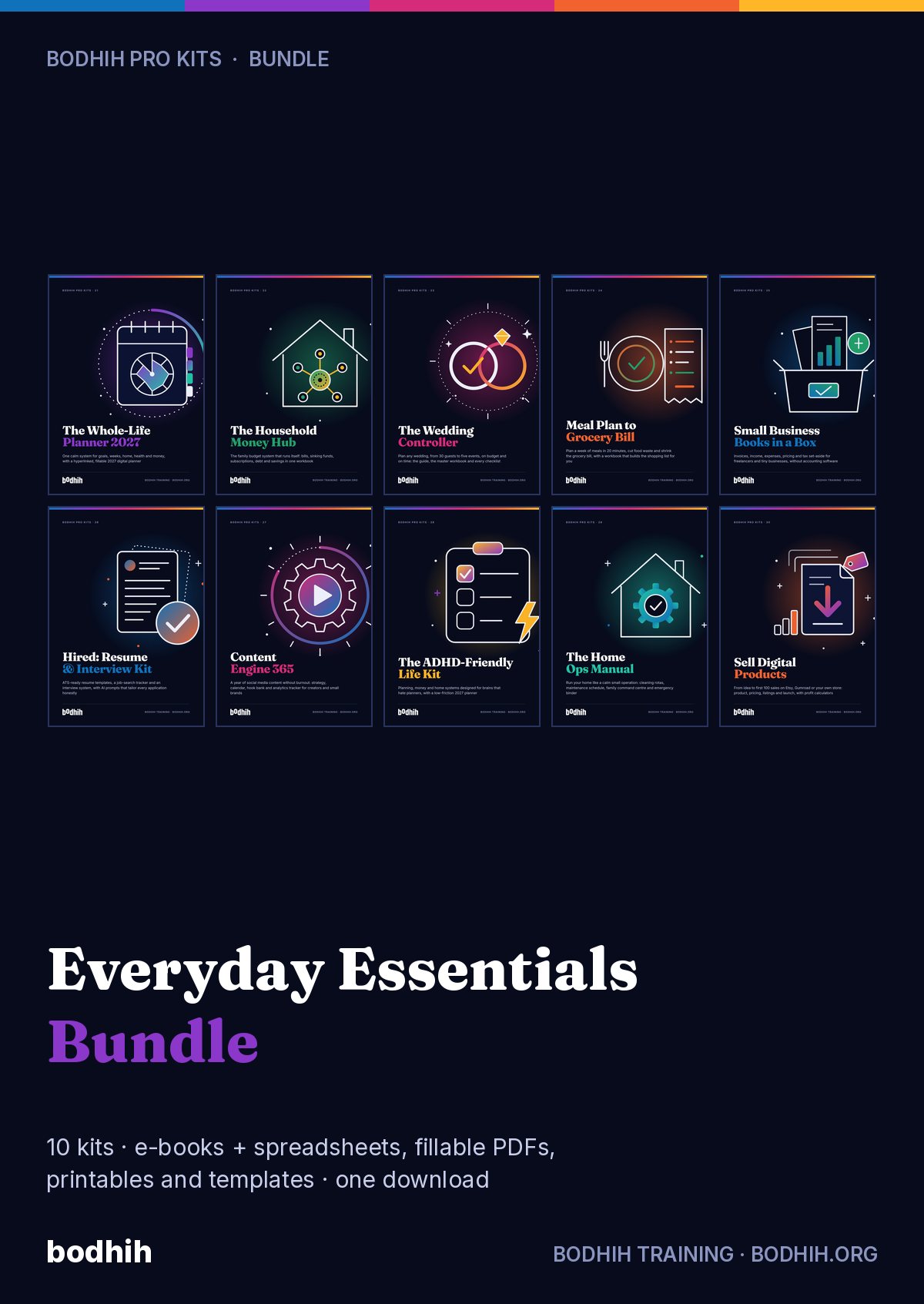
Meal Plan to Grocery Bill is a planning method plus a workbook that builds your shopping list for you: type seven recipe numbers, get a scaled, priced, pantry-aware list. Built for real households in any country, any currency and any cuisine.
Meal Plan to Grocery Bill · Bodhih Pro Kits · 24 by Bodhih Training, trainers to 2,000+ companies since 2008.
Plan once a week in five steps: check what you already have, mark busy and slow nights, slot meals that use up what you own, build one list, and post the plan on the fridge. The Meal Plan to Grocery Bill kit from Bodhih Training adds a workbook that turns your plan into a priced shopping list.
Want the full free guide first? Read How to Meal Plan for a Week and Cut Your Grocery Bill.
You are tired, everyone is hungry and nothing is thawed. So it is the corner shop or the delivery app again, and you pay extra for not having decided earlier.
The coriander for a dish you never made. The leftovers lost behind the milk. You are not careless; shopping and cooking were never connected.
The big shop looks reasonable. It is the top-up trips, the rescue takeaways and the duplicates that push the month over, and no receipt shows you that.
One vegetarian, one child who eats only plain food, one person who wants meat. Cooking separate dinners is exhausting, and nobody planned for it.
A blank grid does not tell you what to cook, what to buy or what it will cost. You filled it in once, and then life happened.
Imagine Saturday morning. You make a cup of tea, open the fridge and write down three things that need using up. You mark Tuesday and Thursday as busy nights. Then, as you type seven recipe numbers into the Week plan, the Grocery list quietly turns orange where something needs buying, already scaled for your household and priced in your own currency.
You notice the total before you leave the house. You notice that the rice you already own has been subtracted. When you print the fridge sheet and stick it on the door, something small but important changes: the question has an answer, at eye height, for the whole week.
Picture Thursday at seven. You are home late, and it does not matter, because Thursday says freezer night and the chilli you doubled last week is already thawed. Dinner is on the table in twelve minutes. Nobody opened an app.
And at the end of the month, when you open the Dashboard, you can see what you spent, what you binned and what each meal really cost. You may find yourself wondering why you ever did this from memory.
The e-book shows you how. The tools make it happen. Here is exactly what you download.
The guide: methods, worked examples, scripts and exercises
Type recipe numbers into the week and get a scaled, priced, pantry-aware shopping list, plus a 40-recipe bank, inventory with use-by alerts, spend and waste logs, a swap lab and a dashboard.
One fillable page for the fridge door: seven dinners, lunches, who cooks, the thaw and prep reminders and the use-it-up list.
A two-page fillable survey that turns everyone's likes, dislikes, allergies and wishes into your first 15 household recipes.
Plan a one-hour prep session: what to chop, cook and portion, in what order, with a cooling, labelling and storing checklist.
Plan a meal for guests without panic: headcount, dietary needs, a scaled menu, a work-back timeline and a budget.
Sixty dinner ideas sorted into six theme families, drawn from Indian, Western, East Asian, African, Middle Eastern and Latin American kitchens.
Dated general guidance on fridge and freezer times, what freezes well or badly, and safe cooling, thawing and reheating, with sources named.
A shared base plus staples for Indian, Western, East and Southeast Asian and African kitchens, with five buying rules.
Twenty-one common leftovers with three second lives each, plus the four-part remix formula.
Metric to US cups, spoons, ounces and oven temperatures, cup weights for common foods and uncooked portion amounts per adult.
The weekly plan on one page: the five timed steps, the Busy, Normal, Slow night matcher, five rescue plays and the base-and-branch table for mixed diets.
Eighteen editable prompts for ChatGPT, Gemini, Claude, Copilot or any assistant: plan from your pantry, scale recipes, build lunchboxes, cost a menu and remix leftovers.
Twenty calendar reminders over four weeks: the 20-minute plan, the shop, batch-prep hour, the midweek thaw check and the weekly review.
The same 40 recipes as a plain CSV for importing into any app, notes tool or AI assistant.
Each chapter opens with a real situation, gives you a method and ends with something to do today, using the tools in your kit.
Why dinner is five decisions pretending to be one, and how the kit's tools fit together.
The three leaks in every food budget (forgotten food, top-up shops, rescue meals) and a one-week check to find yours.
The five timed steps: look, calendar, slot, list, post, with a worked week and a rescue plan for when it falls over.
How theme nights shrink the choice and a family survey turns into fifteen recipes everyone accepts.
A use-it-up shelf, a dated inventory, first-in-first-out and a short staples list for four kitchens.
Cost per serving, setting up your prices once, a list that builds itself, shop tactics and the Swap lab.
Repeat, remix or bank: doubling the pot on purpose, cooking in components and the one-hour batch prep.
What freezes well and badly, four habits of a working freezer, and general thawing and reheating guidance.
The base-and-branch method for mixed diets, calm tactics for fussy eaters and treating allergies as rules.
Planning lunch at dinner, the four-part lunchbox, three rotating breakfasts and cheaper snacks.
The 1-2-1 menu, scaling for guests, a work-back timeline and a plan for the leftovers.
The ten-minute weekly review and the four monthly numbers that keep the habit alive.
A four-week ramp that adds one habit a week.
Fixes for the eight most common snags, from ignored plans to living alone.
Every outcome is practised with a worked example and a tool, not just described.
People who measure before and after improve faster and can show it. AssessAll, our sister assessment platform, has AI-graded assessments that pair with this kit. Take one now, work through the kit, then re-take it.
Sarah, a nurse in Leeds, tried meal planning three times before it worked. The first time she spent two hours on a Sunday with four cookbooks and produced a week of ambitious dinners, of which she cooked two. The second time she downloaded a pretty blank grid, filled it in once and never looked at it again. The third time she set a timer for twenty minutes and followed five steps in the same order every week. That version has now survived night shifts, school holidays and a broken oven. The difference was not effort. It was order. A plan that starts with recipes fails, because recipes are the fun part and they ignore the fridge and the calendar. A plan that starts with what you have and what your week looks like nearly writes itself.
| Free templates and typical advice | This kit | |
|---|---|---|
| Starting point | A blank weekly grid and good intentions | A five-step, 20-minute method that starts with your fridge and your calendar |
| Shopping list | You write it by hand from memory | Builds itself from recipe numbers, scaled to your household and minus what is in your pantry |
| Cost | No prices, or US dollars only | Cost per recipe, per serving and per week in any currency, with a budget dashboard |
| Cuisine | Western dinners, US cups | Indian, Western, East Asian, African, Middle Eastern and Latin American examples; metric with cup conversions |
| Food waste | Not mentioned | Use-by alerts, a waste log with reasons, a remix chart and a freezer guide |
| Real households | Assumes everyone eats the same thing | Base-and-branch planning for mixed diets, fussy eaters, allergies, lunchboxes and guests |
| Instructions | None | A Start here sheet, sample data throughout and a 10-chapter e-book |
Bodhih Training has designed and delivered corporate programmes since 2008. Bodhih Pro Kits package what works in those workshops into a guide plus the exact tools we use, so you can apply it the same day without a facilitator in the room.
Name, email and country. UPI, card or netbanking in India; international cards everywhere else. No account to create.
Your download page opens at once, with every file and a one-click ZIP. A permanent link lands in your inbox too.
Start with the quick-start chapter, then the main spreadsheet or planner. Most buyers use something from the kit the same day.
When you download Meal Plan to Grocery Bill, plan just four dinners this week and let the workbook write the list. Whether you start with the fridge sheet tonight or your prices in the workbook tomorrow, you will have taken the decision out of the tired end of the day.
Personal licence for the buyer's own use (and use with your own team or clients where the kit says so). Please don't share or resell the files. Team and company licences: solutions@bodhih.com.
Projects, habits, HR, careers, communication and more.
Five Professional Playbooks for the AI-era workplace.
250+ AI-graded assessments to measure skills and earn verified credentials.
Individual development plans that start from evidence and stay yours.
Run this topic as a live workshop for your team, in person or online.
Book a vetted coach for career, leadership or communication. Pay per session.
Certification pathways in Applied AI, Workplace English and management.
Every recipe in the Recipe bank has a number and a short list of main ingredients. When you type recipe numbers into the Week plan, the Grocery list adds up each ingredient across the week, scales it to the number of people you feed, subtracts matching items in your Pantry sheet, rounds packs up to whole units and multiplies by your prices. You type recipe numbers; there are no macros.
Yes. The workbook has no currency symbols. You overwrite the sample prices once with what you pay, in rupees, pounds, dollars, naira, shillings, dirhams or anything else. Quantities are metric, and a Converter sheet and Kitchen Conversions Card handle US cups, ounces and pounds.
Follow the five steps in Chapter 2: look at what you have, mark busy and slow nights, slot meals, build the list, post the plan. Start with four dinners, not seven. Appendix A gives a four-week ramp that adds one habit a week.
Close the three leaks: food you bin, top-up shops and unplanned takeaways. Planning from your pantry, shopping from one list and keeping two meals in the freezer can save more than hunting for cheaper brands. The Swap lab sheet ranks your own ideas by yearly saving so you can see what is worth the effort. Results depend on your household, and we make no savings guarantee.
No. The kit is educational and about planning, shopping and budgeting. It contains no calorie counts or health claims and is not dietary, medical or professional food-safety advice. Freezer and storage times are general guidance with sources named; check your national food-safety agency, and ask a doctor or dietitian about allergies or medical diets.
Yes, as many as you like. Add a row in the Recipe bank with the next free number, then list its main ingredients and quantities on the Recipe ingredients sheet. The cost per serving and the shopping quantities then calculate themselves. Entering fifteen favourites takes roughly an hour.
Chapter 8 teaches the base-and-branch method: one shared base with small add-ons, so you cook once. It also covers low-pressure habits for cautious eaters, drawing on general NHS guidance, and how to handle allergies as firm rules. Every recipe carries a diet tag so you can balance the week.
Yes. Upload the workbook to Google Drive and open it with Sheets; the formulas, dropdowns and colour rules carry across. You can tick items as Bought on your phone in the shop. The PDFs fill in on screen or print on A4 or US Letter.
If you are curious about your starting point, AssessAll offers three relevant assessments: Time, Priorities and Focus; Estimation and Number Sense; and the Plan Strength Assessment with an Eight-Week Re-Measure. They are optional and separate from the kit, and the re-measure is a neat way to see whether the weekly habit has stuck.
Tie it to a fixed day, use the calendar reminders for the first four weeks, and write an if-then plan for the evening things go wrong. Jobulary's article on if-then plans explains the technique and shows how to turn it into a small development plan you can use well beyond the kitchen.
Digital kits are non-refundable once downloaded. The exceptions are a corrupted file we cannot fix within 3 working days, a duplicate charge or a failed delivery. Write to solutions@bodhih.com and we will sort it out.
₹499 including 18% GST for buyers in India, or $15 for buyers outside India. One-time payment, no subscription, with an automatic invoice.
Instantly. Your download page opens the moment payment succeeds, and a permanent download link is emailed to you. Download each file separately or everything in one ZIP.
Any of the usual tools: Excel or Google Sheets for spreadsheets, Word or Google Docs for templates, Adobe Acrobat Reader, Preview, Xodo or GoodNotes for the fillable PDFs, and Google, Outlook or Apple Calendar for the calendar plan.
Yes. Team and company licences, and workshops on this topic run by Bodhih Training, are available. Write to solutions@bodhih.com or call +91 99000 11601.