The job: Lead with fairness and listening, using Ptahhotep's advice
Lead with truth, balance and a listening ear: Ptahhotep's advice, built for modern teams
The Instruction of Ptahhotep and the Egyptian idea of Ma'at turned into an evening balance check, a petitioner protocol for every request and complaint, a team ethics code in your own words and a 12-week programme.
- A 10-chapter e-book with 56 verbatim quotations from public-domain translations (Gunn 1906, Budge 1920) and Bodhih's own plain-words renderings
- Two Excel workbooks: a 9-sheet practice workbook with streak counter and dashboard, and the Balance Ledger for evening checks, requests and complaints, and your team code
- 5 fillable forms and 7 Word templates, including 40 scripts, a workshop guide, a team ethics code, an instruction letter, 52 team emails and 27 AI prompts
- A 52-card practice deck, 3 cheat sheets, a Start Here map, a 55-event calendar and a 34-task board import
Ma'at and Ptahhotep: Leadership from Ancient Egypt · Bodhih Pro Kits · 149 by Bodhih Training, trainers to 2,000+ companies since 2008.
Pick this kit when: listen better to requests and complaints from my team; use leadership lessons from ancient Egypt at work.
What can leaders learn from Ptahhotep and Ma'at?
The Instruction of Ptahhotep advises leaders to stay humble about their knowledge, hear people's requests and complaints fully, speak less and without heat, avoid grasping and treat those who serve with them generously. Ma'at adds truth, fairness and balance. Bodhih Training's Ma'at and Ptahhotep kit turns these into daily practices and tools.
Want the full free guide first? Read Leadership Lessons from Ptahhotep and Ma'at: A Guide for Managers.
You already feel the problem. Here is what it is costing you.
Answering before they finish
You know the rule by the third sentence, so you say it. People leave with the right answer and still feel unheard, and the same complaint comes back louder.
Small tilts nobody mentions
A sharp word to a junior, a promise you half knew was wrong, a rule applied to one team and not another. None of it is a crisis, and it adds up.
Numbers that lean
A forecast nudged, a late case reclassified, a status softened. Nobody calls it dishonest, and the team quietly learns what kind of numbers these are.
Credit that flows upward
The idea came from a junior designer or a night-shift agent. By the time it reaches the board pack, it belongs to the leader.
A code nobody reads
The company code of conduct is forty pages long. Your team needs six lines it wrote itself and actually checks.
Judgement that leaves with you
Years of decisions live in your head. If you were away tomorrow, nobody would know how you decide.
Picture the next few weeks with the kit open beside you.
Picture this evening at 18:15. Before you log off, you write two lines: one thing you set right today, one thing you tipped out of balance. You score four weights and write one small repair. Five minutes, and tomorrow already has a plan.
Now it is mid-morning and someone brings you a complaint. You put the phone face down and let them finish. You ask whether there is anything else, and the real point arrives. As you give your answer with a reason and a date, you notice the conversation is shorter than the ones you used to have.
Imagine the end of week five. Your team has turned a list of ancient declarations into six plain lines about how you work: honest numbers, hearing people out, credit to the source. Everyone signed it, and the first monthly review is already in the calendar.
And picture week twelve. You open the Balance Ledger: your lightest weight has risen, overdue follow-ups are down, the team code scores are climbing. Whether you begin with the e-book tonight or the balance check before you log off, the practice is already in your calendar.
22 files that do the work for you
The e-book shows you how. The tools make it happen. Here is exactly what you download.
Ma'at and Ptahhotep: Leadership from Ancient Egypt (e-book, PDF)
The guide: methods, worked examples, scripts and exercises
Start here map
The daily, weekly and monthly rhythm on one page, which file to open for each leadership moment, your first hour and a 30/60/90 day use plan.
Ma'at Leadership Practice Workbook
Nine-sheet master workbook: settings, 20-principle library, daily practice log with streak counter, weekly review and humility check, situations log, monthly team pulse, 12-week programme tracker and a dashboard with a balance-by-week chart.
Balance Ledger workbook
The kit's signature diagnostic: an evening balance check log with four weights, a balance score and repairs; a petitioner log for requests and complaints with heard-fully scores and follow-up status; a team ethics code tracker with monthly scores; and a dashboard.
Evening balance check (a week per page)
Three fillable pages: a week of five-minute evening balance checks on one page, a weekly summary with the four weights, and a repair log.
Petitioner protocol: hearing a request or complaint
Two-page fillable protocol for every request or complaint: prepare, let them finish, reflect back, answer with a reason, and follow up, plus a ten-line log.
Humility check: whose idea did I learn from?
Two-page fillable weekly humility check: whose ideas I learned from, credit given, where my knowledge made me deaf, and a quarterly credit audit.
Mentoring a successor: the instruction letter
Three fillable pages: choosing what to pass on, a six-session mentoring plan with your successor, and a one-page draft of your instruction letter.
Speaking and silence: before a hard meeting
Two-page fillable preparation for a difficult meeting: when to speak and when to keep silent, the one point to make, heat triggers, and a short debrief.
Leadership scripts and messages
40 exact-words scripts and messages for hearing requests and complaints, saying no, meetings, disagreeing up and across, honest numbers, confidences and credit, each with when to use it and what to do next.
Team workshop facilitator guide
Facilitator guide for a 90-minute session and a half-day workshop: hearing each other fully, speaking and silence, and drafting a Ma'at-inspired team ethics code in your own words, with timings, slide outline, exercises and debrief questions.
Our team ethics code (Ma'at-inspired, our own words)
One-page team ethics code to adopt in a workshop, written in your own words and inspired by the old Egyptian declarations, with a monthly review table and a note on what the code does and does not replace.
Principle of the week: 52 team emails
52 short team emails or chat posts (one per card), each with a subject line, one principle, one question and one action, ready to send every Monday.
Instruction letter template: your leadership instruction for your successor
A ready-to-edit letter template for writing your own leadership instruction to the person who will follow you, with prompts for each section and a short example.
AI prompt pack for Ma'at leaders
27 tool-agnostic prompts grouped by leadership moment, each with what to paste in and what to check before using the output.
Worked example pack: Daniel's 12 weeks
The kit's main forms completely filled in for one composite leader: evening balance checks, petitioner protocol, humility check, speaking and silence preparation, the team ethics code, the mentoring plan and instruction letter, and his week-12 dashboards.
All principles on one page, and about the sources
All 20 principles with source and plain words, the four weights of the balance check, and a card on the texts and translations used and how to read them.
Situation finder decision card
If this happens, use this: 16 leadership moments with the principle, the file to open and the first move.
Misreadings and mistakes card
Eight harmful misreadings of Ptahhotep and Ma'at at work, ten practice mistakes and a Friday self-check.
Ma'at practice card deck
52 printable practice cards in four suits, one principle per card with a verbatim source line or an In plain words line, a question and a one-line action, plus a how-to page.
12-week programme calendar
55 calendar events: set-up, a Monday card-and-chapter reminder, each programme action and a Friday review for all 12 weeks, each naming the file to open.
12-week programme task board import
34 programme actions as a CSV for Trello, Asana, Notion, Planner or Jira, with week, focus, file to open and due date.
Chapter by chapter
Each chapter opens with a real situation, gives you a method and ends with something to do today, using the tools in your kit.
- Format
- PDF e-book + XLSX + fillable PDF + DOCX + printable PDF + ICS + CSV
- Files
- 22 files plus a one-click ZIP
- E-book
- 68 pages
- Workbooks
- 9 and 6 sheets with sample data, formulas and dashboards
- Works with
- Excel, Google Sheets, LibreOffice, Word, Google Docs, Acrobat Reader, GoodNotes, Google Calendar, Outlook, Apple Calendar, Trello, Asana, Notion, Planner, Jira
- Best for
- Managers and leaders who hear requests and complaints, make fairness calls and want a shared ethical standard
A Feather on the Scale
A rota call that went wrong, the Instruction of Ptahhotep and the idea of Ma'at, the daily engine, and a note on the sources and translations used.
Ma'at at Work: The Evening Balance Check
Ma'at as a working principle and the five-minute evening balance check: set right, tipped, four weights, one repair.
The Petitioner Protocol
Ptahhotep's advice on hearing a petition turned into a five-step protocol for every request and complaint.
Humility: Whose Idea Did I Learn From?
Learning from every rank, crediting ideas to their source, and the weekly 'whose idea did I learn from?' check.
Speaking and Silence
Saying less, later and without heat, and knowing when silence would be wrong.
From Old Declarations to Our Team Ethics Code
The declarations of Chapter 125 read as historical evidence of values, and turned into a one-page team code in your own words.
Up, Across and Down
Four rules for four directions: senior colleagues, peers, juniors and the newly promoted.
Leading Many Fairly
Agreed rules actually followed, favours handed out sparingly, judgement without sides and no rule by fear.
Against Grasping: Shares, Credit and Control
A monthly audit of the credit, resources and control you hold, and giving back what is not yours to keep.
Generosity and Rest
Treating the people who serve with you generously, protecting the overloaded and keeping enough rest to judge well.
Instructing a Successor
Teaching the judgement behind your role in six sessions and writing a one-page instruction letter.
Keeping the Balance
How the twelve weeks run, what to do when you miss days, and the closing review.
Misreadings, Hard Passages and Getting Support
Passages we do not use, misreadings that do harm, invented quotations and when to get support.
Reading the Old Translations
Four tips for reading Gunn's and Budge's translations, and how the dates and numbering work.
Not just reading. Tools you will actually open again.
E-book
- Ma'at and Ptahhotep: Leadership from Ancient Egypt: 10 chapters, introduction, conclusion, 2 appendices and 6 hand-drawn figures, about 10,500 words (PDF)
Start here
- 00-Start-Here-Map: the daily, weekly and monthly rhythm, which file to open for each leadership moment, your first hour and a 30/60/90 day plan
Spreadsheets
- Ma'at Leadership Practice Workbook (9 sheets): Start here, Settings, Principles library of 20, Daily Log with streak counter, Weekly Review and humility check, Situations Log, Team Pulse, Programme Tracker and a Dashboard with a balance-by-week chart
- Balance Ledger (6 sheets): evening balance check with four weights and repairs, petitioner log for requests and complaints with follow-up status, team ethics code tracker and a dashboard
Fillable PDF forms
- Evening balance check (a week per page)
- Petitioner protocol: hearing a request or complaint
- Humility check: whose idea did I learn from?
- Mentoring a successor: the instruction letter
- Speaking and silence: before a hard meeting
Word templates
- Leadership scripts and messages: 40 scripts
- Team workshop facilitator guide: 90-minute and half-day versions
- Our team ethics code (Ma'at-inspired, our own words): one page with monthly review
- Principle of the week: 52 team emails
- Instruction letter template for your successor
- AI prompt pack for Ma'at leaders: 27 prompts
- Worked example pack: Daniel's 12 weeks, the main forms filled in
Cheat sheets
- All 20 principles on one page, and about the sources
- Situation finder decision card: if this happens, use this
- Misreadings and mistakes card
- Ma'at practice card deck: 52 cards in four suits plus a how-to page (14 printable pages)
Calendar and import
- 12-week programme calendar (ICS): 55 events for Google Calendar, Outlook or Apple Calendar
- 12-week programme task board (CSV): 34 tasks for Trello, Asana, Notion, Planner or Jira
When you have worked through it, you will be able to…
Every outcome is practised with a worked example and a tool, not just described.
- Run a five-minute evening balance check on truth, fairness, restraint and hearing, and make small repairs soon
- Hear any request or complaint fully, then answer with a reason and a follow-up date you keep
- Notice whose ideas you learn from each week and make sure the credit lands with them
- Prepare for hard meetings with one point, a plan for silence and a first steady sentence
- Lead your team in writing a one-page ethics code in its own words, and review it monthly
- Disagree upward without heat, correct peers privately and never talk down to juniors
- Audit the credit, resources and control you hold, and protect overloaded colleagues
- Teach a successor the judgement behind your role and write your own instruction letter
Know your starting point. Prove your progress.
People who measure before and after improve faster and can show it. AssessAll, our sister assessment platform, has AI-graded assessments that pair with this kit. Take one now, work through the kit, then re-take it.
Workplace Listening Assessment for Employees, Managers and Support Teams
Take the assessment →AssessAll assessmentEthical Leadership & Judgment
Take the assessment →AssessAll assessmentMentoring & Sponsorship
Take the assessment →JobularyTurn what you learn into a measured development plan (Jobulary)
Make it a growth plan →A taste of Chapter 2
Wanjiru tries the protocol with the young woman sent between three desks. She lets her finish: the woman applied for a food kiosk permit in March, paid twice because the first receipt was lost, and has been told by each desk that the problem belongs to another. "Anything else?" A pause. "My stall is already built. I'm paying rent on it." Reflect back: "So you've paid twice, nobody owns your file, and you're losing money every week the permit is delayed." Yes. Answer: partly. Wanjiru cannot refund the second payment herself, but she can take ownership of the file, issue the permit today and send the refund request to finance with a note. Follow up: Friday, by phone. It took eighteen minutes, and the woman did not come back the next Tuesday.
The honest comparison
| Free templates and typical advice | This kit | |
|---|---|---|
| The ideas | Inspirational 'ancient wisdom' quotes | 56 verbatim quotations with sources, each turned into a method with steps and a worked example |
| The sources | Unattributed lines, often modern inventions | Word-for-word public-domain translations (Gunn 1906, Budge 1920), cited by section |
| Daily practice | "Reflect on your day" | An evening balance check with four weights, a Daily Log with streak counter and a weekly review |
| Complaints | "Be a good listener" | A five-step petitioner protocol, a log with follow-up status and 40 scripts |
| Ethics | A long code of conduct | A one-page team code in your own words with monthly scores |
| Cautions | Uncritical praise of the ancients | A 'What this does not mean' box in every chapter and an appendix on passages we do not use |
Made for you if…
- Managers, team leads and supervisors who handle a steady stream of requests, complaints and decisions
- Founders and heads of function who want a simple ethical standard their teams can share
- Leaders in operations, public service, healthcare, retail, education and professional services
- HR and L&D leaders looking for a structured listening, ethics and succession programme for managers
- Senior professionals preparing a successor or deputy
- Leaders of any faith or none: the kit is philosophy and heritage for work, not religion
Probably not for you if…
- Readers wanting an academic study of Egyptology: the history is brief and modest, and the focus is practice
- Anyone looking for spiritual or religious instruction: the kit teaches no belief, ritual or practice
- People looking for a script to make teams obey: the kit argues for disagreement without heat, not obedience
Built by trainers, tested in real rooms.
Bodhih Training has designed and delivered corporate programmes since 2008. Bodhih Pro Kits package what works in those workshops into a guide plus the exact tools we use, so you can apply it the same day without a facilitator in the room.
From here to using it in three steps
- STEP 1
Tap Get the kit
Name, email and country. UPI, card or netbanking in India; international cards everywhere else. No account to create.
- STEP 2
Download instantly
Your download page opens at once, with every file and a one-click ZIP. A permanent link lands in your inbox too.
- STEP 3
Open the first tool
Start with the quick-start chapter, then the main spreadsheet or planner. Most buyers use something from the kit the same day.
Tonight, check the balance. Tomorrow, let someone finish.
Open the Start Here map, type your start date into the Settings sheet and put the evening balance check where you will see it before you log off. Whether you start with the e-book tonight or the petitioner protocol on tomorrow's first complaint, the practice begins the same day.
Personal licence for the buyer's own use (and use with your own team or clients where the kit says so). Please don't share or resell the files. Team and company licences: solutions@bodhih.com.
What buyers say
No ratings yet. Only people who have bought this kit can rate it - every buyer gets a one-click rating link a couple of days after their purchase.
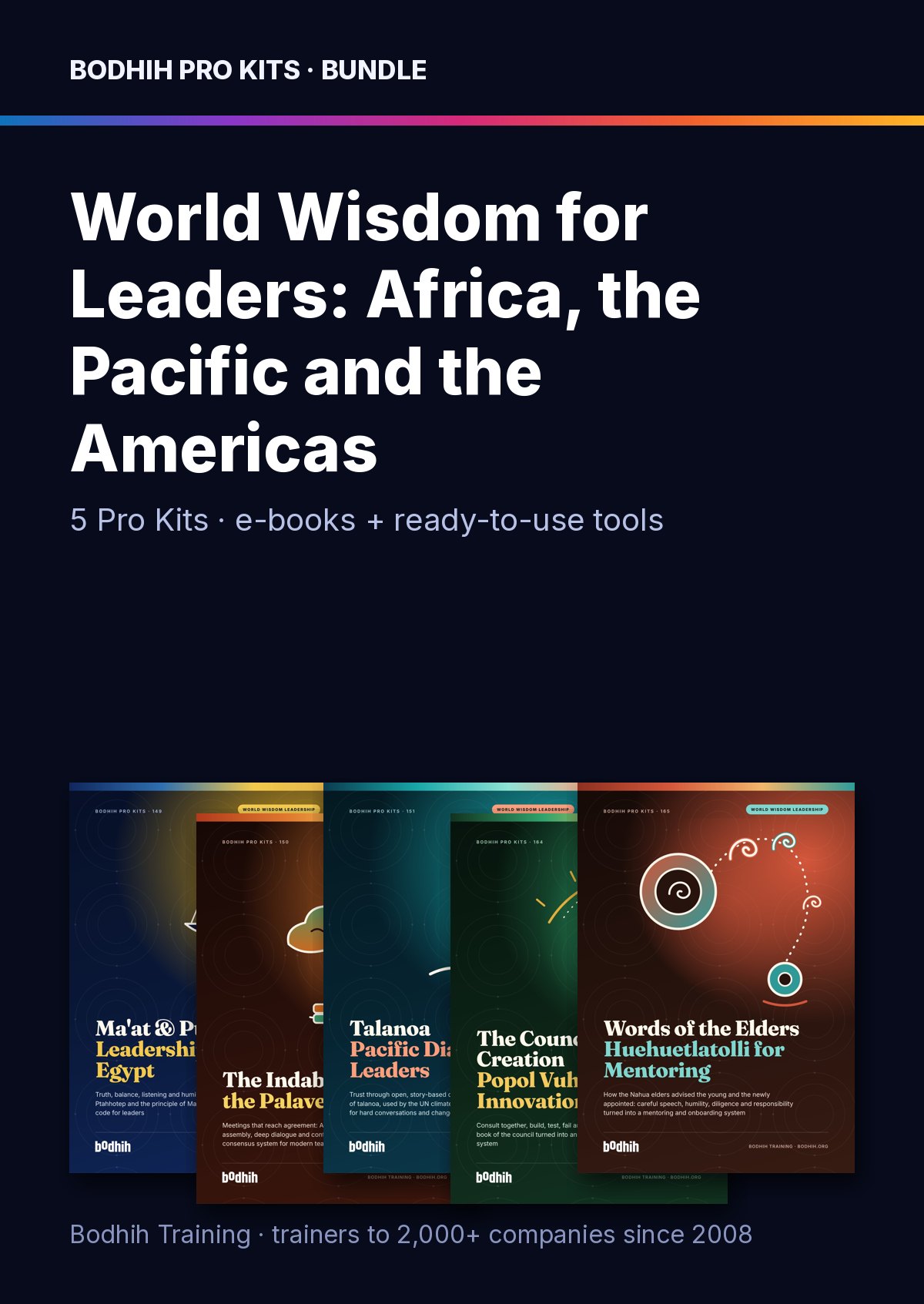
The Bodhih family, when you are ready for more
The Indaba and the Palaver Tree: Consensus Leadership
Meetings that reach agreement.
Talanoa: Pacific Dialogue for Leaders
Trust through open, story-based dialogue.
The Gita Leader
A daily operating system for decisions, duty and calm under pressure, built from the 18 ch.
Old Wisdom for Modern Days
Ten philosophies for everyday life.
AssessAll
250+ AI-graded assessments to measure skills and earn verified credentials.
Jobulary
Individual development plans that start from evidence and stay yours.
Bodhih Training
Run this topic as a live workshop for your team, in person or online.
Pewple
Book a vetted coach for career, leadership or communication. Pay per session.
Bodhih.org pathways
Certification pathways in Applied AI, Workplace English and management.
Ma'at and Ptahhotep: Leadership from Ancient Egypt: FAQs
Read the free guideAlready bought? Resend my linkIs this a religious book?
No. It is philosophy and heritage put to work in leadership. Ptahhotep's Instruction is mostly about how to treat people, and the Book of the Dead is used only as historical evidence of the values Egyptians recorded. The kit teaches no belief, ritual or practice, draws no deities and treats with respect anyone who holds these texts in reverence.
Which translation do you use and why?
Every quotation is copied word for word from Battiscombe Gunn's translation of the Instruction of Ptah-hotep (1906) and E. A. Wallis Budge's account of Chapter 125 of the Book of the Dead (British Museum, 1920). Both are in the public domain and citable by section. The In plain words lines and everything else are Bodhih Training's own original wording; no modern translation is used.
Who was Ptahhotep?
Ptahhotep is traditionally named as a vizier, the king's chief official, under King Isesi of the Fifth Dynasty, around 2400 BCE. The only complete copy of his Instruction, Papyrus Prisse, dates from the Middle Kingdom, about 1900 BCE, and many scholars think the text was composed then and set in the earlier age.
What is Ma'at?
Ma'at is the ancient Egyptian idea of truth, justice, balance and right order, which the king was expected to uphold; in Egyptian religion it was also personified as a goddess. The kit uses it only as an ethical principle: each evening, are things more level than this morning?
How do I handle complaints and requests better as a manager?
Use the petitioner protocol from Chapter 2: welcome the person, let them finish, ask whether there is anything else, reflect back what you heard, answer with a reason (yes, partly, not yet, no or referred on) and follow up on a date you keep. The Petitioner Log tracks every one.
How long does the daily practice take?
About five minutes each evening for the balance check, around fifteen minutes for each request or complaint you hear properly, ten minutes on Friday for the humility check and thirty minutes a month for the team code review.
Can I use it with my team?
Yes. The workshop guide has 90-minute and half-day versions, the team ethics code template is written for a whole team, and the 52 principle-of-the-week emails match the card deck. Your personal licence covers use with your own team; company licences are available.
How do I measure my starting point?
AssessAll offers three assessments that fit this kit: Workplace Listening Assessment for Employees, Managers and Support Teams, Ethical Leadership & Judgment, Mentoring & Sponsorship. Take one in week one and again after week twelve to compare. They are separate products, not included in the kit; links are on the Start Here map.
How do I turn this into a development plan?
Jobulary's guide 'Turn what you learn into a measured development plan', linked on the Start Here map, shows how to turn your lightest weight, your listening habits and your mentoring goals into a measured individual development plan.
How is this different from Old Wisdom for Modern Days?
Old Wisdom for Modern Days covers ten traditions for personal life. This kit goes deep on one tradition for people who lead, with a complaints protocol, a team ethics code, two workbooks, succession tools and a 12-week programme.
How much does Ma'at and Ptahhotep: Leadership from Ancient Egypt cost?
₹1,299 including 18% GST for buyers in India, or $34 for buyers outside India. One-time payment, no subscription, with an automatic invoice.
How do I get the files after paying?
Instantly. Your download page opens the moment payment succeeds, and a permanent download link is emailed to you. Download each file separately or everything in one ZIP.
What software do I need?
Any of the usual tools: Excel or Google Sheets for spreadsheets, Word or Google Docs for templates, Adobe Acrobat Reader, Preview, Xodo or GoodNotes for the fillable PDFs, and Google, Outlook or Apple Calendar for the calendar plan.
Can I get a refund?
Because it is a digital download, kits are not refundable once downloaded. We always refund a duplicate charge or a failed delivery, and if a file is corrupted and we cannot fix it within 3 working days. Full terms: bodhih.org/refunds.
Can my company buy this for a team?
Yes. Team and company licences, and workshops on this topic run by Bodhih Training, are available. Write to solutions@bodhih.com or call +91 99000 11601.