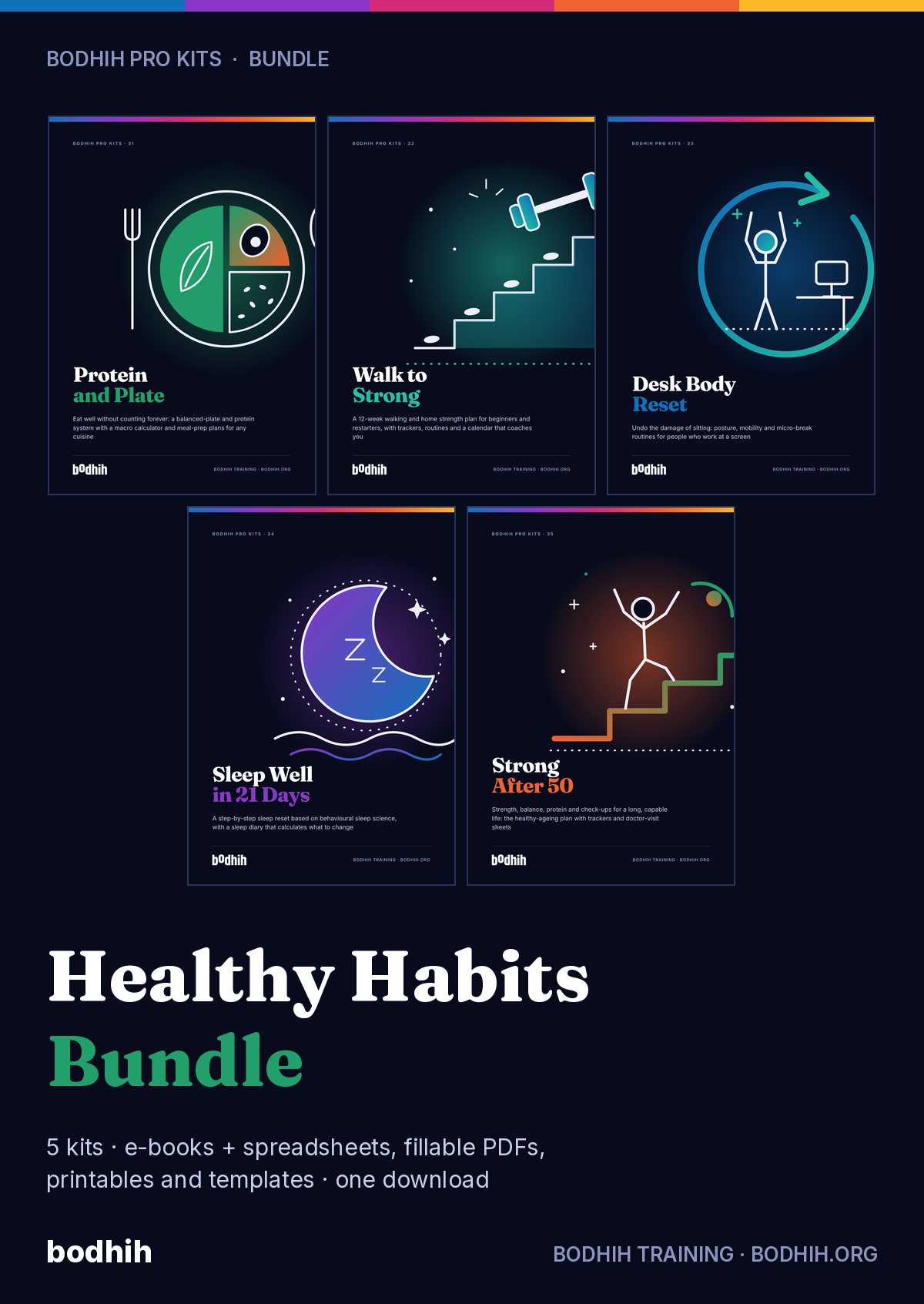
Protein and Plate teaches a simple method (anchor, plate, hands, weekly prep) and gives you the calculator, food bank and planners to make it stick. Educational content, not medical advice.
Protein and Plate · Bodhih Pro Kits · 31 by Bodhih Training, trainers to 2,000+ companies since 2008.
Give every meal a protein anchor, fill half the plate with vegetables and fruit, measure grains with a cupped hand and fats with a thumb, and prep once a week. Count for two weeks only, to find your gaps. The Protein and Plate kit from Bodhih Training supplies the calculator, food bank and planners for exactly this.
Want the full free guide first? Read How Much Protein Do I Need a Day? A Balanced-Plate Guide.
Most trackers are built around American packaged food. You spend more time searching for jollof rice or rajma than eating it, and the numbers you find were typed in by strangers.
A calculator with no method keeps you dependent on it. The moment you stop logging, you are back where you started, because nobody taught you what a balanced plate looks like.
You know protein matters. Nobody has told you how much, as a sensible range, or what that looks like in dal, tofu, eggs, fish or paneer on an ordinary Tuesday.
By Wednesday evening you are tired and hungry and a delivery app is one tap away. The problem is logistics, not willpower.
Daily weight bounces with water, salt and sleep. Without a way to read the trend, a normal fluctuation feels like failure and a plateau feels like the end.
Imagine next Sunday afternoon. You open the Prep Run Sheet, put the rice and the rajma on, and two hours later the fridge holds two protein anchors, a grain, two vegetables and a jar of sauce. You notice how different Wednesday night looks when dinner takes ten minutes to assemble.
On Monday you glance at your lunch and count hands instead of calories: a palm of protein, two fists of vegetables, a cupped hand or two of rice. Twenty seconds in the Plate Check sheet, a score out of four, and you get on with your day. As you fill in a few plates, you begin to see the pattern for yourself.
When you run the two-week audit, the dashboard shows what many people discover: breakfast carries almost none of the day's protein. You change one meal. That is often all it takes, and because you found it yourself, it stays fixed.
A month on, there is a festival dinner, a wedding or a work trip. You fill in the Eating-Out Plan while you are calm, enjoy the food you came for, and eat a normal plate at the next meal. Whether you start with the Settings sheet tonight or the plate poster on the fridge tomorrow, the method is the same, and it is yours to keep.
The e-book shows you how. The tools make it happen. Here is exactly what you download.
The guide: methods, worked examples, scripts and exercises
Energy and protein range estimator (metric or imperial), 181-food bank across cuisines, no-counting Plate Check, two-week Daily Log with lookups, Meal Lab, measurement trend, meal-prep planner and dashboard.
Fillable worksheet that turns your own cuisine into three default plates: pick anchors, vegetables, carbs and fats, then write your go-to breakfast, lunch and dinner.
A ten-minute fillable weekly review built on energy, hunger, plates, strength, sleep and how clothes fit, with weight as an optional extra.
A one-page fillable plan for restaurants, takeaways, festivals, weddings and travel days: decide your anchor, your one indulgence and your exit line before you arrive.
Eighty foods from Indian, East Asian, African, Middle Eastern and Western kitchens with approximate protein and energy per normal portion, grouped by vegan, vegetarian, eggetarian and non-vegetarian.
The palm, fist, cupped hand and thumb method on one page, with starting portions per meal, cuisine examples and when to switch to a scale.
How to reach a protein range without meat: pairing pulses, grains, dairy, soy, nuts and seeds, with 24 ready combinations and a sample 90 g day for vegans and vegetarians.
Read any packaged-food label in 20 seconds: the four-step scan, per-100 g thresholds for fat, saturates, sugars and salt, protein claims decoded and regional label differences.
Four weeks of 2-hour prep sessions with a vegetarian and a non-vegetarian track, each week themed on a different kitchen, plus shopping patterns and a midweek top-up.
Editable Word template: a weekly shopping list organised by plate section, twelve no-recipe batch formulas from four cuisines, a label template for boxes and a household agreement for shared kitchens.
The full food bank as a plain CSV with approximate per-100 g energy, protein, carbs, fat and fibre plus typical portions, ready for Google Sheets, Numbers, Notion or your own tracker.
Eight weeks of Sunday prep sessions, Saturday ten-minute check-ins and four midweek top-ups, each with a single focus, importable into Google Calendar, Outlook or Apple Calendar.
A colour A4 poster of the balanced plate with hand portions for the fridge door, plus eight cut-out anchor cards with build-a-meal formulas for different kitchens.
Each chapter opens with a real situation, gives you a method and ends with something to do today, using the tools in your kit.
Why this kit teaches a method and then lets you put the calculator away.
How energy balance really works, and how to estimate your needs as a range with the Mifflin-St Jeor equation.
Protein minimums versus working ranges, with a per-meal anchor method that replaces gram counting.
The half, quarter, quarter plate and how to apply it to a thali, a rice bowl, a soup and swallow or a sandwich.
The palm, fist, cupped hand and thumb method, and how to use a scale for a short audit instead of for life.
Why fibre and plants keep you full, where they live in every cuisine and how to build up without discomfort.
A four-step scan, per-100 g thresholds and two quick sums that expose 'high protein' and 'no added sugar' claims.
Vegan, vegetarian, eggetarian and non-vegetarian anchors across Indian, East Asian, African, Middle Eastern and Western food, plus a one-pot method for mixed households.
Two anchors, one grain, two vegetables, one sauce: a minute-by-minute prep session and a midweek top-up.
How to handle restaurants, wedding seasons, festivals and airports with a plan and no guilt.
Reading the trend instead of the scale, a six-step plateau protocol and the warning signs that mean stop tracking.
What eating well looks like when it has become ordinary.
The method, the tools and the key figures with their sources on two tables.
The public guidance behind the book and when to see a doctor or registered dietitian.
Every outcome is practised with a worked example and a tool, not just described.
People who measure before and after improve faster and can show it. AssessAll, our sister assessment platform, has AI-graded assessments that pair with this kit. Take one now, work through the kit, then re-take it.
It's 8.15 on a Wednesday evening. Ahmed has just got home, the fridge holds half a lemon and some ketchup, and a delivery app is already open on his phone. He is about to make a food decision at the exact moment he's least equipped to make a good one: tired, hungry and holding a device that will bring butter chicken to his door in 25 minutes. Willpower didn't fail Ahmed. Logistics did. And logistics, happily, is something you can fix on a Sunday afternoon. The classic meal-prep photo shows fifteen identical boxes of chicken, rice and broccoli. By Thursday you'd rather eat the box. We teach a different approach: prep components, then assemble different meals from them through the week. The pattern is easy to remember. Two anchors, one grain, two vegetables, one sauce.
| Free templates and typical advice | This kit | |
|---|---|---|
| Method | A blank macro tracker with no explanation of what to do with the numbers | A taught method: anchor, plate, hands, prep, weekly check-in, with counting as a short optional audit |
| Foods | US packaged foods; little or nothing for Indian, African or East Asian kitchens | 181 foods across seven cuisine groups, filterable by vegan, vegetarian, egg and non-veg |
| Targets | One exact calorie number that invites failure | Ranges from the Mifflin-St Jeor equation with a built-in sense check and adjustable protein band |
| Units | Pounds and ounces only | Metric or imperial with one setting; no currency or country assumptions |
| Tracking | Log every gram for ever | A no-numbers Plate Check for daily life, a Meal Lab to test changes and a log you are told to stop using |
| Wellbeing | Scale weight as the only measure | A no-scale weekly check-in, a 7-entry average for those who weigh, and clear guidance on when tracking turns unhealthy |
Bodhih Training has designed and delivered corporate programmes since 2008. Bodhih Pro Kits package what works in those workshops into a guide plus the exact tools we use, so you can apply it the same day without a facilitator in the room.
Name, email and country. UPI, card or netbanking in India; international cards everywhere else. No account to create.
Your download page opens at once, with every file and a one-click ZIP. A permanent link lands in your inbox too.
Start with the quick-start chapter, then the main spreadsheet or planner. Most buyers use something from the kit the same day.
Open the Settings sheet, find your ranges, and build your first balanced plate at your next meal. Whether you begin with the fridge poster tonight or a full prep session on Sunday, you will be eating from a method you understand.
Personal licence for the buyer's own use (and use with your own team or clients where the kit says so). Please don't share or resell the files. Team and company licences: solutions@bodhih.com.
Recover energy and set limits at work.
Emotional intelligence and resilience at work.
250+ AI-graded assessments to measure skills and earn verified credentials.
Individual development plans that start from evidence and stay yours.
Run this topic as a live workshop for your team, in person or online.
Book a vetted coach for career, leadership or communication. Pay per session.
Certification pathways in Applied AI, Workplace English and management.
No. Protein and Plate is educational content for generally healthy adults. It cannot assess your health or prescribe a diet. If you are pregnant or breastfeeding, have a medical condition, take regular medication or have any history of disordered eating, please speak to your doctor or a registered dietitian before changing how you eat.
Official minimums are about 0.8 g per kg of body weight in the US and 0.75 g per kg in the UK. Active adults often aim higher, and the American College of Sports Medicine suggests 1.2 to 2.0 g per kg for athletes. The workbook uses an adjustable 1.2 to 1.6 g per kg working range and converts it into a per-meal figure.
No. The Plate Check sheet and the hand-portion method need no numbers at all. The Daily Log is there if you want a 7 to 14 day audit to find your gaps, after which the book tells you to stop logging and go back to the plate.
Yes. The food bank includes dals, paneer, soya chunks, sattu, tofu, tempeh, natto, githeri, moin moin, egusi, jollof, ugali, injera and many more alongside Western staples. There is a dedicated vegetarian combinations cheat sheet and both veg and non-veg tracks in the 4-week prep plan.
It uses the Mifflin-St Jeor equation with standard activity factors, which is a reasonable estimate for an average adult and can be 10 percent or more out for an individual. That is why every result is shown as a range, and why food values are marked approximate. Use the figures for direction, not precision.
No. It makes no weight, health or appearance promises and shows no before-and-after claims. It teaches a balanced way of eating and a sensible, gradual approach for those who do want to manage weight, and it pushes no supplements.
Prep components instead of identical boxes: two protein anchors, one grain, two vegetables and one sauce, in about two hours, with a twenty-minute top-up midweek. The workbook's Prep Run Sheet gives the minute-by-minute order and the calendar file reminds you for eight weeks.
Use the Settings sheet and a first Weekly Check-In as your baseline. If you would like an outside measure of how well you plan and how critically you read health claims, AssessAll offers the Plan Strength Assessment with an Eight-Week Re-Measure and the Reading Statistics in News, Advertising and Social Media Assessment for Everyday Readers at assessall.com.
Chapter 9 teaches if-then plans, and the Weekly Check-In asks you to write one each week. Jobulary has a helpful article on if-then plans that make habits stick at jobulary.com, which pairs well with the eight-week calendar in this kit.
The workbook opens in Excel, Google Sheets or LibreOffice; the PDFs fill in with Acrobat Reader or a notes app; the calendar file imports into Google, Outlook or Apple Calendar. Digital kits are non-refundable once downloaded, except for corrupted files not fixed within 3 working days, duplicate charges or failed delivery.
₹599 including 18% GST for buyers in India, or $17 for buyers outside India. One-time payment, no subscription, with an automatic invoice.
Instantly. Your download page opens the moment payment succeeds, and a permanent download link is emailed to you. Download each file separately or everything in one ZIP.
Any of the usual tools: Excel or Google Sheets for spreadsheets, Word or Google Docs for templates, Adobe Acrobat Reader, Preview, Xodo or GoodNotes for the fillable PDFs, and Google, Outlook or Apple Calendar for the calendar plan.
Because it is a digital download, kits are not refundable once downloaded. We always refund a duplicate charge or a failed delivery, and if a file is corrupted and we cannot fix it within 3 working days. Full terms: bodhih.org/refunds.
Yes. Team and company licences, and workshops on this topic run by Bodhih Training, are available. Write to solutions@bodhih.com or call +91 99000 11601.