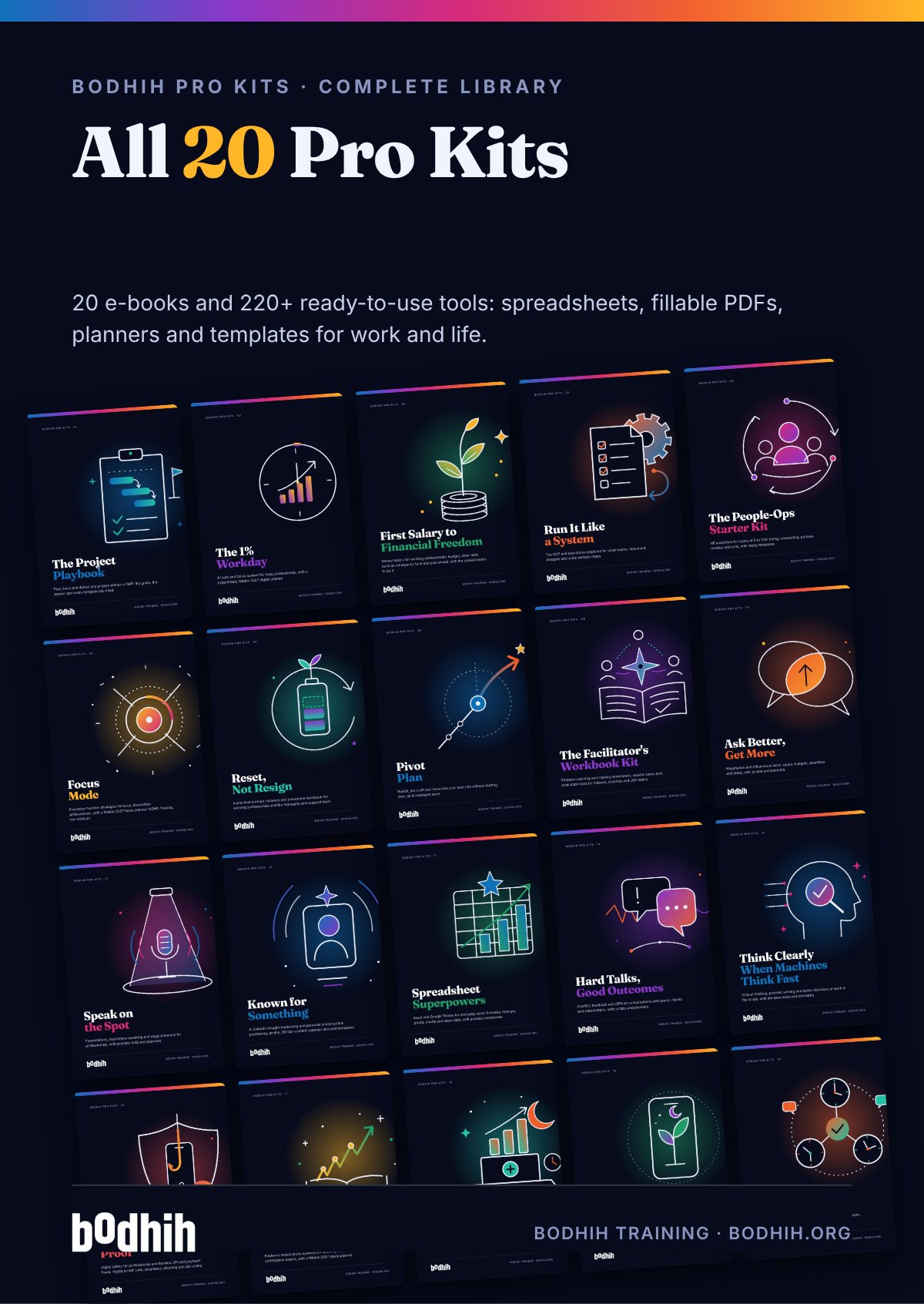
Speak on the Spot is a complete presentation and impromptu speaking kit from Bodhih Training: a practical e-book plus ready-to-use planners, scorecards, templates and a 21-day drill plan.
Speak on the Spot · Bodhih Pro Kits · 11 by Bodhih Training, trainers to 2,000+ companies since 2008.
Learn a few answer structures such as PREP and What, So what, Now what; lead with your point; pause instead of filling silence; and practise in short daily drills while recording yourself. Speak on the Spot from Bodhih Training gives you the structures, planners and a 21-day drill calendar to build the habit.
Want the full free guide first? Read How to Speak Confidently on the Spot: 7 Impromptu Speaking Techniques.
Someone senior asks a question and you start with the history, wander, and end with 'so, yeah'. The perfect answer arrives on the walk back to your desk.
Your heart races, you speak too fast and your opening disappears. Being told to 'just relax' has never helped.
Dense decks, bullet points read aloud and an audience reading ahead. The point gets lost in the detail.
The prepared part goes fine. Then a sharp question from the most senior person in the room undoes the good impression.
Twelve small faces, no reaction, and you speed up because you can't tell if anyone is listening.
Imagine the next quarterly review. A director turns to you with a question you weren't expecting. You notice the jolt, recognise it as your body getting ready, and pause for two seconds. You pick a structure. Answer first, one reason, one specific example, the point again. You stop. Someone nods and the meeting moves on.
That calm is built, not born. As you open the Talk Planner for your next presentation, you'll find your message shrinking to one clear sentence, and the slides almost plan themselves once you've written the headlines in the Slide Outline Template.
Picture Friday afternoon three weeks from now. You open your Speaking Practice Log and the Weekly Trend sheet shows your average rating climbing and your filler words falling. Ten minutes a day, logged and visible.
And when the hard question comes, you'll already have it on your Q&A Prep Sheet, with a calm answer and a bridge back to your message. Whether you start with the Impromptu Structures Card tonight or the 21-day calendar on Monday, you'll notice the difference the first time your name is called.
The e-book shows you how. The tools make it happen. Here is exactly what you download.
The guide: methods, worked examples, scripts and exercises
Log every drill, track self-ratings and filler words, plan talk timings and watch your weekly rating trend on a live chart.
Plan any talk in 30 minutes: audience, one-sentence message, spine, story, opening, close and timing.
Score a run-through on 10 criteria out of 50, capture feedback and pick the single fix for the next rehearsal.
Predict the questions you dread, draft structured answers and plan your recovery lines before any talk.
A one-page, bottom-line-up-front update for senior leaders, with a 90-second spoken version.
Plan a ten-slide talk with sentence headlines, visuals and speaker notes before you design a single slide.
Four answer structures, bridging lines and the LAAB Q&A rhythm on one printable card.
Sixty workplace speaking prompts in six categories, each matched to a structure and difficulty level.
The 60 prompts as a CSV with category, suggested structure and level, ready to sort, filter or randomise in Excel or Google Sheets.
Camera, light, sound, interaction and recovery checks for presenting on Teams, Zoom, Meet or any video platform.
Twenty-one daily 15-minute speaking drills that import into Google Calendar, Outlook or Apple Calendar.
Each chapter opens with a real situation, gives you a method and ends with something to do today, using the tools in your kit.
Why nerves hit capable people hardest, and how reappraising anxiety as excitement helps you perform.
Four structures (PREP, What/So what/Now what, Past/Present/Future, Problem/Options/Recommendation) for answering any question in thirty seconds.
How to plan for your audience and reduce any talk to one arguable sentence that passes the corridor test.
Six openings that earn attention and a five-step close that ends on your ask, not the hardest question.
A four-part story shape, a story bank and the story-then-data pairing that makes points memorable.
Sentence headlines, one idea per slide and the headline test, grounded in research on multimedia learning.
Pace, pauses, filler words, volume and emphasis, with simple drills to measure progress.
Presence through stillness, purposeful gestures and eye contact, minus the 93% myth.
Predicting tough questions, the Listen, Acknowledge, Answer, Bridge rhythm and handling hostile moments calmly.
Camera, light, sound and interaction for video calls, plus the bottom-line-up-front executive update.
Every outcome is practised with a worked example and a tool, not just described.
People who measure before and after improve faster and can show it. AssessAll, our sister assessment platform, has AI-graded assessments that pair with this kit. Take one now, work through the kit, then re-take it.
A second reason smart people freeze is that they overestimate how much the audience notices. Psychologists call this the spotlight effect, a term associated with research by Thomas Gilovich and colleagues showing that people tend to overestimate how much others notice their appearance and actions. Your shaking hand feels enormous to you. To the room, it is barely visible. The "um" that made you cringe was probably forgotten by the next sentence. Audiences are mostly thinking about themselves: whether this talk is useful to them, whether they will be asked a question next, what they need to pick up from the shop on the way home. That is not an insult. It is a relief. You do not need to be perfect. You need to be useful.
| Free templates and typical advice | This kit | |
|---|---|---|
| Impromptu answers | 'Think before you speak' | Four named structures, bridging lines and a printable card |
| Nerves | 'Just relax' and breathe | A five-minute pre-talk routine plus reappraisal grounded in published research |
| Planning | Start building slides | A Talk Planner that starts with audience, goal and one-sentence message |
| Practice | Rehearse when you remember | A 21-day drill calendar, scorecard and practice log with a trend chart |
| Q&A | Hope for easy questions | A Q&A Prep Sheet and the Listen, Acknowledge, Answer, Bridge rhythm |
| Executive audiences | Long status decks | A one-page bottom-line-up-front template and a 90-second script |
Bodhih Training has designed and delivered corporate programmes since 2008. Bodhih Pro Kits package what works in those workshops into a guide plus the exact tools we use, so you can apply it the same day without a facilitator in the room.
Name, email and country. UPI, card or netbanking in India; international cards everywhere else. No account to create.
Your download page opens at once, with every file and a one-click ZIP. A permanent link lands in your inbox too.
Start with the quick-start chapter, then the main spreadsheet or planner. Most buyers use something from the kit the same day.
Open the Impromptu Structures Card, pick one prompt and answer it out loud: that is the first rep. Whether you begin with the card tonight or start the 21-day calendar on Monday, Speak on the Spot gives you everything you need to sound like you planned it.
Personal licence for the buyer's own use (and use with your own team or clients where the kit says so). Please don't share or resell the files. Team and company licences: solutions@bodhih.com.
Professional English for the global workplace.
Daily speaking practice with feedback.
250+ AI-graded assessments to measure skills and earn verified credentials.
Individual development plans that start from evidence and stay yours.
Run this topic as a live workshop for your team, in person or online.
Book a vetted coach for career, leadership or communication. Pay per session.
Certification pathways in Applied AI, Workplace English and management.
Pause for two seconds, choose a structure and lead with your answer. PREP (Point, Reason, Example, Point) works for opinions, and What, So what, Now what works for updates. Aim for 30 to 60 seconds, then stop and let follow-up questions tell you what detail people want.
PREP stands for Point, Reason, Example, Point. You state your answer, give the reason, add one concrete example, and restate the point, ideally with a next step. Chapter 2 of the e-book shows it alongside three other structures, and the Impromptu Structures Card puts all four on one page.
You may not stop feeling nervous, and you don't need to. Research by Alison Wood Brooks at Harvard Business School found that people who reappraised pre-performance anxiety as excitement performed better than those who tried to calm down. The kit pairs this with a five-minute pre-talk routine and knowing your opening lines by heart.
Don't fight fillers mid-talk. Practise replacing them with a short pause, record two-minute talks and count your fillers. The Speaking Practice Log calculates fillers per minute and shows the weekly trend so you can see the habit change.
No. It focuses on delivery and presence: structure, message, stories, slides, voice, body language, Q&A and virtual presenting. It works well for people speaking English as a second language because audiences respond to clarity far more than perfect grammar.
Most people notice they sound clearer within the first week of structure drills. The 21-day plan uses about 10 to 15 minutes a day, and your practice log shows the trend. Results depend on how consistently you practise and speak up in real meetings.
Yes. Alongside the baseline recording in Chapter 1, you can measure your starting point with AssessAll assessments such as Executive Presence & Communication, the Speaking Sprints Drill and the Communication Style Profile, then retake them after your 21 days.
Turn it into a development plan: add 'speak confidently on the spot' as a goal in a Jobulary individual development plan, attach your practice log trend and scorecard results as evidence, and agree real speaking opportunities with your manager.
Yes. The workbook opens in Excel or Google Sheets, the templates in Word or Google Docs, the fillable PDFs in Acrobat Reader or apps like GoodNotes, and the calendar file imports into Google Calendar, Outlook or Apple Calendar.
The personal licence covers your own use. For running practice sessions with a team or across a company, contact solutions@bodhih.com about team and company licences.
₹499 including 18% GST for buyers in India, or $15 for buyers outside India. One-time payment, no subscription, with an automatic invoice.
Instantly. Your download page opens the moment payment succeeds, and a permanent download link is emailed to you. Download each file separately or everything in one ZIP.
Any of the usual tools: Excel or Google Sheets for spreadsheets, Word or Google Docs for templates, Adobe Acrobat Reader, Preview, Xodo or GoodNotes for the fillable PDFs, and Google, Outlook or Apple Calendar for the calendar plan.
Because it is a digital download, kits are not refundable once downloaded. We always refund a duplicate charge or a failed delivery, and if a file is corrupted and we cannot fix it within 3 working days. Full terms: bodhih.org/refunds.
Yes. Team and company licences, and workshops on this topic run by Bodhih Training, are available. Write to solutions@bodhih.com or call +91 99000 11601.