Run one-to-ones people value, and give feedback while it can still help
A complete routine for managers of 3 to 12 people: the rhythm, the agenda, the notes, the words for praise and correction, development plans and review prep. Everything needed to start is in the ZIP, and the first step takes about an hour.
- A 10-chapter e-book that teaches the 15-10-5 one-to-one, four-sentence feedback, coach-or-tell and evidence-based reviews
- The One-to-One Hub: a 13-sheet workbook with next-due dates, overdue flags, action tracker, feedback balance, recognition check, recency check and dashboard
- Five fillable PDF forms and seven Word files, including 150 questions, 42 feedback scripts, 12 ready-to-send messages and a one-page team charter
- Five printable cheat sheets, 28 AI prompts, an eight-week rollout calendar (28 events) and a 30-card task-board import
The One-to-One and Feedback System · Bodhih Pro Kits · 72 by Bodhih Training, trainers to 2,000+ companies since 2008.
How do I run effective one-to-one meetings with my team?
Hold them on a fixed rhythm, weekly to monthly, for about 30 minutes. Share an agenda and put the team member's items first: 15 minutes theirs, 10 yours, 5 on next steps. Write down commitments, follow through, and give specific feedback every week. The One-to-One and Feedback System kit from Bodhih Training supplies the method and every template.
Want the full free guide first? Read How to Run Effective One-to-One Meetings With Your Team.
You already feel the problem. Here is what it is costing you.
The one-to-one that keeps getting moved
A client shouts, the slot gets dragged to next week, and it happens three times in a row. Nobody complains, and the person quietly stops preparing. The kit gives you a rhythm with a rule (move it, never cancel it) and a roster that flags anyone overdue.
"How's it going?" "Fine."
Eleven minutes, both relieved, nothing learned. Without a shared agenda and a better second question, a one-to-one drifts into silence or status. The 15-10-5 shape and the question bank are built for both problems.
"Remind me what we said?"
A promise made in a one-to-one and then forgotten costs more trust than never asking. A five-minute close-out and an action tracker that counts days open do the remembering for you.
Feedback saved for the review
Corrections arrive months late and feel like an ambush. Praise is vague and goes to the same two people. Four sentences, given within a week, and a recognition check are the kit's answer.
Reviews written from the last six weeks
Without notes, the most recent events decide the rating. Two factual lines a month per person, with a built-in recency check, give you a whole year to draw on.
Picture the next few weeks with the kit open beside you.
Imagine a Monday about a month from now. You open the One-to-One Hub and the Dashboard shows zero overdue one-to-ones and two actions that are yours, both due Wednesday. You know who you are meeting this week and what each of them last asked you for, because the Person View shows it in one screen.
On Tuesday at 10.00 you sit down with someone who used to say 'fine'. Their items are already on the shared agenda. You ask one question from the bank, wait a little longer than is comfortable, and hear about a problem that has been costing them an hour a day. In your ten minutes you thank them for one specific thing, with the example, and notice how differently that lands from 'great job'.
Later in the week there is something small you need someone to change. In the past it might have waited. This time you fill in the Feedback Preparation Sheet in five minutes, say four sentences in private, and listen. As you log it and set a follow-up date, notice that the conversation you used to dread took under ten minutes.
And when review season comes round, you open Review Evidence and read the year in order. Whether you start with the workbook tonight or with the first invitation tomorrow morning, the routine begins with one calendar entry.
21 files that do the work for you
The e-book shows you how. The tools make it happen. Here is exactly what you download.
The One-to-One and Feedback System (e-book, PDF)
The guide: methods, worked examples, scripts and exercises
Start-here map
Two-page map of the whole job: each step, the file to open, your first hour and a 30/60/90-day plan.
One-to-One Hub workbook
13-sheet workbook: roster with next-due dates and overdue flags, meeting log, person view, action tracker, feedback log and balance, recognition check, development plans, review evidence with recency check, and a dashboard.
One-to-one agenda and notes
Two-page fillable form for every regular one-to-one: shared agenda, 15-10-5 notes, commitments on both sides and the close-out checklist.
First one-to-one: get-to-know-you sheet
Three-page fillable sheet for the first one-to-one with each person, including the manager's own page to share first.
Feedback preparation sheet
Two-page fillable sheet to prepare praise or a redirect in four sentences, test the observation and plan the follow-up.
Career conversation and development plan
Three-page fillable form: a career conversation map for the team member to prepare, then a development plan with goals built on 70-20-10 and review dates.
Support plan for someone who is struggling
Three-page fillable form: early-signals check, conversation preparation, and an informal support plan with weekly check-ins and a review date.
Question bank: 150 one-to-one questions by purpose
150 numbered questions: 20 each for check-in, progress, blockers, growth, wellbeing, career and feedback upward, plus 10 skip-level questions and a shortlist table.
Feedback script library
42 numbered scripts: permission openers, specific praise, everyday redirects, responses to hard reactions, asking for feedback and closing the loop.
One-to-one invitation and message templates
12 ready-to-send messages: team announcement, invitations, remote version, restart after a lapse, reminders, rescheduling, recap, upward feedback ask, career conversation, skip-level and review season.
Team one-to-one charter
A one-page agreement the team can adopt: purpose, rhythm, what the manager and each team member commit to, confidentiality limits and review.
Review-season summary template
A ready-to-complete summary that turns a year of one-to-one notes into a fair review: evidence by quarter, results, strengths, growth areas, the no-surprises test and next-year goals.
Worked example pack
The main forms shown fully completed for one composite team (manager Asha Menon and her support engineers), so you can see what good looks like.
AI prompt pack for one-to-ones and feedback
28 tool-agnostic prompts grouped by the seven steps of the job, each with what to paste in and what to check before you use the output.
The 30-minute one-to-one
One-page running order for a 15-10-5 one-to-one, with opening questions, the close-out and timing variants.
Feedback in four sentences
One-page cue card for praise and redirects: the four sentences, the camera test, swaps for risky phrases and how to receive feedback.
Coach or tell? decision card
One-page decision card: if this situation, do that, with the words to use for tell, show, coach and delegate, plus everyday one-to-one decisions.
Seven one-to-one mistakes
One-page card of the seven most common one-to-one and feedback mistakes, the signal for each and the fix, with a monthly self-check.
Eight-week rollout and first-quarter rhythm calendar
Calendar events for the eight-week rollout, the Friday dashboard check and the first monthly and quarterly reviews. Imports into Google Calendar, Outlook or Apple Calendar.
Action board import (rollout tasks)
30 ready-made task cards for the eight-week rollout and ongoing rhythm. Import into Trello, Asana, Notion, Planner or Jira and map the columns.
Chapter by chapter
Each chapter opens with a real situation, gives you a method and ends with something to do today, using the tools in your kit.
- Format
- PDF e-book + XLSX + fillable PDF + DOCX + printable PDF + ICS + CSV
- Files
- 21 files plus a one-click ZIP
- E-book
- 62 pages
- Works with
- Excel, Google Sheets, LibreOffice, Word, Google Docs, Adobe Acrobat and other PDF readers, Google Calendar, Outlook, Apple Calendar, Trello, Asana, Notion, Planner, Jira
- Best for
- Managers, team leads, supervisors and founders with a team of 3 to 12
- Time to start
- About one hour using the Start-here map
- Licence
- Personal licence, for use with your own team
Why Thirty Minutes Beats Any Other Management Tool
Why daily chat is not a one-to-one, whose meeting it is, and the four jobs it does.
Set the Rhythm and Say It Out Loud
Choosing cadence and length, the three rules of the rhythm, the charter, the first meeting and how to restart after a lapse.
The Thirty-Minute One-to-One
The shared agenda, the 15-10-5 shape and questions that get past 'fine'.
Notes and Follow-Through
What to write down, the five-minute close-out, the action tracker and what never to put in notes.
Praise That Lands
Specific praise in three parts, public or private, and a recognition check so nobody is missed.
Corrective Feedback in Four Sentences
Observation, impact, question, request: small, soon and about the work, with preparation and follow-up.
Receiving Feedback as the Manager
Asking a smaller question, the thank-clarify-commit response and closing the loop where the team can see it.
Coach or Tell, and Helping People Grow
A two-question coach-or-tell decision, five coaching questions, career conversations, 70-20-10 plans and stretch assignments.
Remote, Skip-Level and When Someone Is Struggling
Adjustments for remote and skip-level meetings, early signals, an informal support plan and when to involve HR.
From Notes to a Fair Review
Collecting evidence all year, the recency check, drafting from facts and the no-surprises test.
Not just reading. Tools you will actually open again.
E-book
- The One-to-One and Feedback System: Introduction, 10 chapters, Conclusion and two appendices (the eight-week rollout and a which-file-for-which-moment finder)
Start here
- 00-Start-Here-Map: the job in seven steps, the file for each, your first hour and a 30/60/90-day plan
Spreadsheet
- One-to-One Hub workbook (13 sheets): Start here, Settings, Roster, One-to-One Log, Person View, Actions, Feedback Log, Feedback Balance, Recognition Check, Development Plans, Review Evidence, Review Summary and Dashboard, with sample rows from a composite team
Fillable PDF forms
- One-to-one agenda and notes
- First one-to-one: get-to-know-you sheet (with a manager's page)
- Feedback preparation sheet
- Career conversation and development plan
- Support plan for someone who is struggling
Word templates
- Question bank: 150 one-to-one questions by purpose
- Feedback script library: 42 scripts
- One-to-one invitation and message templates: 12 ready-to-send messages
- Team one-to-one charter (one page)
- Review-season summary template
- Worked example pack: six forms completed for one composite team
- AI prompt pack: 28 prompts with what to paste in and what to check
Cheat sheets
- The 30-minute one-to-one
- Feedback in four sentences
- Coach or tell? decision card
- Seven one-to-one mistakes (with a monthly self-check)
Calendar and import
- Eight-week rollout and first-quarter rhythm calendar (ICS, 28 events)
- Action board import (CSV, 30 task cards for Trello, Asana, Notion, Planner or Jira)
When you have worked through it, you will be able to…
Every outcome is practised with a worked example and a tool, not just described.
- Set a one-to-one cadence for each person and see the yearly time cost before committing to it
- Announce, invite and run a first one-to-one using ready-made messages and a get-to-know-you sheet
- Run a 30-minute one-to-one in the 15-10-5 shape with a shared agenda and questions chosen by purpose
- Close out each meeting in five minutes and track every commitment, yours included
- Give specific praise and a four-sentence redirect, and check who has been missed
- Ask for feedback on your own management in a way that is safe to answer
- Decide when to coach and when to tell, and turn a career conversation into a development plan
- Draft a review from evidence across all four quarters, with a recency check and a no-surprises test
Know your starting point. Prove your progress.
People who measure before and after improve faster and can show it. AssessAll, our sister assessment platform, has AI-graded assessments that pair with this kit. Take one now, work through the kit, then re-take it.
Coaching & Developing Others
Take the assessment →AssessAll assessmentWritten Feedback Quality Assessment for Managers, Teachers and Reviewers
Take the assessment →AssessAll assessmentTeam Read Accuracy Assessment for People Managers
Take the assessment →JobularyTurn what you learn into a measured development plan (Jobulary)
Make it a growth plan →A taste of Chapter 6
Corrective feedback has a poor reputation because most of us have only met it in its stored-up form: late, large and personal. The everyday version is the opposite. It is small (one behaviour), soon (within days) and about the work. That last point has good evidence behind it. In a 1996 analysis of feedback studies in Psychological Bulletin, Avraham Kluger and Angelo DeNisi found that although feedback improved performance on average, more than a third of feedback interventions made performance worse. Their explanation was about attention: feedback that points at the task helps, and feedback that points at the person's sense of self tends to backfire. The CIPD's evidence review on performance feedback reaches a similar practical conclusion: feedback can harm performance if it is not done in the right way. So the form matters.
The honest comparison
| Free templates and typical advice | This kit | |
|---|---|---|
| Method | A blank agenda template with five generic questions | A taught routine: rhythm, 15-10-5 agenda, close-out, feedback loop, growth and review, in ten chapters |
| Tracking | A notes page per person, no formulas | A 13-sheet workbook with next-due dates, overdue and stale flags, feedback balance, recognition and recency checks and a dashboard |
| Words to say | A list of question ideas | 150 questions by purpose, 42 feedback scripts and 12 ready-to-send messages |
| Hard moments | Left to the manager | A support plan form, HR checkpoints, scripts for difficult reactions and a decision card |
| Seeing what good looks like | Empty forms | A worked example pack with six completed forms that match the sample data in the workbook |
| Where it works | Often assumes one country's HR rules | Written for managers worldwide, with clear prompts to check local law and company policy |
Made for you if…
- First-time and early-career managers who were promoted for being good at the job and never shown how to run a one-to-one
- Team leads and supervisors with 3 to 12 people in corporate, IT services, retail, healthcare or the public sector
- Founders with a small team who meet people 'when needed' and suspect the quiet ones are being missed
- Managers whose one-to-ones have lapsed or turned into status updates
- Anyone who puts off corrective feedback until the annual review and wants a calmer way
- HR and L&D partners who want a ready routine to hand to new managers (team licence available)
Probably not for you if…
- People facing a formal disciplinary, grievance or dismissal process: follow your HR process and local law (Bodhih's Difficult Conversations Kit covers the conversation itself)
- Organisations looking for performance management software or a 360-degree survey platform
- Readers who want theory without a routine to run
Built by trainers, tested in real rooms.
Bodhih Training has designed and delivered corporate programmes since 2008. Bodhih Pro Kits package what works in those workshops into a guide plus the exact tools we use, so you can apply it the same day without a facilitator in the room.
From here to using it in three steps
- STEP 1
Tap Get the kit
Name, email and country. UPI, card or netbanking in India; international cards everywhere else. No account to create.
- STEP 2
Download instantly
Your download page opens at once, with every file and a one-click ZIP. A permanent link lands in your inbox too.
- STEP 3
Open the first tool
Start with the quick-start chapter, then the main spreadsheet or planner. Most buyers use something from the kit the same day.
The system starts with one calendar entry
Open the Start-here map, put your team on the Roster, and send the first invitation. Whether you begin with the person you have been meaning to talk to or with the easiest slot in your week, the next thirty minutes is where it starts.
Personal licence for the buyer's own use (and use with your own team or clients where the kit says so). Please don't share or resell the files. Team and company licences: solutions@bodhih.com.
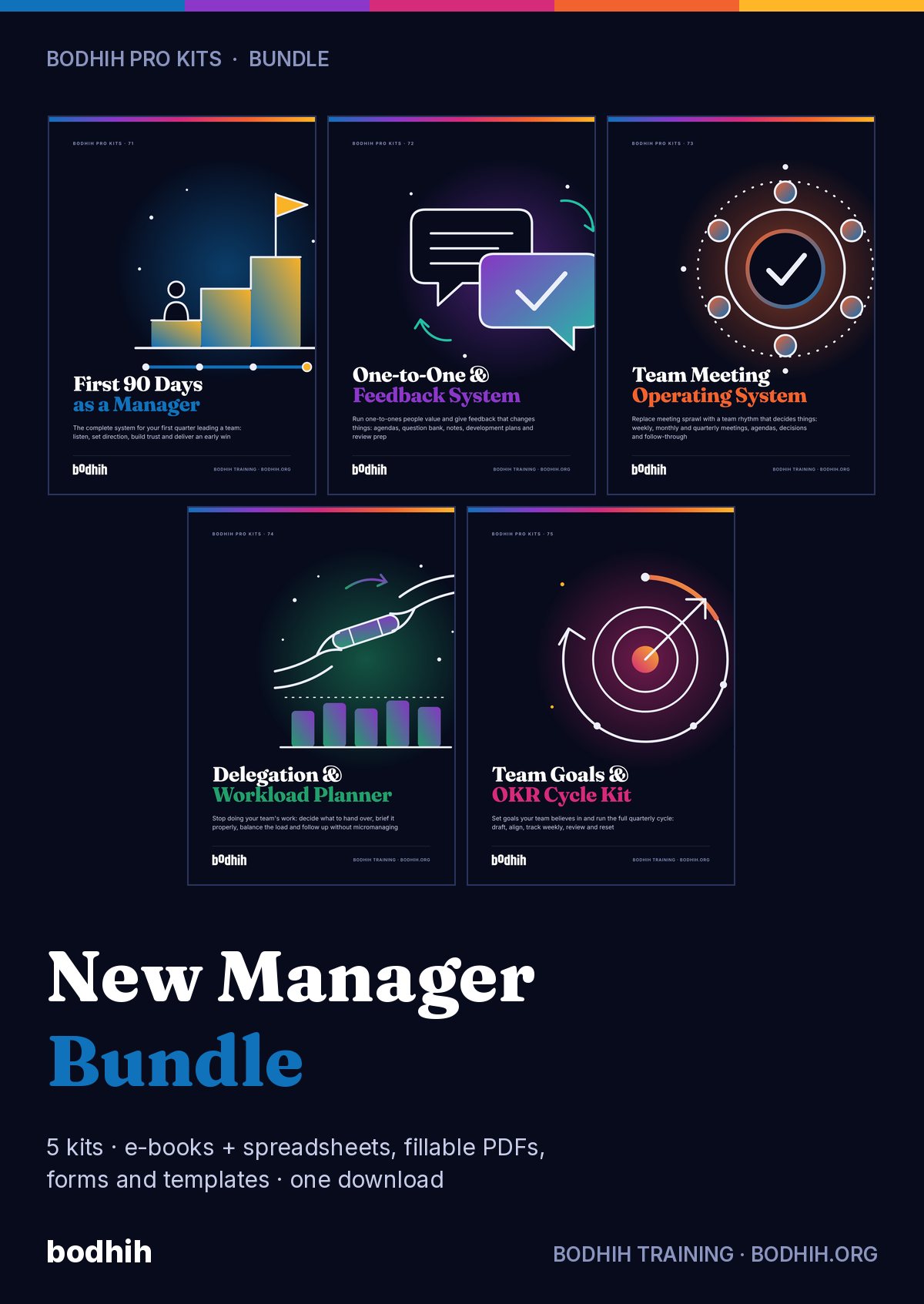
The Bodhih family, when you are ready for more
New Manager, Day One (e-book)
The companion read for first-time managers.
Difficult Conversations Kit
Scripts and planners for the hard conversations.
AssessAll
250+ AI-graded assessments to measure skills and earn verified credentials.
Jobulary
Individual development plans that start from evidence and stay yours.
Bodhih Training
Run this topic as a live workshop for your team, in person or online.
Pewple
Book a vetted coach for career, leadership or communication. Pay per session.
Bodhih.org pathways
Certification pathways in Applied AI, Workplace English and management.
The One-to-One and Feedback System: FAQs
Read the free guideAlready bought? Resend my linkHow often should I have one-to-ones with my team?
Fortnightly for 30 minutes suits most people. Go weekly for new starters and anyone who needs extra support, and no less than monthly for experienced people you see every day. The Roster sheet shows the hours per year for each choice, so the cadence you set is one you can keep.
What should I ask in a one-to-one?
Start with a real check-in question, then follow their agenda. The Question Bank has 150 questions in seven purposes (check-in, progress, blockers, growth, wellbeing, career and feedback upward) plus a skip-level set. Most managers need seven or eight that sound natural, and the patience to wait for the answer.
How do I give corrective feedback without it turning into a confrontation?
Keep it small, soon and about the work. The kit teaches four sentences: what you observed, the impact, a question to hear their side, and one clear request. It builds on the Situation-Behavior-Impact model from the Center for Creative Leadership. The Feedback Preparation Sheet and the script library supply the wording.
Is this different from the Difficult Conversations Kit?
Yes. This kit is the routine system: regular one-to-ones, everyday praise and correction, development and review prep. The Difficult Conversations Kit goes deep on crisis and formal conversations. The routine is designed to catch problems while they are small, though no kit can promise that a harder conversation will not be needed.
Does the workbook work in Google Sheets?
Yes. The One-to-One Hub uses standard formulas (COUNTIFS, INDEX and MATCH, SUMPRODUCT) with no macros, so it opens in Excel, Google Sheets and LibreOffice. It is built for a team of up to 12 and about 200 rows per log, roughly a year of use.
How can I measure my starting point as a manager?
AssessAll offers three relevant assessments: Coaching & Developing Others, Written Feedback Quality Assessment for Managers, Teachers and Reviewers, and Team Read Accuracy Assessment for People Managers. Taking one before you begin gives a baseline to compare against after a quarter of one-to-ones.
How do I turn what I learn into a development plan?
The kit includes a Career Conversation and Development Plan form and a Development Plans sheet in the workbook. For a measured plan with more structure, Jobulary's individual development plan tool (jobulary.com/individual-development-plan) is a natural next step, for you or for your team members.
Is this legal or HR advice?
No. The kit is practical education in good management practice. Employment law, performance management, data protection and dismissal rules differ by country and employer. Check your HR team, company policy and local law before any formal step, and treat the support plan as an informal, good-faith tool.
Can I use the kit with my whole management team?
The personal licence covers your own use with your own team. For several managers, or to roll the routine out across a company, ask about team and company licences at solutions@bodhih.com.
What is the refund policy?
Digital kits are non-refundable once downloaded. The exceptions are corrupted files that are not fixed within 3 working days, duplicate charges, or failed delivery.
How much does The One-to-One and Feedback System cost?
₹999 including 18% GST for buyers in India, or $29 for buyers outside India. One-time payment, no subscription, with an automatic invoice.
How do I get the files after paying?
Instantly. Your download page opens the moment payment succeeds, and a permanent download link is emailed to you. Download each file separately or everything in one ZIP.
What software do I need?
Any of the usual tools: Excel or Google Sheets for spreadsheets, Word or Google Docs for templates, Adobe Acrobat Reader, Preview, Xodo or GoodNotes for the fillable PDFs, and Google, Outlook or Apple Calendar for the calendar plan.
Can I get a refund?
Because it is a digital download, kits are not refundable once downloaded. We always refund a duplicate charge or a failed delivery, and if a file is corrupted and we cannot fix it within 3 working days. Full terms: bodhih.org/refunds.
Can my company buy this for a team?
Yes. Team and company licences, and workshops on this topic run by Bodhih Training, are available. Write to solutions@bodhih.com or call +91 99000 11601.