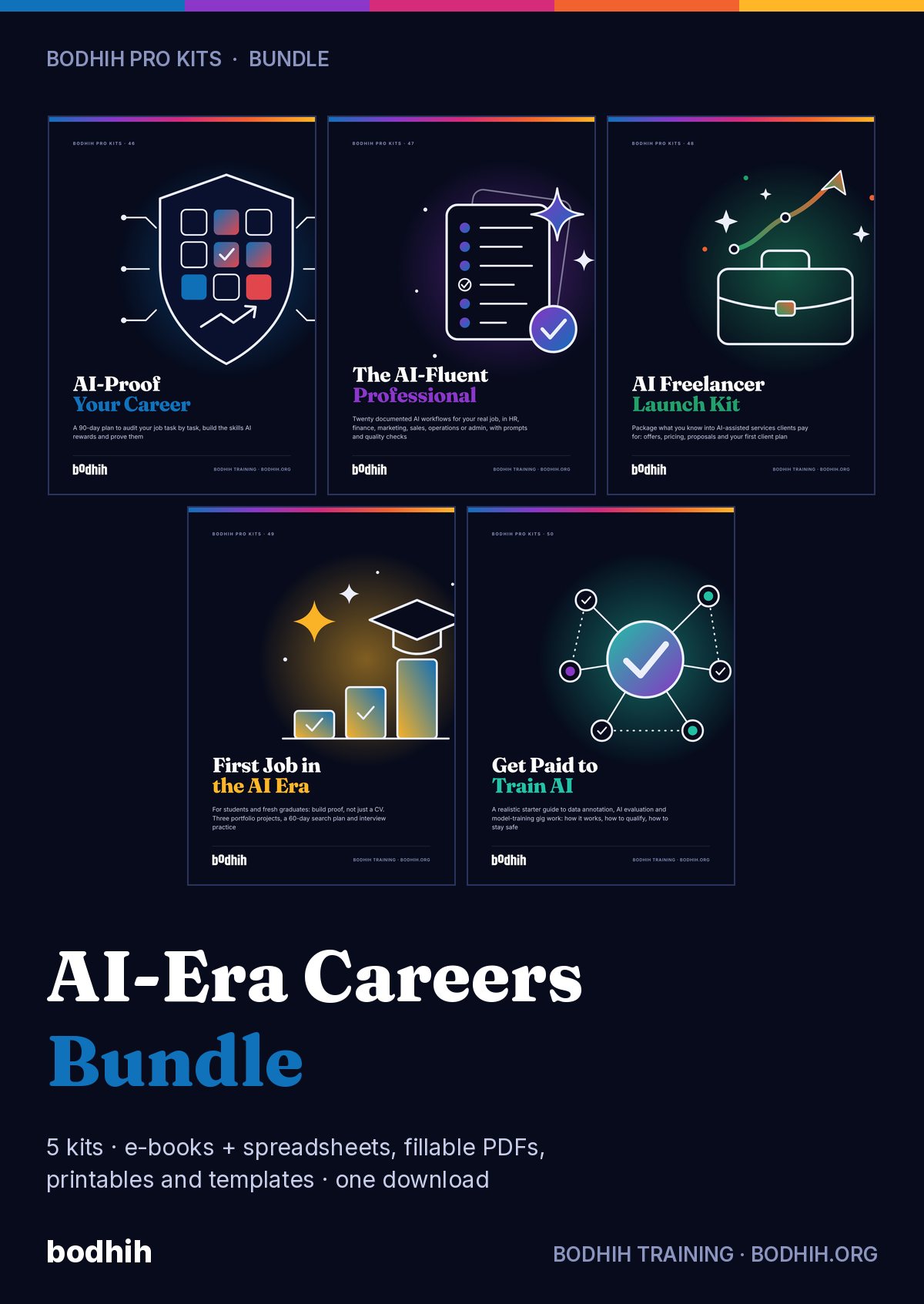
The entry-level market got harder while you were studying. This kit gives you the new rulebook: three target roles, three small portfolio projects, real conversations with alumni, timed practice and an offer check, all tracked in one workbook.
First Job in the AI Era · Bodhih Pro Kits · 49 by Bodhih Training, trainers to 2,000+ companies since 2008.
Pick three target roles, build three small real projects that prove fundamentals, honest AI use and communication, and put them in front of people through alumni conversations and tailored applications. The First Job in the AI Era Kit from Bodhih Training gives you the method, a tracker and a 60-day plan. It does not promise a job.
Want the full free guide first? Read How to Get Your First Job as a Graduate in the AI Era.
You click apply every evening and the portal count climbs, but nothing comes back. Nobody has told you that the same CV sent to twelve different roles is too thin to stand out in any of them.
Entry-level roles now seem to expect someone who has already done the job. You have a degree, some group assignments and a part-time job, and you can't see how that becomes evidence.
One person says AI will take half the jobs, another says it is a fad. You need to know what the research really shows and what to do about it this month.
You are capable, but you have never practised against a clock or watched yourself in a group discussion. So you never reach the interview where you would do well.
When you are tired and under pressure from family, a letter with a logo and a high salary is tempting. You need a ten-minute check you can run every time.
Imagine the first Saturday after you start. You open the First Job Tracker, rate eight roles from 1 to 5, and watch the sheet rank them. For the first time you can say, in one sentence, which three jobs you are going for and why. You notice how much lighter that feels than applying to everything.
Two weeks later you finish your first project. It is small: twelve months of a local shop's sales, three patterns, one recommendation, two pages. When you attach the write-up to your CV, you realise you finally have an answer to the question every interviewer asks: can you show me something you have made?
By week five your phone reminds you each evening what today's task is, so you no longer have to decide. You send five short messages to alumni, hold your first fifteen-minute call and log it. As you look at the Door check dashboard, you can see which source is producing replies and you move your hours there.
And around day 60, whether an offer has arrived yet or not, you are no longer guessing. You have three projects, eight stories you can tell aloud, a practice log with your accuracy climbing, and people in your target field who know your name. You know which stage needs work and exactly what to do next week.
The e-book shows you how. The tools make it happen. Here is exactly what you download.
The guide: methods, worked examples, scripts and exercises
Role scorer that ranks your options, skills gap finder, applications pipeline, aptitude practice log, networking tracker, project rubric, 60-day plan and three live dashboards.
A one-page, ATS-friendly graduate CV in two layouts: Style A leads with projects, Style B leads with education. Worked example wording included.
Twelve ready-to-run project briefs for business, tech, creative and operations roles, each with steps, deliverables, honest-AI guidance and a 20-point rubric.
A two-page template that turns any project into proof: Problem, Approach, Result, What I learned, with an AI-use disclosure line and a worked example.
Fifteen short, polite, copy-and-adapt messages: first contact, follow-ups, thank-yous, recruiter notes, referral requests and graceful replies to a no.
Twenty-five tool-agnostic prompts for role research, tutoring, timed drills, project testing, CV feedback, mock interviews and offer questions, written to stop the AI inventing things.
A 40-minute fillable worksheet that finds patterns in what you enjoy and do well, then turns them into a long list of roles to score.
Mine five areas of your life for eight interview stories, shape each with STAR plus Learned, and tag them against the themes interviewers ask about.
A two-part fillable check: verify that an offer is genuine in ten minutes, then record and compare the real terms before you say yes.
One page on the three corners employers check in graduates (fundamentals, AI fluency, communication), how each is tested and what proof to bring.
A two-page quick reference: question types and time-savers for screening tests, the 20-minute daily drill, and what assessors score in group discussions.
A phone-friendly one-pager: the warning signs of fake offers and pay-to-work schemes, a ten-minute verification routine and what to do if you have paid.
A desk card for your first three months in a job: what to learn, how to contribute, what to own, how to ask good questions and how to use AI tools at work.
One clear task a day for 60 days, importable to Google, Outlook or Apple Calendar: direction, three projects, CV, outreach, test and interview practice, reviews.
Each chapter opens with a real situation, gives you a method and ends with something to do today, using the tools in your kit.
Why 143 applications got nowhere, and the one idea behind the whole kit: claims are cheap, proof is not.
What the research on AI and entry-level hiring really says, read carefully, and the three things employers now test.
A four-step way to go from applying to everything to three scored, evidence-based target roles and a list of skills gaps.
How to build three small, real projects (by hand, AI-assisted, with people) and write each up in two pages.
A traffic-light rule for AI tools, plus tutor and mock-interviewer prompts that stop the AI inventing your achievements.
A one-page, projects-first CV, bullets that carry proof, ten-minute tailoring and a forty-minute LinkedIn tidy-up.
Campus, off-campus, internships, apprenticeships and small firms, and the 80-word alumni message that opens conversations.
The 20-minute daily drill for screening tests and what assessors really score in group discussions.
Finding eight interview stories in a life with no job history and shaping them with STAR plus Learned.
Spotting fake offers and pay-to-work schemes, verifying in ten minutes, reading real terms and asking once about salary.
Learn, contribute, own: how to become the new joiner people want to keep, including using AI tools at work.
The method in three words, and an honest picture of what 60 days of it looks like.
The week-by-week overview, the weekly rhythm and how to read your dashboard like an analyst.
Every source used, with what each one does and does not say.
Every outcome is practised with a worked example and a tool, not just described.
People who measure before and after improve faster and can show it. AssessAll, our sister assessment platform, has AI-graded assessments that pair with this kit. Take one now, work through the kit, then re-take it.
"Tell me about a time you dealt with a difficult situation at work." Tunde, from Chapter 1, had never had a job. He said so, apologised, and waited for the next question. The interviewer, who had asked the same thing of nine graduates that day, wrote "no example" and moved on. Tunde had examples. He had kept a five-person group assignment alive after two members stopped replying. He had run the till at his mother's shop every December since he was fifteen. He had organised transport for 60 people to a cousin's wedding. He just did not think any of it counted. It counts. Interviewers asking a graduate for "a time when" are not expecting a boardroom. They want evidence of how you behave: what you do when something goes wrong, when people disagree, when you do not know the answer.
| Free templates and typical advice | This kit | |
|---|---|---|
| Method | A blank application tracker and a list of generic tips | A full method: roles, proof, people, practice, offer check, first 90 days |
| AI and jobs | Alarming headlines or vague reassurance | Named sources described carefully: what was measured, where, and what is only a projection |
| Portfolio | "Build a portfolio" with no detail | 12 briefs across four fields, a write-up template and a 20-point rubric |
| Spreadsheet | One tab, no formulas, one country's assumptions | Eleven sheets with a role scorer, gap flags, follow-up flags and three dashboards; works in any country |
| AI use | Prompts that write your CV for you | A traffic-light rule, disclosure wording and prompts that use only your real facts |
| Safety | Not covered | Red-flag sheet, ten-minute verification routine and an offer comparison form |
Bodhih Training has designed and delivered corporate programmes since 2008. Bodhih Pro Kits package what works in those workshops into a guide plus the exact tools we use, so you can apply it the same day without a facilitator in the room.
Name, email and country. UPI, card or netbanking in India; international cards everywhere else. No account to create.
Your download page opens at once, with every file and a one-click ZIP. A permanent link lands in your inbox too.
Start with the quick-start chapter, then the main spreadsheet or planner. Most buyers use something from the kit the same day.
You can keep clicking apply and hoping, or you can start building proof tonight. Whether you begin with the worksheet this evening or the tracker tomorrow morning, open the first file and do Day 1. The rest follows one task at a time.
Personal licence for the buyer's own use (and use with your own team or clients where the kit says so). Please don't share or resell the files. Team and company licences: solutions@bodhih.com.
CVs, interviews and remote jobs worldwide.
Role-based Applied AI certifications from Bodhih.
250+ AI-graded assessments to measure skills and earn verified credentials.
Individual development plans that start from evidence and stay yours.
Run this topic as a live workshop for your team, in person or online.
Book a vetted coach for career, leadership or communication. Pay per session.
Certification pathways in Applied AI, Workplace English and management.
No kit can promise that, and you should be wary of anything that does. What this kit gives you is a clear method, real tools and a 60-day plan so that your effort goes into the things employers respond to: proof of work, conversations with people and practice. Results depend on your field, your location and the market.
The evidence is more specific than the headlines. A Stanford Digital Economy Lab working paper using US payroll data found a relative decline in employment for 22 to 25 year olds in the most AI-exposed occupations, mainly through reduced hiring, and no evidence of economy-wide job loss. Chapter 1 and Appendix B explain what that does and does not mean, alongside WEF, ILO, LinkedIn and PwC findings.
You make some. Three small projects of 10 to 15 hours each, built on real data or for a real person and written up in two pages, give you evidence for your CV and stories for interviews. The kit includes 12 briefs and a write-up template so you are not starting from a blank page.
Yes, honestly. The e-book gives a traffic-light rule: use AI freely to learn and rehearse, check and disclose it when it drafts work you keep, and never use it to invent experience or take live tests. The 25 prompts are written so the assistant uses only your real facts.
Yes. The examples come from India, Nigeria, Kenya, the Philippines, the UAE, Australia, the UK and the US, and the tools make no single-country assumptions. Campus placements, group discussions, off-campus applications, graduate schemes and apprenticeships are all covered. Where rules differ by country, the kit tells you to check the official source.
Use the self-check on the What Entry-Level Employers Test sheet on day 1. For a scored baseline, AssessAll offers Ready for Placement Week, Job Interview Readiness and the Graduate Employability Skills Assessment with a Portable Record. Retake at day 60 to see what moved.
The Skills match sheet lists your gaps with a priority flag. Once you are in a role, or if you want a more formal plan, Jobulary's individual development plan tool can turn those gaps into goals with dates and measures.
One row per application with its source, stage and next action, reviewed weekly. The Applications sheet in the First Job Tracker flags follow-ups after 10 days, and the Door check dashboard shows which source produces replies so you can shift your time.
No. It is educational. Employment law, bonds, notice periods, deductions and tax differ by country and change. Check your local law, your placement office or a qualified professional before signing anything or making financial decisions.
Excel, Google Sheets or LibreOffice for the workbook; Word or Google Docs for the templates; any PDF reader for the worksheets; any calendar app for the plan. Digital kits are non-refundable once downloaded, except for corrupted files not fixed within 3 working days, duplicate charges or failed delivery.
₹599 including 18% GST for buyers in India, or $17 for buyers outside India. One-time payment, no subscription, with an automatic invoice.
Instantly. Your download page opens the moment payment succeeds, and a permanent download link is emailed to you. Download each file separately or everything in one ZIP.
Because it is a digital download, kits are not refundable once downloaded. We always refund a duplicate charge or a failed delivery, and if a file is corrupted and we cannot fix it within 3 working days. Full terms: bodhih.org/refunds.
Yes. Team and company licences, and workshops on this topic run by Bodhih Training, are available. Write to solutions@bodhih.com or call +91 99000 11601.