Get new customers to value fast, then keep and grow them, with one repeatable playbook
A complete onboarding and customer success toolkit for CSMs, CS leaders, founders and account teams: the method, the workbook, the forms, the scripts and the renewal process, from handoff to advocacy.
- A 10-chapter e-book teaching a seven-stage method, with one composite customer onboarding running through every chapter
- The Customer Success Workbook: 14 Excel sheets with a customer register, weighted health scores, onboarding milestones and time to first value, success plans, risks, renewals forecast, expansion, GRR and NRR, CSM capacity and a dashboard
- 5 fillable PDF forms and 7 Word templates, including 44 customer messages and scripts, a QBR outline with script, a renewal playbook with letters and 28 AI prompts
- A Start Here map, 4 more cheat sheets including dated data and AI rules by country, a 43-event onboarding calendar and a 30-task CSV
The Customer Onboarding and Success Playbook · Bodhih Pro Kits · 93 by Bodhih Training, trainers to 2,000+ companies since 2008.
What are the steps in a customer onboarding process?
A strong customer onboarding process runs in five steps: a written sales-to-CS handoff, a kickoff where the customer defines outcomes, a success plan with measures and baselines, a milestone plan to first value within about 30 days, and adoption by every user group. The Customer Onboarding and Success Playbook from Bodhih Training gives you a file for each step.
Want the full free guide first? Read Customer Onboarding Process: 7 Steps to First Value and Renewal.
You already feel the problem. Here is what it is costing you.
Promises you hear about from the customer
The deal closes, a party emoji appears in the sales channel, and your first call starts with a feature nobody in Customer Success knew was promised. The relationship starts on the back foot.
Kickoffs that turn into demos
Eleven people watch a screen share for an hour. Nobody writes down what success means to the customer, so every later review becomes a debate about feelings.
Onboarding that drifts
The data export is coming 'this week' for the third week running. First value slips from month one to month three, and the sponsor's enthusiasm slips with it.
Warning signs nobody connected
The champion left, usage fell at two sites and an invoice went unpaid. Each signal lived in a different system, and the renewal conversation is where they finally met.
Business reviews about your roadmap
Twenty slides of features and activity, and the sponsor still cannot tell their boss what changed. Renewal becomes a negotiation about price instead of a conversation about results.
Numbers you cannot defend
The board asks for gross and net revenue retention, time to first value and capacity per CSM. You have call counts and a spreadsheet nobody trusts.
Picture the next few weeks with the kit open beside you.
Picture the morning after a big deal closes. The handoff form is already complete because the deal could not close without it. You read it, notice the one promise you cannot keep, and plan how to raise it on your terms. By lunchtime the kickoff invitation is out with a six-part agenda.
Now it is the end of the kickoff. As you write the customer's outcomes on the success plan, each one has a measure, a baseline and a date. First value has a day number. Two days later the sponsor agrees the plan in writing, and the same outcomes sit on the Success Plans sheet, tracking progress on their own.
Imagine a Monday six weeks later. You open the Dashboard: one customer turned amber and falling, two milestones overdue, a renewal entering its window. Ten minutes, two messages from the library and a save plan later, every red item has a named action.
And then the renewal. You open the review with the customer's own numbers, from baseline to now, and the sponsor does most of the talking about next year. Whether you start with the e-book tonight or the workbook tomorrow morning, the next customer starts from everything this one taught you.
21 files that do the work for you
The e-book shows you how. The tools make it happen. Here is exactly what you download.
The Customer Onboarding and Success Playbook (e-book, PDF)
The guide: methods, worked examples, scripts and exercises
Start here: customer success map
The whole job as seven stages with the file to open at each, your first hour, a 30/60/90 day use plan and links to measure your starting point.
Customer Success Workbook
14-sheet workbook: settings, customer register with segments and renewal flags, weighted health scores, onboarding milestones, time-to-value summary, success plan outcomes, risk register with save plays, renewals and quarterly forecast, expansion pipeline, GRR and NRR, CSM capacity and a dashboard with a health chart.
Sales-to-CS handoff form
Three-page fillable form the account executive completes before a deal is marked closed: the deal, the people, why they bought, every commitment made, risks, and the internal handoff call sign-off.
Kickoff meeting agenda and notes
Three-page fillable form for a 60 to 90 minute kickoff in six parts: introductions, why they bought, outcomes, the onboarding plan, ways of working, risks and next steps.
Customer success plan
Two-page fillable success plan: up to four customer-defined outcomes with measure, baseline, target, date and owners, the milestones that lead there, and sponsor agreement.
Business review preparation form
Two-page fillable form to prepare a QBR or EBR two weeks ahead: outcomes against baseline, value in the customer's language, adoption, support, gaps, proposed priorities and the follow-up.
Churn risk save plan
Two-page fillable save plan for any Critical risk: situation, root cause, the customer's view, the chosen save play, actions with owners, escalation, what 'saved' looks like and the lesson.
Customer success message library
44 ready-to-edit emails, chat messages and scripts in 8 groups: handoff and welcome, onboarding progress, adoption, check-ins and reviews, risk and recovery, renewals, expansion and advocacy, and voice of the customer.
Customer onboarding plan template
A ready-to-send welcome letter and a customer-facing onboarding plan: outcomes, first value, a 90-day milestone plan with customer tasks marked, roles, ways of working, scope and a digital-onboarding variant.
QBR and EBR deck outline and script
A ten-slide business review outline built around the customer's outcomes, with speaker script for each slide, an EBR variant for senior executives, a one-page summary template and a rehearsal checklist.
Customer success charter one-pager
A one-page charter your company can adopt: purpose, segments and coverage commitments, the handoff rule, onboarding targets, health and risk rules, renewals and expansion, AI use and the measures you report.
Renewal playbook
The renewal process from 120 days out to signature: timeline with owners, forecast category rules, a contract checklist, conversation scripts, two ready-to-send renewal letters, a price-change letter and a post-renewal checklist.
Worked example pack: onboarding Harbourline Facilities Services
The main forms and decisions shown completed for one composite customer, from handoff to the first business review and the renewal plan, with the numbers, so you can see what good looks like.
AI prompt pack for customer success
28 tool-agnostic prompts grouped by stage, from handoff to voice of the customer, each with what to paste in and what to check before you use the output.
Health signals decision card
If-this-then-that card for sixteen health and risk signals with response times, score bands and three checks before acting on a score.
Customer success mistakes to avoid
Fifteen onboarding and customer success mistakes with what to do instead and the file that prevents each, plus five traps in the numbers.
Customer success metrics formulas card
GRR, NRR, logo churn, time to first value, adoption, health, risk, forecast, NPS, CSAT, effort and capacity formulas with worked examples.
Customer data and AI rules by country (October 2026)
Dated quick reference to data protection, marketing, call recording and AI disclosure rules across the EU, UK, US, India, the Gulf and other markets, with AI tool categories and human checks.
90-day customer onboarding calendar
43 calendar events for one new customer over 90 days, from handoff to the first outcome review, each naming the file to open. Import into a new calendar and move to your dates.
Customer onboarding task board import
30 onboarding tasks for one new customer as a CSV ready to import into Trello, Asana, Notion, Planner or Jira, with stage, week, owner, file to open and due date.
Chapter by chapter
Each chapter opens with a real situation, gives you a method and ends with something to do today, using the tools in your kit.
- Format
- PDF e-book + XLSX + fillable PDF + DOCX + printable PDF + ICS + CSV
- Files
- 21 files plus a one-click ZIP
- E-book
- 65 pages
- Workbook
- 14 sheets with sample data, formulas, a dashboard and a chart; any currency
- Works with
- Excel, Google Sheets, LibreOffice, Word, Google Docs, Acrobat Reader, GoodNotes, Google Calendar, Outlook, Apple Calendar, Trello, Asana, Notion, Planner, Jira
- Best for
- B2B and subscription businesses with a handful to several hundred customers, high touch or digital, in any country
Customer Success Is a Job You Can Run
Why customer success is a job you can run, what has changed in late 2026, and the seven-stage method in one page.
What Customer Success Is and How to Cover Every Customer
What customer success is and is not, segments, and high-touch, low-touch and digital coverage with capacity checked.
The Handoff from Sales to Customer Success
A written handoff that captures every commitment, a 30-minute internal call and a warm introduction.
The Kickoff Meeting and the Success Plan
A kickoff where the customer talks most, and a success plan with outcomes, measures, baselines and targets.
Time to First Value: Milestones and Implementation
Defining first value, a milestone plan with customer tasks, and the implementation basics that prevent delays.
Adoption and Training That Sticks
Adoption by user group, short role-based training, internal champions and a switch-off date for the old way.
Health Scores and Risk Signals
A five-component weighted health score, same-day risk triggers, and where AI helps and a person decides.
Check-ins and Business Reviews
Purposeful check-ins and business reviews built on the customer's outcomes, not your roadmap.
Churn Risk and Save Plays
A risk register, eight save plays matched to causes, save plans for critical risks and professional exits.
Renewals, Expansion and Advocacy
A 120-day renewal timeline, evidence-based forecasting, expansion for healthy customers and advocacy asks.
Metrics, Team Rhythms and Capacity
GRR, NRR, logo churn and time to first value, a weekly team rhythm, capacity per CSM and differences by country.
The Playbook You Now Own
What you now have, the three rules to keep, and your first step.
Customer Success Metrics Definitions
Plain formulas for the customer success metrics, matched to the workbook.
Using AI in Customer Success Safely
Six rules for using AI in customer success safely, with a prompt that summarises a call against the success plan.
Not just reading. Tools you will actually open again.
E-book
- The Customer Onboarding and Success Playbook: 10 chapters, 2 appendices and 6 hand-drawn figures (PDF)
Start here
- 00-Start-Here-Customer-Success-Map: the job as seven stages with the file to open at each, your first hour and a 30/60/90 day use plan
Spreadsheet
- Customer Success Workbook (14 sheets): Start here, Settings, Customers, Health, Onboarding, TTV Summary, Success Plans, Risks, Renewals, Renewal Forecast, Expansion, Retention, Capacity and a Dashboard with 26 live measures and a health chart
Fillable PDF forms
- Sales-to-CS handoff form: the deal, the people, why they bought, every commitment and the handoff call
- Kickoff meeting agenda and notes: six parts, outcomes, first value and next steps
- Customer success plan: outcomes with measure, baseline, target, owners, milestones and sponsor agreement
- Business review preparation form: outcomes, value, adoption, gaps, priorities and follow-up
- Churn risk save plan: situation, root cause, save play, actions, escalation and lesson
Word templates
- Customer success message library: 44 emails, chat messages and scripts from handoff to advocacy
- Customer onboarding plan template: a ready-to-send welcome letter, a 90-day milestone plan with customer tasks and a digital variant
- QBR and EBR deck outline and script: ten slides with what to say, an EBR variant and a one-page summary
- Customer success charter one-pager your company can adopt
- Renewal playbook: 120-day timeline, forecast rules, contract checklist, scripts and three ready-to-send letters
- Worked example pack: one composite customer from handoff to first business review and renewal plan
- AI prompt pack for customer success: 28 prompts, each with what to paste in and what to check
Cheat sheets
- Health signals decision card: 16 if-this-then-that signals with response times
- Customer success mistakes to avoid: 15 mistakes and five traps in the numbers
- Customer success metrics formulas card with worked examples
- Customer data and AI rules by country, dated October 2026
Calendar and import
- 90-day customer onboarding calendar (ICS): 43 events for Google Calendar, Outlook or Apple Calendar
- Customer onboarding task board import (CSV): 30 tasks for Trello, Asana, Notion, Planner or Jira
When you have worked through it, you will be able to…
Every outcome is practised with a worked example and a tool, not just described.
- Segment customers and choose high-touch, low-touch or digital coverage with written rules and checked capacity
- Run a sales-to-CS handoff that captures every commitment before the customer mentions it
- Lead a kickoff that ends with customer-defined outcomes, measures, baselines and a first-value date
- Track onboarding milestones and time to first value, with customer tasks chased like your own
- Build a weighted health score you can explain, and act on risk signals the day they appear
- Hold business reviews about outcomes and value that sponsors would forward to their boss
- Forecast renewals by evidence, run save plays matched to causes and expand only healthy customers
- Report GRR, NRR, logo churn, time to first value and CSM capacity from one dashboard
Know your starting point. Prove your progress.
People who measure before and after improve faster and can show it. AssessAll, our sister assessment platform, has AI-graded assessments that pair with this kit. Take one now, work through the kit, then re-take it.
Customer Success & Renewals - Situational Judgement
Take the assessment →AssessAll assessmentCustomer Success Leadership
Take the assessment →AssessAll assessmentCustomer Renewal and Account Risk Assessment for Customer Success and Account Management Teams
Take the assessment →JobularySet goals you actually reach with the WOOP method (Jobulary)
Make it a growth plan →A taste of Chapter 7
Customer success runs on two kinds of meeting. Check-ins are short, frequent, operational conversations with the champion: what is working, what is blocked, what is coming up. Business reviews are less frequent, more formal conversations with the executive sponsor about outcomes, value and the plan for the next period. A quarterly business review (QBR) is the common format; an executive business review (EBR) is the same idea with more senior people, often twice a year or annually for the largest accounts. If your accounts team also runs strategic account plans, The Key Account Plan Kit covers the sales side of that relationship; here the focus is on outcomes and adoption. Both kinds go wrong in the same way: they turn into status reports nobody needed.
The honest comparison
| Free templates and typical advice | This kit | |
|---|---|---|
| Handoff | A message in the sales channel | A written handoff form that captures every commitment, a handoff call and a closing rule |
| Kickoff | A product demo | A six-part agenda where the customer defines outcomes, plus a success plan with baselines |
| Onboarding | A generic checklist | A milestone plan to first value with customer tasks, target days and live status in the workbook |
| Health | Logins or a gut feel | Five weighted components, colour bands, a weakest-component flag and same-day triggers |
| Business reviews | Feature roadmap slides | A ten-slide outline with script built on the customer's outcomes and value |
| Renewals | Start a month before | A 120-day timeline, evidence-based forecast categories, scripts and letters |
| AI and data rules | Not mentioned | Human review rules, 28 prompts with checks, and dated notes for the EU, UK, US, India, the Gulf and more |
Made for you if…
- Customer success managers who want one consistent way to onboard, review and renew customers
- Heads of customer success building or resetting a team, its rhythms and its metrics
- Founders and early teams in SaaS, platforms and subscription services setting up customer success for the first time
- Account managers and service leads who own renewals and expansion
- Support and contact-centre leaders asked to own retention as well as tickets
- Teams serving customers across countries, including India, the UK, the US, the Gulf, Singapore, Africa and Australia
Probably not for you if…
- Anyone looking for legal advice: the kit teaches good practice and keeps country rules on data, marketing, recording and AI in one sheet dated October 2026
- Teams that need customer success software: the workbook runs the process alongside your CRM or CS platform, it does not replace one
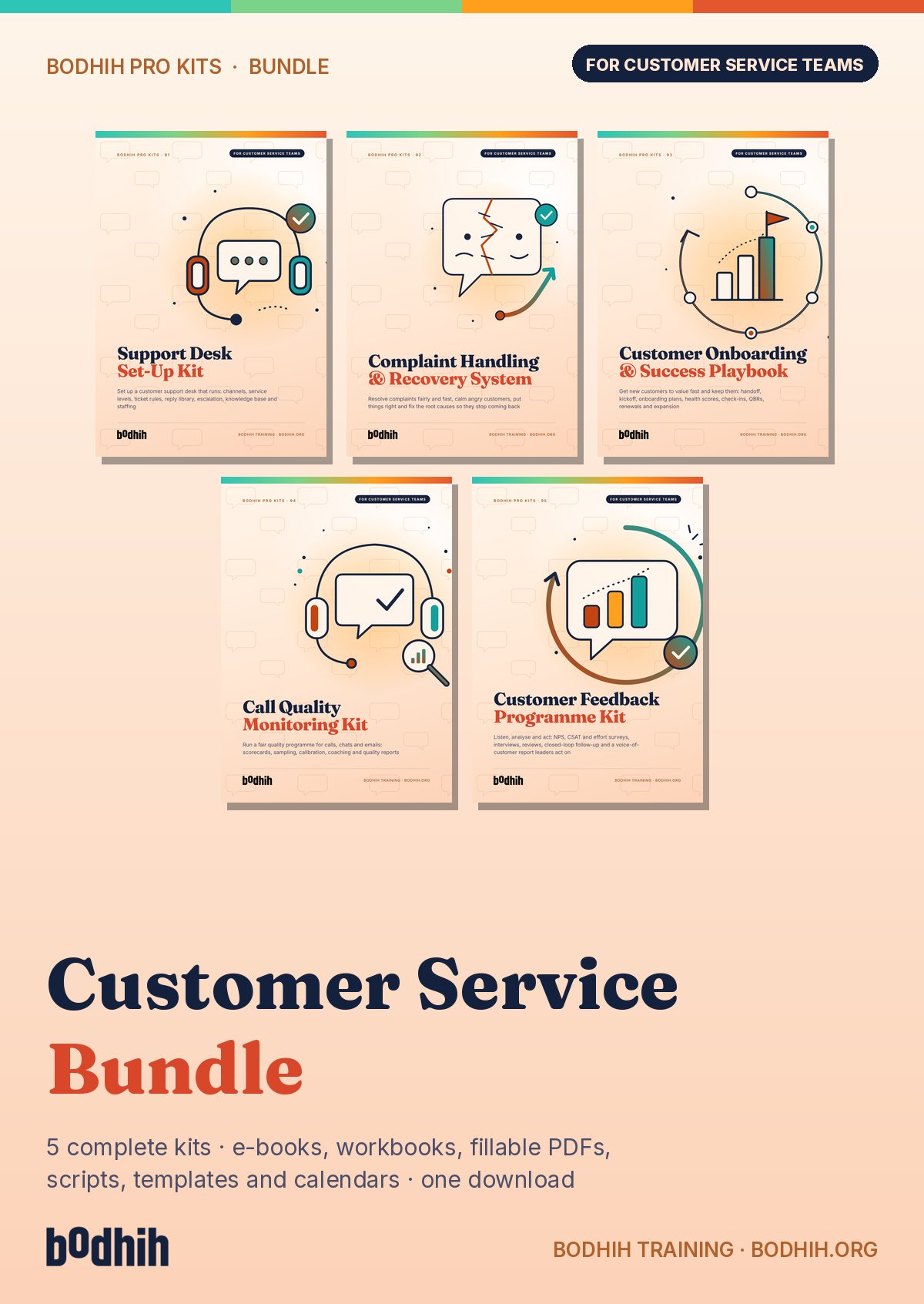
- Readers wanting a support desk or complaints process: The Support Desk Set-Up Kit and The Complaint Handling and Recovery System cover those; this kit goes deep on onboarding and success
Built by trainers, tested in real rooms.
Bodhih Training has designed and delivered corporate programmes since 2008. Bodhih Pro Kits package what works in those workshops into a guide plus the exact tools we use, so you can apply it the same day without a facilitator in the room.
From here to using it in three steps
- STEP 1
Tap Get the kit
Name, email and country. UPI, card or netbanking in India; international cards everywhere else. No account to create.
- STEP 2
Download instantly
Your download page opens at once, with every file and a one-click ZIP. A permanent link lands in your inbox too.
- STEP 3
Open the first tool
Start with the quick-start chapter, then the main spreadsheet or planner. Most buyers use something from the kit the same day.
Your next customer is about to sign. Have the whole playbook ready before they do.
Open the Start Here map, type your settings into the workbook and add the customers you already have. Whether you begin with the e-book this evening or the handoff form on your next deal, the first hour is already planned.
Personal licence for the buyer's own use (and use with your own team or clients where the kit says so). Please don't share or resell the files. Team and company licences: solutions@bodhih.com.
The Bodhih family, when you are ready for more
Hard Talks, Good Outcomes
Scripts for tense conversations.
Run It Like a System
Write SOPs people actually follow.
AssessAll
250+ AI-graded assessments to measure skills and earn verified credentials.
Jobulary
Individual development plans that start from evidence and stay yours.
Bodhih Training
Run this topic as a live workshop for your team, in person or online.
Pewple
Book a vetted coach for career, leadership or communication. Pay per session.
Bodhih.org pathways
Certification pathways in Applied AI, Workplace English and management.
The Customer Onboarding and Success Playbook: FAQs
Read the free guideAlready bought? Resend my linkWhat are the steps in a customer onboarding process?
A written handoff from sales, a kickoff where the customer defines outcomes, a success plan with measures and baselines, a milestone plan to first value, and adoption across every user group, followed by regular reviews and an outcome review at around 90 days. The kit gives each step its own chapter, form or template, and the workbook tracks it.
What is time to first value and what is a good target?
Time to first value is the number of days from contract signature to the first result the customer cares about, such as their first team working live in your product. There is no universal benchmark; set a target that suits your product's complexity, track the median and the share on target, and work backwards from it. The workbook uses 30 days as an editable default.
How do I build a customer health score?
Combine usage, outcomes progress, relationship, support and financial signals, each scored 0 to 100, with weights your team agrees and colour bands that each trigger an action. Test the score every quarter against which customers actually renewed. The Health sheet calculates the weighted score, colour, weakest component and suggested action.
What is the difference between gross and net revenue retention?
Gross revenue retention is the share of starting recurring revenue from existing customers you kept after contraction and churn, ignoring expansion, so it cannot exceed 100%. Net revenue retention adds expansion from the same customers and can exceed 100%. The Retention sheet and the metrics card show both formulas with worked examples.
How do I run a quarterly business review customers value?
Prepare two weeks ahead, agree the agenda with your champion, and build the review around the customer's outcomes: baseline, now and target, value in their language, honest gaps with a plan, and their priorities for the next period. The QBR outline includes a script for every slide and an EBR variant for senior executives.
How do I measure my starting point as a CSM or CS leader?
AssessAll offers assessments that match this kit, including Customer Success & Renewals - Situational Judgement, Customer Success Leadership and the Customer Renewal and Account Risk Assessment for Customer Success and Account Management Teams. Take one before you start and again after a renewal cycle to see what has changed. Links are on the Start Here map; the assessments are separate products and not included in the kit.
How do I turn this into a development plan for myself or my team?
Pick one or two skills from the kit, such as running outcome-based reviews or forecasting renewals honestly, and set a goal for each. Jobulary explains the WOOP method for professional goals, which helps you plan for the obstacles that usually get in the way. The link is on the Start Here map.
Does it work for small customers and digital programmes?
Yes. Segments and coverage come from thresholds you set, the onboarding template includes a digital sequence for small customers, and the Capacity sheet handles pooled programmes. The message library includes automated value summaries and check-ins that reply to a person.
Can I use AI for health scores and call summaries?
Yes, with care. The kit shows where AI helps (summarising calls, drafting, spotting patterns) and sets rules: approved tools only, least data, a person checks every summary and decides any change to coverage, pricing or renewal terms, and customers are told when AI is used. Country rules are in the dated sheet.
Is this legal advice for my country?
No. The kit teaches good practice. Data protection, marketing consent, call recording, AI disclosure and auto-renewal rules differ by country and state, so they sit in one cheat sheet dated October 2026 with what to check. Check your legal team, company policy and local law before acting.
What is the refund policy?
Digital kits are non-refundable once downloaded. The exceptions are corrupted files that are not fixed within 3 working days, duplicate charges, or failed delivery.
How much does The Customer Onboarding and Success Playbook cost?
₹999 including 18% GST for buyers in India, or $29 for buyers outside India. One-time payment, no subscription, with an automatic invoice.
How do I get the files after paying?
Instantly. Your download page opens the moment payment succeeds, and a permanent download link is emailed to you. Download each file separately or everything in one ZIP.
What software do I need?
Any of the usual tools: Excel or Google Sheets for spreadsheets, Word or Google Docs for templates, Adobe Acrobat Reader, Preview, Xodo or GoodNotes for the fillable PDFs, and Google, Outlook or Apple Calendar for the calendar plan.
Can I get a refund?
Because it is a digital download, kits are not refundable once downloaded. We always refund a duplicate charge or a failed delivery, and if a file is corrupted and we cannot fix it within 3 working days. Full terms: bodhih.org/refunds.
Can my company buy this for a team?
Yes. Team and company licences, and workshops on this topic run by Bodhih Training, are available. Write to solutions@bodhih.com or call +91 99000 11601.