How to Run a Household: A Simple Home Management System
By Bodhih Training · UpdatedThe short answer
To run a household well, treat it as a small operation. List its areas, agree a short checkable standard for each, and give every chore one owner, including planning jobs. Put cleaning on a daily and weekly rhythm, put maintenance on a calendar with intervals, keep a home inventory, and record key people, policies, accounts and contacts in an emergency binder without passwords. Review it together for twenty minutes a week.
- Most chore arguments come from a missing standard or a missing owner, not from laziness
- Count minutes and include the thinking work when you judge whether the split is fair
- A 15-minute daily reset plus one zone a day beats a lost Saturday
- Maintenance needs two facts per task: the interval and the last-done date
- An emergency binder is a map of what exists and whom to call, never a list of passwords
- A short weekly household meeting keeps the whole system alive
What does it mean to run a household like a small operation?
Homes rarely feel chaotic because the people in them are careless. They feel chaotic because the work is held in memory and goodwill, and both run out on a busy Tuesday. A well-run small business does not rely on memory. It knows its areas of work, it has an agreed idea of what a finished job looks like, every task has a name beside it, recurring work sits on a calendar, and the important information is written down where more than one person can find it.
You can borrow those five habits without turning your home into an office. People who run large teams at work often find that the household is the hardest operation they are part of, simply because nobody ever set it up. The steps below are that set-up. They work for a single renter, a couple, a family with children, a multi-generation home or four flatmates who met online.
How do you decide who does what at home?
Start with three questions for each part of the home. What is the area? What does 'done' look like? Who owns it? Areas include rooms (kitchen, bathrooms, bedrooms) and functions that have no room, such as food, laundry, paperwork, maintenance, school life and pets. Most households end up with six to twelve.
A standard is a short list anyone can check. 'Keep the kitchen clean' means something different to everyone. 'By 10 p.m.: sink empty, counters wiped, floor swept, bin out if full' does not. Set standards at the level you can sustain in a bad week, and agree them together so that they are 'what we decided' and not one person's private exam.
Then give each chore exactly one owner. The owner is the person who notices the job is due, does it or arranges it, and checks it meets the standard. A job that belongs to everyone tends to belong to no one. Children can own real jobs too, from feeding a pet at six to running their own laundry as teenagers.
- List your areas together in ten minutes
- Write three or four checkable items for the five areas that cause the most friction
- Put one name against every chore; never 'everyone'
- Set a review date four weeks ahead
How do you split chores fairly, including the mental load?
Fairness is hard to judge by feel. The sociologist Allison Daminger, writing in the American Sociological Review in 2019, described the thinking side of housework as four activities: anticipating needs, identifying options, making decisions and monitoring progress. This work produces nothing you can see, so it is easy to overlook, and it often sits with one person. At a global level the imbalance in unpaid work is large: the International Labour Organization reported in 2018 that women perform 76.2 per cent of total hours of unpaid care work, more than three times as much as men.
Whatever your household looks like, the practical fix is the same. Write every chore down, including the thinking ones: planning meals, tracking school forms, noticing what is running low, booking appointments, buying gifts. Estimate how many minutes each takes and how often it happens, so that you compare weekly minutes and not the number of tasks. Ten minutes of bins is not equal to three hours of laundry.
Next, agree what fair means for you. Equal is right for many flat-shares. In a family, paid working hours, study, health and caring for a baby or an elder all change what a fair share is. Finally, hand over whole jobs. If one person still has to remind the other, the reminding person still owns the job. Use AssessAll's Time, Priorities & Focus assessment if you would like an outside measure of how you each handle planning and prioritising.
- Count minutes per week, not tasks
- Add at least one thinking job per area
- Weight the jobs nobody wants, and rotate them
- Trade by preference first, then by time
- Review each quarter and whenever life changes
What is a realistic cleaning schedule for a busy household?
The pattern that fails is familiar: ignore the mess until it is unbearable, then lose a Saturday to it. The pattern that works spreads the same effort across three layers so that no session is large enough to dread.
Each layer has a different job. The daily reset stops clutter and dishes building up. The weekly zones do the real cleaning, one area at a time. The seasonal list catches the jobs that only make sense twice a year. If you miss a zone, let it go: it comes round again in seven days.
| Layer | How long | What it covers | Tip |
|---|---|---|---|
| Daily 15 | 15 minutes, timer on | Dishes, counters, things back in place, one laundry step, quick sweep | Attach it to a fixed moment such as clearing the dinner plates |
| Weekly zones | 20 to 30 minutes a day | One zone per day: bathrooms, bedrooms, kitchen deep spots, floors, living areas | Give each zone an owner; rotate monthly in a flat-share |
| Monthly extras | 30 to 40 minutes | Fridge deep clean, washing machine clean cycle, fans and fittings | Pick one per weekend |
| Seasonal list | Two weekends a year | Curtains, mattresses, behind appliances, windows, wardrobes | Use spring and autumn, before and after the monsoon, or your main festival |
What home maintenance should be on a schedule?
Anything with a filter, a seal, a battery, a moving part or a drain. Walk through your home and list safety items (smoke and carbon monoxide alarms, fire extinguisher, gas hose), water (purifier filters, tanks, water heater, taps), air and climate (air conditioner or heating service and filters, cooker hood), appliances, the building itself (gutters, drains, sealant, damp) and pests. For each task you need two facts: how often it is due and when it was last done. From those you can work out the next due date and see what is overdue.
Some intervals come from official guidance. The US Fire Administration advises testing smoke alarms monthly and replacing the whole unit every ten years, and the UK government's Prepare campaign also suggests a monthly reminder to check smoke alarms. For appliances, the manufacturer's manual is the authority.
Climate changes the calendar. In temperate countries the big moments are spring (gutters, exterior, cooling service) and autumn (heating service, draught-proofing). In monsoon climates they are the weeks before the rains (drains, waterproofing, electrical checks by a licensed professional) and the weeks after (damp, pests, tank cleaning, painting). Renters have a shorter list but still usually handle filters, alarm tests and prompt written reporting; your tenancy agreement says who is responsible for what. Leave gas, mains electrics, work at height and structural repairs to qualified people.
Reading helps; measuring tells you what to work on. These AI-graded assessments on AssessAll pair with this topic:
- Time, Priorities & Focus (AssessAll)
- Family & Elder Caregiving Judgment (AssessAll)
- Everyday Agreements Assessment: Reading What You Are About to Sign (AssessAll)
What should go in a home inventory and an emergency binder?
A home inventory is a record of what you own, made before you need it. The quick method is to film each room slowly with cupboards open, list the big items individually (electronics, appliances, furniture, jewellery, bicycles) with model, purchase date and today's replacement cost, and bundle the small things as lots. Store the list and the video outside the home, for example in cloud storage. Compare the total with the contents cover on your policy and talk to your insurer if the gap is large; policies differ on limits and proof.
An emergency binder answers a different question: if the person who handles everything could not speak for a month, what would the family need to know? It normally covers household members and where ID documents are kept, medical summaries, a list of bank, investment and loan accounts, insurance policies, property papers and how to shut off water, gas and electricity, regular bills and how they are paid, care notes for pets and dependants, and an index of where important documents are.
Treat it as a map, not a vault. Record institutions, account types and the last four digits only. Keep passwords and PINs out of it and note instead where access is held, such as a password manager with an emergency-access feature. The binder is not a will; inheritance, nominations and powers of attorney are legal matters that vary by country, so see a qualified professional. Keep one printed copy locked away and one encrypted digital copy, and tell two trusted people where they are. If you are organising a parent's affairs, AssessAll's Family & Elder Caregiving Judgment assessment is a useful prompt for the decisions involved.
How should a household prepare for emergencies?
Aim to be comfortable for a few days without power, water or open roads, and to know what you would do if you had to leave quickly. The hazards and the official advice differ by place, so your first step is to find your national or local disaster management authority's guidance and save it on your phone. That guidance always takes priority over general articles like this one.
The American Red Cross describes household planning in three steps: discuss which emergencies are most likely where you live, identify each person's responsibilities, and practise. Agree two meeting places and one out-of-town contact. For supplies, Ready.gov, the US government's preparedness site, lists water at one gallon (about 3.8 litres) per person per day for several days, non-perishable food, a torch, a battery or hand-crank radio, a first aid kit, spare batteries and a phone with a backup battery. Add regular medicines, some cash and anything babies, elders or pets need. The UK's Prepare campaign also recommends joining your utility suppliers' priority services registers if someone in the home would need extra support during a supply interruption.
Most homes already own half of this, scattered across cupboards. Gather it on one shelf, list the gaps, and check it every six months.
How do you keep a home management system going?
Systems lapse. Exam season arrives, someone travels, the daily reset slips. What keeps a household system alive is a short weekly meeting: twenty minutes, same time each week. Look at the week ahead, plan seven dinners, check what is due (chores, maintenance, bills, renewals), raise one thing that is bothering someone as a problem with the system and not with a person, and end with a thank-you.
Habits hold better when they are tied to a cue. Psychologists call these implementation intentions, or if-then plans: 'when the plates are cleared, we set the 15-minute timer'. Jobulary has a clear guide to writing if-then plans if you want to practise the technique.
If you would like the whole system ready-made, The Home Ops Manual kit from Bodhih Training includes a workbook with a chore matrix, fairness score, maintenance schedule and inventory, a fillable emergency binder, agreements and checklists. You can also build your own with a notebook and a shared calendar. The tools matter less than the three habits: write it down, give it an owner, put it on a rhythm.
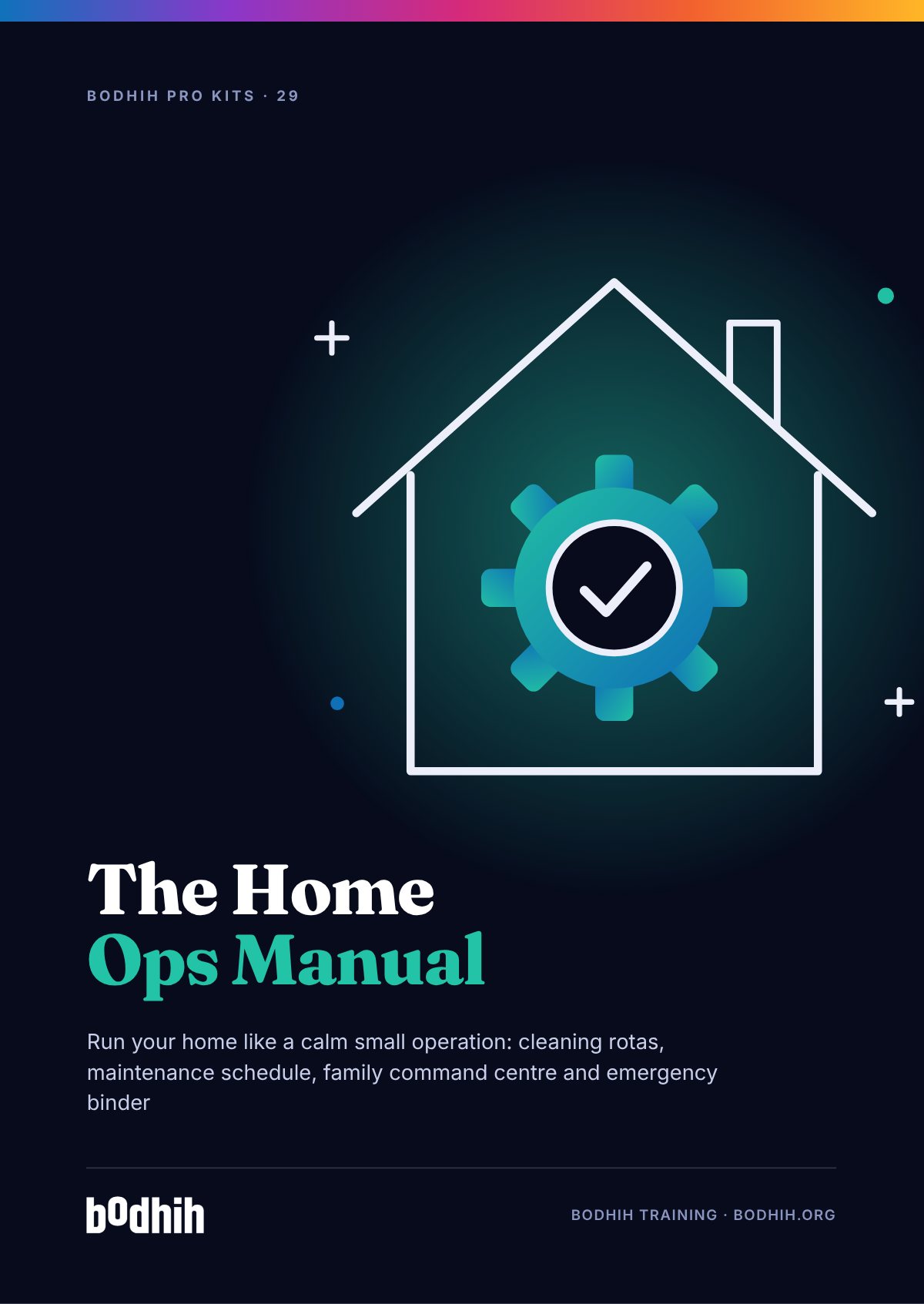
Get the whole system, ready to fill in
The Home Ops Manual kit from Bodhih Training gives you the e-book, a workbook with fairness score and maintenance alerts, a 13-page emergency binder, agreements, cheat sheets and a year of reminders. Open the Chores sheet tonight and name your first owner.
Sources
- Ready.gov (US Government): Build A Kit
- GOV.UK Prepare: Get prepared for emergencies
- American Red Cross: Make a Plan
- US Fire Administration: Smoke alarms
- International Labour Organization: ILO calls for urgent action to prevent looming global care crisis (2018)
- American Sociological Review: Daminger, The Cognitive Dimension of Household Labor (2019)
More from the Bodhih family
Questions people ask next
What is a home management system?
It is a small set of lists and routines that run a household without relying on one person's memory: areas with agreed standards, one owner per chore, a cleaning rhythm, a maintenance calendar, an inventory and an emergency binder, reviewed in a short weekly meeting.
How do couples divide housework fairly?
List every chore including planning and remembering, estimate weekly minutes for each, agree what share is fair given paid work and health, and compare. Then trade whole jobs, from noticing to finishing, until the gap is small. Review every few months.
How many minutes a day should cleaning take?
For many households a 15-minute reset each evening plus one 20 to 30 minute zone on most days is enough to keep a home in good order. The exact time depends on the size of the home, the number of people and your agreed standards.
How often should I test smoke alarms?
The US Fire Administration advises testing monthly and replacing the alarm every ten years; UK government guidance also suggests a monthly check. Follow the instructions for your alarm and the guidance of your local fire service.
Should I write passwords in my emergency binder?
No. A binder can be lost or stolen. Record only where access is kept, for example a password manager with emergency access or a sealed envelope held securely, and list institutions with the last four digits of account numbers.
What is the mental load in a household?
It is the thinking work of running a home: anticipating needs, working out options, deciding and checking that things were done. Research by Allison Daminger describes these four components. Because it is invisible, it needs to be written down to be shared.
How do I make a home inventory for insurance?
Film each room, list high-value items with model, purchase date and replacement cost, group small items into lots, keep receipts or photos as proof, and store copies outside the home. Check your policy for single-item limits and proof requirements.
Is this advice suitable for my country?
The method is general and educational. Tenancy rules, domestic worker law, insurance terms and emergency guidance vary, so check your local authority, your policy documents and qualified professionals for anything legal, financial or safety-related.