How to Plan a Training Session: A Step-by-Step Guide for Trainers
By Bodhih Training · UpdatedThe short answer
To plan a training session, start with the performance gap rather than the topic: find out what people should be doing, what they do now and why. Write three to five observable learning objectives, then build a timed session plan where practice takes the largest share of time. Mark each block core or flex, choose activities that serve an objective, and agree how you will evaluate and follow up before the session runs.
- Begin with a short needs analysis: many performance gaps are not training problems.
- Write objectives with observable verbs; the revised Bloom's taxonomy is a helpful check.
- Give practice the biggest share of time and protect it by marking blocks core or flex.
- Plan evaluation before delivery, working down from the business result.
- Design the follow-up: action plans and manager check-ins are where change happens.
Why do so many training sessions miss the mark?
Most disappointing training is not badly delivered. It is well delivered training for the wrong problem, or training that ends when the session ends. A sponsor asks for 'communication skills', a trainer delivers a pleasant day on listening styles, and nothing changes because the real issue was a missing handover process or a target that rewards the wrong behaviour.
The fix is not more slides or better icebreakers. It is planning in the right order: gap first, objectives second, session design third, and evaluation and follow-up decided before anyone walks into the room. The steps below follow that order. They work whether you are planning a one-hour lunch-and-learn or the first module of a leadership programme.
Step 1: What problem is this training meant to solve?
A training request usually describes a symptom. Your first job is a proportionate needs analysis: a few short conversations that establish what people should be doing, what they are actually doing, and why the difference exists. For a half-day workshop, two fifteen-minute calls (one with someone who will attend, one with their manager) and a short survey are often enough.
A useful test is to ask: if their job depended on it, could they do this correctly today? If the answer is yes, the gap is probably about tools, process, workload, incentives or management, and training alone will not close it. Say so to the sponsor. It is one of the most valuable things a trainer can do, and the CIPD's guidance on learning evaluation makes a related point: evaluation only makes sense when learning is linked to identified performance gaps.
- What will be different if this works? Ask for something you could see or measure.
- What is happening now? Get recent, specific examples and any numbers already tracked.
- Who is the audience, and what do they already know?
- What else gets in the way: systems, workload, unclear expectations?
- How will we know it worked, 30 to 90 days later?
Step 2: How do you write learning objectives people can see?
A learning objective is a promise about what participants will be able to do at the end. Avoid verbs you cannot observe, such as understand, know, appreciate or be aware of. Use verbs that describe visible behaviour, add the conditions, and add a standard.
Bloom's taxonomy, revised in 2001 by Lorin Anderson and David Krathwohl, is the classic tool here. As the University of Waterloo's Centre for Teaching Excellence explains, the revision reframed the levels as verbs, with 'create' at the top: remember, understand, apply, analyse, evaluate and create. If every objective in your plan sits at remember and understand, you are planning a lecture. Aim for three to five objectives per half-day; more than that usually means you are listing topics.
| Weak objective | Stronger objective | Bloom's level |
|---|---|---|
| Understand complaint handling | Handle a recorded complaint role-play using a four-step structure without escalating | Apply |
| Be aware of customer needs | Identify the likely need behind six real customer emails and draft a first reply | Analyse |
| Know the refund policy | Choose the right option for three borderline cases and justify it to a peer | Evaluate |
| Appreciate good feedback | Rewrite five judgement statements as observable behaviours | Apply |
Step 3: How do you build a minute-by-minute session plan?
A session plan is how you decide, with a clear head, what gets your limited time. It also tells you what to cut when the day runs late, so you cut the right thing rather than the last thing. Build it in passes rather than top to bottom.
First, fix the boundaries: start, finish, breaks. Second, place your core practice activities in the strongest energy slots (mid-morning is usually good; straight after lunch usually is not). Third, wrap each objective in a simple cycle: connect it to real work, give just enough concept, practise, then reflect. Fourth, add a proper opening and close, including action planning. Fifth, mark every block core or flex. Finally, add a few minutes of buffer per ninety minutes, because moving people into groups always takes longer than you expect.
| Start | Mins | Block | Core or flex |
|---|---|---|---|
| 09:00 | 15 | Welcome, objectives, pairs connector | Core |
| 09:15 | 20 | Connect: best and worst examples in trios | Core |
| 09:35 | 15 | Concept: a simple structure | Core |
| 09:50 | 10 | Facilitator demonstration | Flex |
| 10:00 | 35 | Practice round 1 with observer checklist | Core |
| 10:35 | 15 | Break | Core |
| 10:50 | 10 | Energiser | Flex |
| 11:00 | 35 | Practice round 2, harder scenarios | Core |
| 11:35 | 15 | Debrief | Core |
| 11:50 | 10 | Action plan and feedback | Core |
How do you choose the right activities?
Every activity should help someone meet an objective. Match the activity to the level of the objective: quizzes and card sorts for remembering, practice with feedback for applying, case studies and debates for analysing and evaluating, and time to build something real for creating.
Energisers are different. Their job is to change the state of the room in three to five minutes, not to teach. Use them when energy dips, mark them flex, and always offer a pass or observer option so nobody is put on the spot. A simple test for any activity: if you deleted it, would participants miss anything they need? If not, it is optional.
- Openers build safety and connection: pairs share, human scale, hopes and hesitations.
- Practice activities build skill: trio role-plays, case clinics, teach-backs.
- Review games build memory: three-two-one, quiz show, explain it to a new starter.
- Closers build commitment: commitment circle, letter to self.
Reading helps; measuring tells you what to work on. These AI-graded assessments on AssessAll pair with this topic:
- Training Facilitation and Group Handling (AssessAll)
- Lesson Design and Questioning Technique (AssessAll)
- Training Evaluation and Programme Effectiveness (AssessAll)
How long should a training session be?
There is no single right length, but there are useful rules of thumb. Many experienced facilitators avoid any single block of one-way input longer than about ten to fifteen minutes before participants do something. In person, a half-day can comfortably carry three to five objectives. Online, attention is harder to hold, so two ninety-minute sessions usually work better than one three-hour block, and the mode of interaction should change every few minutes: chat, poll, breakout, whiteboard, workbook.
If you are short of time, cut input, not practice. A session that covers less but lets people practise twice will usually change more behaviour than one that covers everything once.
How will you know the session worked?
Decide this before you deliver. The most widely used frame is Donald Kirkpatrick's four levels, now maintained by Kirkpatrick Partners: Level 1 reaction (did people find it engaging and relevant?), Level 2 learning (did they acquire the knowledge, skills, confidence and commitment?), Level 3 behaviour (are they applying it on the job?) and Level 4 results (did the targeted organisational outcomes occur?).
Plan from the top down: agree the business result, then the behaviours that would produce it, then the learning needed, then the session. Measure from the bottom up. Keep it proportionate. A one-hour briefing may only need a feedback form and a quick skills check; a six-month programme deserves all four levels, using data the business already collects.
| Level | Question | Typical evidence | When |
|---|---|---|---|
| 1 Reaction | Was it relevant and engaging? | Feedback form with intended-use questions | End of session |
| 2 Learning | Can they do it? | Observed practice, skills check, quiz | During session |
| 3 Behaviour | Are they doing it at work? | Manager check-in, work samples | 30 to 90 days |
| 4 Results | Did the target measure move? | Existing business data | 3 to 6 months |
How do you make the learning stick after the session?
Transfer of learning is where the value of training lives, and it is mostly decided outside the room. Brief managers beforehand and ask them to have a two-minute conversation with each participant about what they want from the session. During the session, use real work examples and leave at least fifteen minutes for action planning. Afterwards, send a short follow-up within two days and schedule a check-in at two to four weeks.
Make action plans specific. 'Listen more' is a wish. 'When Ravi brings me a late report on Friday, I will describe the behaviour and its impact before suggesting a fix' is a plan. Linking each action to a real trigger, an approach known as an implementation intention, makes follow-through more likely.
The Center for Creative Leadership's 70-20-10 research is a useful reminder that formal training is only one part of development: much of it comes from challenging experience and from relationships such as coaching. Jobulary's explanation of the 70-20-10 model is a good starting point if you want participants to turn their action plan into a wider development plan. Treat the numbers as a rough guide; the point is to design for what happens back at work.
What should a complete training plan include?
Pull it together into a short pack you can reuse and improve. If you would like templates for every item, The Facilitator's Workbook Kit from Bodhih Training includes a needs questionnaire, a minute-by-minute session plan, a participant workbook, a feedback form, action plans and an L&D tracker that records evidence at all four Kirkpatrick levels. If you want an honest picture of your own design skills first, AssessAll's Lesson Design and Questioning Technique assessment is a practical place to start.
- A one-page needs summary, including any non-training issues for the sponsor.
- Three to five observable objectives.
- A timed session plan with core and flex blocks and a cut list.
- A participant workbook or handout for activities and action planning.
- A feedback form that asks about relevance and intended use.
- An evaluation plan covering the levels that matter for this programme.
- A follow-up email and manager check-in, scheduled before the session runs.
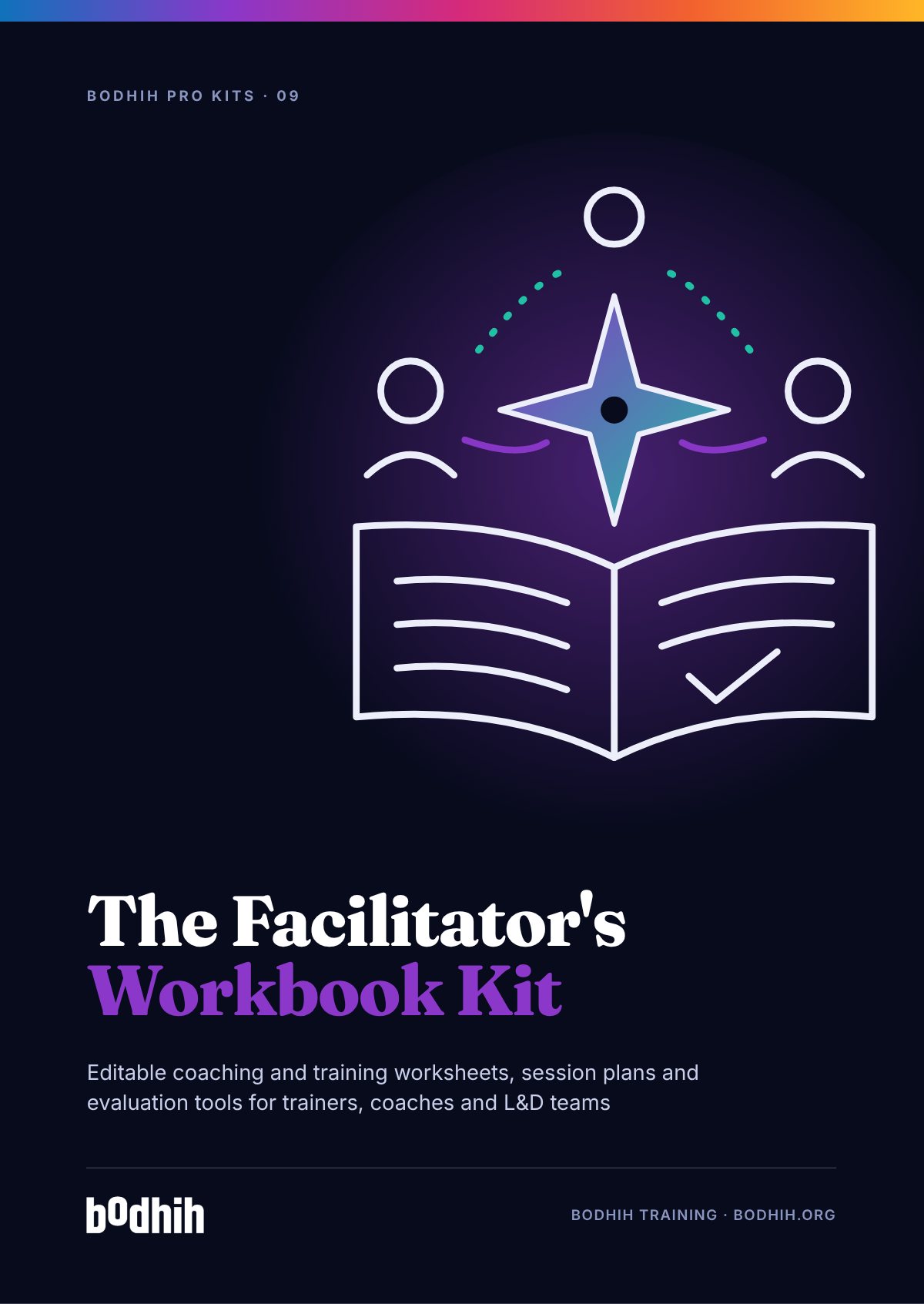
Plan your next session with ready-made templates
The Facilitator's Workbook Kit gives you the method and 14 editable tools, from needs analysis to the 90-day check-in, so your next session is planned, delivered and evaluated with confidence.
More from the Bodhih family
Questions people ask next
What is the first step in planning a training session?
Find the performance gap. Talk briefly to the sponsor, to someone who will attend and to their manager to establish what people should be doing, what they do now and why. Only then write objectives and design activities.
How many learning objectives should a session have?
Three to five for a half-day is a sensible range. Each should start with an observable verb and suggest an activity that would show whether it has been met. More than that usually means you are listing topics.
What is the difference between a session plan and a lesson plan?
They are closely related. In workplace training, a session plan usually adds business context, participant numbers, materials, room or platform set-up and a core or flex marker for each block so the facilitator knows what to cut if time runs short.
How much of a training session should be practice?
There is no fixed percentage, but practice with feedback should normally be the largest single share of time. If one-way input dominates your plan, look for blocks to turn into activities.
What is the Kirkpatrick model?
It is a four-level model for evaluating training, originated by Donald Kirkpatrick: reaction, learning, behaviour and results. It is used to plan evaluation from the business result down and to gather evidence from reaction up.
How do I plan a virtual training session differently?
Keep sessions shorter, use a producer to manage technology and breakouts if you can, change the type of interaction every few minutes, and give written instructions for every activity. Send a workbook in advance so people can work away from the screen.
Should I use icebreakers?
Use them when they have a job: building safety at the start, changing energy after lunch or linking lightly to the topic. Avoid anything that forces personal disclosure or physical contact, and always offer a pass option.