How to Recover From Burnout at Work: A Practical 7-Step Guide
By Bodhih Training · UpdatedThe short answer
To recover from burnout at work, treat it as a mismatch between you and your job rather than a personal failing. Track your energy for a few weeks, identify which area of work is draining you (workload, control, reward, community, fairness or values), make your workload visible, have a prepared conversation with your manager, set one clear boundary and build small recovery habits into every day. See a doctor if symptoms persist or spread beyond work.
- The WHO describes burnout as an occupational phenomenon resulting from chronic workplace stress that has not been successfully managed, not as a medical condition.
- Burnout has three parts: exhaustion, mental distance or cynicism, and reduced professional efficacy.
- Self-care alone rarely works if the cause is in the job; find the mismatch first.
- Putting your workload in hours turns a vague complaint into a problem your manager can act on.
- Recovery is daily, not annual: detachment, relaxation, mastery and control all help.
- Talk to a doctor if low mood lasts more than two weeks or affects life outside work.
What is burnout, according to the WHO?
In 2019 the World Health Organization included burn-out in the eleventh revision of the International Classification of Diseases, ICD-11. It sits in the chapter on factors influencing health status, not among medical conditions. The WHO describes it as a syndrome resulting from chronic workplace stress that has not been successfully managed, and it says the term should be used only for experiences at work.
The WHO names three dimensions, which closely follow decades of research led by the psychologist Christina Maslach: feelings of energy depletion or exhaustion; increased mental distance from your job, or cynicism and negativity about it; and reduced professional efficacy. Most people think burnout simply means very tired. In practice, the cynicism and the sense that nothing you do matters are often what hurt most.
This matters for recovery. If burnout were only exhaustion, rest would cure it. Because it also involves how you relate to the work, recovery usually needs changes to the work as well as to your habits.
How do I know if it is burnout or just stress?
Stress usually feels like pressure and urgency linked to a particular demand, and it eases quickly once the demand passes. Burnout feels more like depletion, detachment and futility, and it builds over months of conditions that do not change. Depression is different again: low mood and loss of interest that spread across every part of life, which needs a professional to assess.
The table below is a rough guide to help you think, not a way to diagnose yourself.
| Everyday stress | Burnout | Depression | |
|---|---|---|---|
| Main feeling | Pressure, urgency | Depletion, cynicism, futility | Low mood, loss of interest across life |
| Linked to | A specific demand | Chronic work conditions | Can affect every area of life |
| Does rest help? | Usually, quickly | Partly and slowly | Often not enough on its own |
| Who to talk to | Manager, peers | Manager, HR, EAP, doctor | Doctor or mental health professional |
What are the early warning signs of burnout?
Burnout tends to drift in rather than arrive. A helpful picture is a traffic light. In the green zone you feel stretched but recover. In the amber zone, recovery stops keeping up: weekends do not refill you and you start cutting things that look optional. In the red zone, exhaustion, cynicism and inefficacy are all present for weeks and your health or relationships are suffering.
The goal is to notice amber early. Watch for clusters of these signs lasting more than a couple of weeks:
- Body: waking tired, broken sleep, frequent headaches or colds, more caffeine or alcohol.
- Mind: rereading emails, forgetting simple tasks, struggling to decide, constant low worry about work.
- Feelings: irritability, Sunday-evening dread, flatness, cynical jokes.
- Behaviour: working through breaks, checking email in bed, dropping hobbies and friends.
Step 1 and 2: How do I find out what is really causing it?
Step one is to track a few simple ratings for two to four weeks. Each evening, rate your energy, sleep quality, calm and how well you switched off from work on a 1 to 5 scale, and add a one-line note. Look at weekly averages rather than individual days. Patterns in the notes often point straight to the problem. The Energy and Recovery Tracker in our Reset, Not Resign kit does the averaging for you.
Step two is to look at the fit between you and the work. Christina Maslach and Michael Leiter describe six areas of worklife where mismatches feed burnout: workload, control, reward, community, fairness and values. Rate each from 1 (poor fit) to 5 (good fit) for the last three months, then write one concrete example for your two lowest scores. Sort each example into what you can change, what you can influence by asking, and what you may have to accept.
Research from Gallup, based on a study of nearly 7,500 full-time employees published in 2018, pointed in the same direction. The top factors it linked to burnout were unfair treatment at work, unmanageable workload, lack of role clarity, lack of communication and support from a manager, and unreasonable time pressure. None of those can be fixed by a meditation app alone.
Step 3: How do I make my workload visible?
You cannot negotiate a workload nobody can see. List every commitment: projects, recurring tasks, reports, committees and the favours that became permanent. Estimate weekly hours for each, add meetings, email and admin, and compare the total with your contracted hours. The difference is your overload number.
Then tag each item as high, medium or low value and note who asked for it. Old commitments often outlive their purpose. A finance manager we worked with discovered she was carrying 47 hours of commitments against a 40-hour contract, including a weekly report nobody had read for a year. That single number changed her next conversation.
Reading helps; measuring tells you what to work on. These AI-graded assessments on AssessAll pair with this topic:
- Resilience & Stress Management (AssessAll)
- Behaviour Under Pressure Assessment (AssessAll)
- Work Environment and Job Demands Assessment (AssessAll)
Step 4: How do I talk to my manager about burnout?
Prepare it like a short business case. A simple structure is PLAN: Picture the facts (hours, commitments, what has changed), Link them to the impact on the work, Ask for something specific, and Negotiate with two or three options. Options let your manager say yes to something rather than solving everything on the spot.
You choose how much personal detail to share. A sentence such as 'the pace is affecting my sleep and concentration and I want to fix it before it affects my work more' is honest without being a medical disclosure. Book 30 minutes with a clear title, avoid Friday afternoons, and send a short summary email within a day so there is a record of what was agreed.
If you have a health condition, you may have rights to reasonable adjustments. Check your company policy, HR and local employment law.
Step 5 and 6: What actually helps you recover day to day?
Recovery is the process of replenishing the energy you spend at work, and it works best daily. Psychologists Sabine Sonnentag and Charlotte Fritz described four recovery experiences that remain a practical guide: psychological detachment (switching off mentally), relaxation, mastery (absorbing challenges outside work) and control over your own time.
Step five is to build a simple routine around them. Step six is to set one clear boundary that protects it.
- Pick a shutdown time and a short shutdown ritual: write tomorrow's top three and close work for the day.
- Put two 10-minute micro-breaks in your calendar each day. Walk, stretch, look out of a window or refill your water.
- Choose one relaxing evening activity and one absorbing weekly activity, such as a class or a sport.
- Protect a few hours at the weekend that are fully yours.
- Set one specific time boundary, agree an emergency route for genuine urgencies, and let notification schedules hold it.
- Look after the basics: regular sleep and wake times, movement, regular meals, daylight and time with people you like.
Step 7: When should I see a doctor or quit my job?
Please talk to a doctor or GP if low mood, anxiety or numbness lasts more than two weeks, spreads beyond work, or comes with loss of interest in things you used to enjoy, big changes in sleep or appetite, or reliance on alcohol to cope. A doctor can also check for physical causes, since several conditions can mimic burnout. Many employers offer free, confidential counselling through an Employee Assistance Programme. If you ever feel unsafe or think about harming yourself, contact local emergency services or a crisis helpline immediately.
As for resigning: sometimes it is the right answer, especially when the mismatch is about values or fairness that are built into the organisation. But exhausted brains overweight short-term relief. Before deciding, ask whether you have clearly raised the problem with someone who can change it, whether the mismatch is fixable where you are, and whether you are running towards something or only away. If leaving is right, plan it so you leave rested and with options.
What can managers do to prevent burnout on their team?
Managers shape most of the conditions linked to burnout. Hold a 20-minute wellbeing check-in with each person every month, separate from performance reviews, and ask open questions about workload, support and fairness. Track team trends, fix problems at team level (visible rotas, response-time norms, meeting-free mornings) and model healthy behaviour yourself, because people copy what you do more than what you say.
In the UK, the Health and Safety Executive's Management Standards give employers a framework for assessing work-related stress across demands, control, support, relationships, role and change. Other countries have their own rules, so check local guidance with HR. The WHO's 2022 guidelines on mental health at work also recommend organisational interventions and manager training.
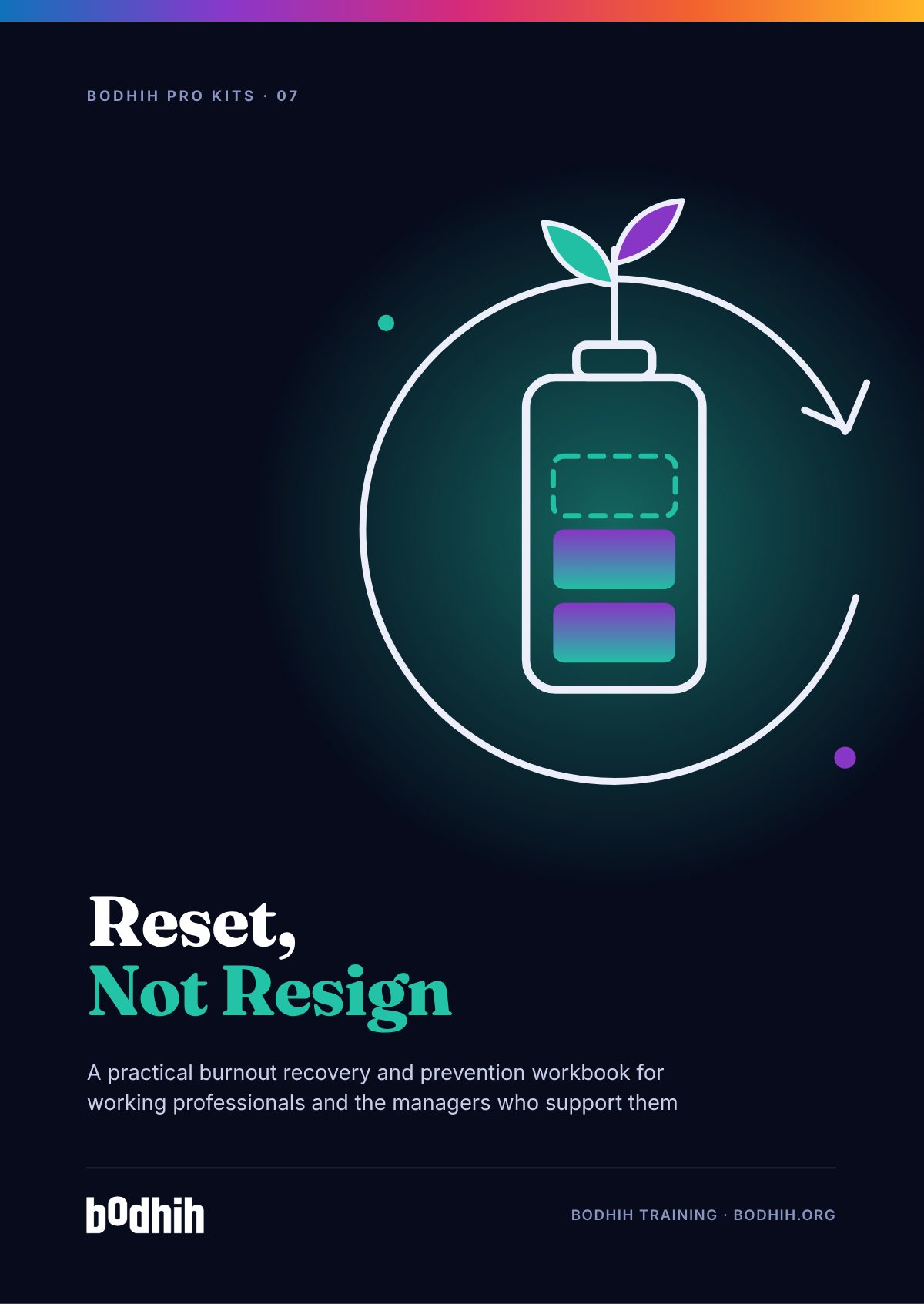
Want the tools to do this properly?
Reset, Not Resign, the Bodhih Burnout Recovery Kit, gives you the e-book plus an energy and recovery tracker, workload map, manager conversation scripts, a team wellbeing guide and a 28-day plan you can start tonight.
Sources
- World Health Organization: Burn-out an occupational phenomenon: International Classification of Diseases
- World Psychiatry (Maslach and Leiter, 2016): Understanding the burnout experience: recent research and its implications for psychiatry
- Gallup: Employee Burnout, Part 1: The 5 Main Causes
- Health and Safety Executive: What are the Management Standards?
- World Health Organization: Guidelines on mental health at work (2022)
More from the Bodhih family
Questions people ask next
How long does it take to recover from burnout?
It varies widely. Many people notice small improvements within a few weeks once recovery habits and workload changes are in place, while deeper recovery can take months, especially if the causes at work stay the same. Tracking weekly averages helps you see progress that is easy to miss day to day.
Is burnout a medical diagnosis?
Not in the WHO's classification. ICD-11 lists burn-out as an occupational phenomenon under factors influencing health status, not as a medical condition. It can overlap with conditions such as depression or anxiety, which a doctor can assess.
Can you recover from burnout without quitting your job?
Often, yes, particularly when the main mismatch is workload, role clarity or a fixable process. Making your workload visible, having a prepared conversation with your manager and building daily recovery can make a real difference. If core values or fairness problems cannot change, leaving may be the healthier long-term choice.
Will a holiday fix burnout?
A holiday helps, but on its own it rarely lasts if you return to the same conditions. Recovery works best in small daily amounts, combined with changes to the work that caused the strain.
How do I measure my stress and resilience?
Simple daily ratings give you a personal trend. For a more structured baseline, the AssessAll Resilience and Stress Management assessment measures how you handle pressure, and you can repeat it later to compare.
How do I turn burnout recovery into a plan I stick to?
Write down three habits, one boundary and one workplace change, each with a date. Jobulary's guide to using the fresh-start effect to reset a goal is a useful companion, and fresh starts like a new month are good moments to begin.
What should I say to my manager if I am burnt out?
Lead with facts and options: your weekly hours against your contract, the impact on the work, what you need and two or three possible solutions. You do not have to share medical details unless you choose to.