How to build a skills matrix and start skills-based hiring
The short answer
To build a skills matrix and start skills-based hiring, define 25 to 40 skills with one 0-4 scale, rate each person with their manager and calibrate, read gaps against each role's needs, rewrite roles on must-have and trainable skills, test every degree requirement, hire with a short work sample and a structured interview, and check selection rates at every stage.
Want the tools, not just the method? The The Skills Matrix and Skills-Based Hiring Kit kit turns this guide into ready-to-use templates, spreadsheets and printables, with an instant download.
- Start small: 25 to 40 skills and one 0-4 scale for everything.
- Rate skills seen at work, with the employee, then calibrate across managers.
- Depth matters: a skill with fewer than two people at level 3 is a key-person risk.
- Changing 'degree required' to 'preferred' is not a fix; test the need and record it.
- Work samples and structured interviews are job-related and score well in validity research.
- A four-fifths flag is a prompt to review a step, never proof either way.
What are the steps to build a skills matrix and move to skills-based hiring?
The same eight steps work for one team of 12 or an organisation of thousands. The order matters: the library and scale come first because every later step depends on them.
- 1. Score where you stand on a 0-4 maturity scale and agree a sponsor, scope and limits (for example: skills ratings will not be used on their own for pay or redundancy).
- 2. Build a small skills library in your own words, checked against open frameworks such as ESCO and O*NET, with one 0-4 proficiency scale for every skill.
- 3. Rate one team: each person and their manager rate separately, agree, then calibrate with other managers.
- 4. Read the gap heat map, coverage and depth, and decide build, borrow, buy or move for every red cell and key-person risk.
- 5. Rewrite role profiles on five to eight must-have skills, with everything else trainable, and run a necessity test on every degree requirement.
- 6. Hire with a short job-related work sample and a structured interview scored on anchored scales.
- 7. Check selection rates and impact ratios at every stage, and record what you did about each flag.
- 8. Open internal gigs and upskilling plans from the gaps, and register every AI tool that touches talent decisions.
| Weeks | Focus | Done when |
|---|---|---|
| 1-2 | Score, sponsor, consult employee representatives | Decision memo signed with limits |
| 2-5 | Library, scale, degree review | Library approved; every degree requirement decided |
| 4-7 | First team matrix and calibration | Heat map read; decisions against every flag |
| 5-11 | Adverts, work sample, structured interview, campaign | Campaign logged; selection rates checked |
| 3-12 | Gigs, upskilling plans, AI tools register | Every red cell owned; no unreviewed AI ranking |
| 12 | Pilot review | Scale, extend or stop, in writing |
What is a skills matrix, and what should it show?
A skills matrix lists people against skills, with each person's current level. On its own it is a snapshot. It becomes useful when you compare each level with what the person's role needs and when the ratings rest on evidence rather than impressions.
Three readings matter. Read across a row to see one person's development needs. Read down a column to see a team gap. Read the depth line, the number of people at level 3 or 4 on each skill, to see risk: a skill with fewer than two people at that level depends on one person, or nobody, to cover absence, check work and coach others.
Use one scale for every skill. A simple one works: 0 none, 1 aware, 2 working (routine work unaided), 3 skilled (complex cases independently, checks others), 4 expert (sets the standard and teaches). Describe behaviour you can see; never years, qualifications or personality.
Keep the matrix to the skills that decide the team's work, up to about ten, and set each role's required level from its role profile, agreed with the manager. The required level is what the job needs today, not a stretch target. Re-rate every six months so the picture does not go stale, and treat a skills rating as a different thing from a performance rating: one describes what someone can do, the other how the year went.
How do you rate a team fairly?
Ratings go wrong in predictable ways: one strong skill lifts every rating (halo), last week's incident decides (recency), people who remind the rater of themselves score higher (similarity), everyone gets the middle score, or one manager rates high and another low.
The fixes are simple. The employee rates first and the manager second, then they meet and look at real work where they differ. Managers in the same job family then calibrate: they compare ratings and the evidence behind any 3 or 4, so a 3 means the same in every team. Use person IDs rather than names in anything shared beyond the team, and say plainly what the ratings will and will not be used for.
Worked example: what a heat map tells you
Here is a fictional 14-person payments investigations team rated on ten skills after calibration. Of 140 person-skill ratings, 45 fell short of the role's requirement, a coverage of 68%. The table shows four of the ten skills.
Coverage is the share of person-skill ratings at or above the role's requirement: (140 - 45) / 140 = 68%. Gap points add up how far short each person is, so one person two levels short counts twice. The two numbers answer different questions: coverage says how widespread the gap is, gap points how deep, and depth says whether anyone can teach it.
| Skill | People below required | Gap points | People at level 3 or 4 | Reading |
|---|---|---|---|---|
| SQL | 8 | 9 | 0 | Biggest gap and key-person risk: build and borrow |
| Process improvement | 8 | 8 | 0 | Key-person risk: workshop plus two projects |
| Financial crime | 7 | 7 | 3 | Wide gap, decent depth: shadowing |
| Written comms | 4 | 4 | 10 | Strength: ten people can coach |
Should you remove degree requirements?
Often, but not blindly. Ask four questions for every role that asks for a degree. Does a law, regulator or licensing body require it? If not, does the work need knowledge only a degree course reliably teaches? If it does, could a work sample, portfolio, apprenticeship or prior work show the same? If the answers are no, no, then remove the degree and assess the skills directly; if a work sample could show it, replace the degree with 'a degree or equivalent evidence of' the named skills.
Two traps are common. Changing 'required' to 'preferred' still filters people out at the sift. Swapping the degree for 'five years' experience' replaces one proxy with another. And the evidence suggests that removing the requirement on paper is not enough: a February 2024 report by the Harvard Business School Project on Managing the Future of Work and the Burning Glass Institute found skills-based hiring changed the outcome for fewer than one in 700 hires in the previous year, even where firms had dropped degree requirements.
Which selection methods work best for skills-based hiring?
Methods that look directly at job-related skills, consistently, do well. In revised estimates published in the Journal of Applied Psychology in 2022, Sackett, Zhang, Berry and Lievens put structured interviews at about .42, job knowledge tests at .40, work samples at .33 and general cognitive ability at .31.
For high-volume roles, combine a short work sample (20 to 40 minutes, built from a real task with fictional data, scored by rubric without the CV) with a structured interview (the same questions for everyone, anchored rating scales written in advance, and two interviewers who score before they discuss). Offer adjustments in every invitation and trial the task on three current staff before it goes live.
Reading helps; measuring tells you what to work on. These AI-graded assessments on AssessAll pair with this topic:
How do you check that skills-based selection is fair?
Measure every stage. For each group you may or must monitor, divide those who advanced by those who entered to get a selection rate, then divide each group's rate by the highest rate in the same dimension to get an impact ratio. The US Uniform Guidelines treat a rate below four-fifths (0.8) of the highest group's rate as generally indicating adverse impact; many employers elsewhere use 0.8 as a review point.
Read with care. In the fictional example, 9 of 19 applicants aged 40 and over passed the work sample (47.4%) against 29 of 52 under 40 (55.8%), a ratio of 0.85. That is above 0.8, but 19 people is a small group, so the right response is to check the task's content, timing and instructions, record what you found, and pool the next campaign before concluding anything.
Rules differ by place. Great Britain uses the Equality Act 2010; Northern Ireland has separate laws and, for registered employers, community background monitoring; some US cities and states regulate automated hiring tools; the EU AI Act treats AI in recruitment as high-risk. Check the official source for each place you hire.
| Group (work sample stage) | Completed | Passed | Selection rate | Impact ratio |
|---|---|---|---|---|
| Female | 37 | 21 | 56.8% | 1.00 |
| Male | 34 | 17 | 50.0% | 0.88 |
| Protestant | 29 | 16 | 55.2% | 1.00 |
| Roman Catholic | 31 | 17 | 54.8% | 0.99 |
| Not determined | 11 | 5 | 45.5% | 0.82 |
| Under 40 | 52 | 29 | 55.8% | 1.00 |
| 40 and over | 19 | 9 | 47.4% | 0.85 |
What about AI skills inference and AI screening tools?
Many HR and learning systems now infer skills from CVs, courses or activity, or rank applicants against a job description. Inference can speed up a first draft of a profile, but it can credit courses people clicked through, miss skills that leave no digital trace and carry historical patterns that disadvantage some groups.
Match controls to how much a tool decides. Admin tools need registering. Tools that assist need a notice and human editing. Tools that materially influence who is seen or shortlisted need validity and fairness evidence, a named reviewer who can overrule them, notices and monitoring. Treat inferred skills as suggestions until the employee confirms them or a person checks the evidence, and do not use them for selection or pay before that.
What are the most common mistakes?
- Building a 600-skill taxonomy before rating anyone.
- Copying framework text instead of writing your own definitions and checking licences.
- Using different scales for different skills.
- Relying on self-ratings alone.
- Rating potential or personality instead of skills seen at work.
- Changing 'degree required' to 'degree preferred'.
- Keeping unstructured 'chemistry' interviews.
- Treating a ratio above 0.8 as clearance.
- Switching on AI features because they came with the system.
- Promising leaders savings or lower turnover you have not measured.
Where do the kit and other tools fit?
You can run every step above in a spreadsheet. If you want the files ready-made, Bodhih Training's Skills Matrix and Skills-Based Hiring Kit includes the workbook with the matrix, heat map, degree review and selection-rate sheets, the forms, templates, a dated rules sheet and an e-book that follows one operations centre through a 12-week pilot. For an independent view of your HR team's own analysis skills, AssessAll's Training Needs Analysis Work Sample is a practical starting point. To turn one gap into a personal plan, Jobulary's guide to the WOOP method is a good next step.
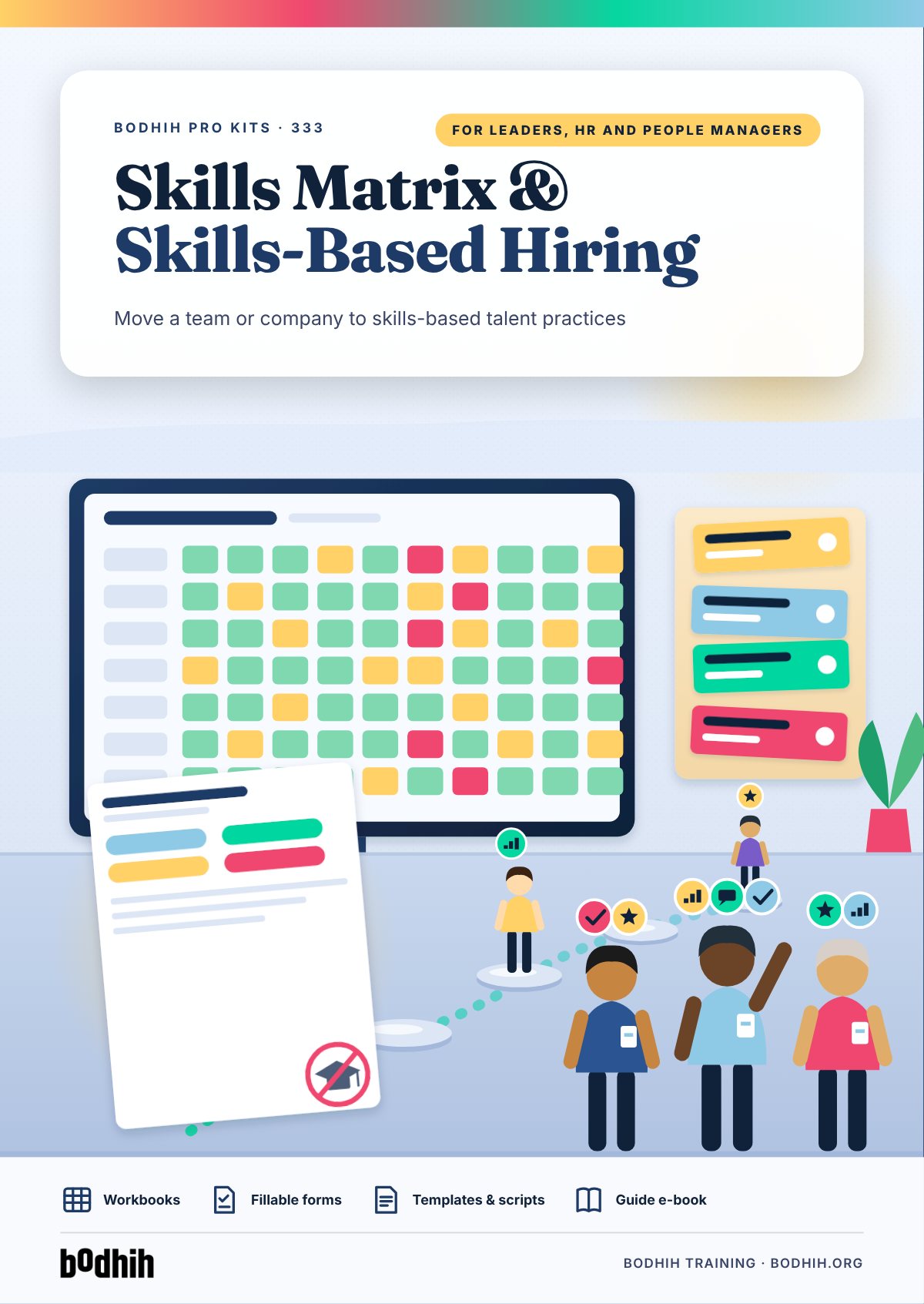
Run it with ready-made files
The Skills Matrix and Skills-Based Hiring Kit gives you the workbook, forms, templates and dated rules sheet to run a 12-week pilot from the first score to the scale-up decision.
Sources
- eCFR: 29 CFR Part 1607, Uniform Guidelines on Employee Selection Procedures (1978)
- US EEOC: Prohibited employment policies and practices
- legislation.gov.uk: Equality Act 2010
- Equality Commission for Northern Ireland: Article 55 reviews
- European Commission AI Act Service Desk: Annex III high-risk AI systems
- NYC Department of Consumer and Worker Protection: Automated employment decision tools
- European Commission: ESCO
- O*NET Resource Center: O*NET database
- SIOP: Is cognitive ability the best predictor of job performance?
- Burning Glass Institute and Harvard Business School: Skills-Based Hiring, the Long Road from Pronouncements to Practice
More from the Bodhih family
Questions people ask next
How many skills should a skills matrix have?
For one team, up to ten skills that decide the team's work. For a library across several roles, 25 to 40 is plenty to start. Bigger libraries tend not to be used.
What scale should I use for a skills matrix?
One scale for every skill. A five-point 0-4 scale (none, aware, working, skilled, expert) with behavioural descriptions works well and lets the matrix, role profiles, interviews and development plans use the same language.
Is a skills matrix the same as a competency framework?
They overlap. A competency framework usually describes behaviours expected across roles; a skills matrix records the levels particular people hold against particular skills. Many organisations use the framework as the library behind the matrix.
Can I use ESCO, O*NET or SFIA for my skills library?
Yes, as references. Write your own definitions and note which framework you checked. ESCO and O*NET are published for reuse with credit; SFIA allows many internal uses free but requires a licence for some larger-organisation and commercial uses, so read its licensing page.
Is removing degree requirements legal?
Removing a requirement the job does not need is generally lawful and can reduce the risk of indirect discrimination. Keep any qualification a regulator or licensing body requires, and check local rules with your adviser.
What is an impact ratio?
A group's selection rate at a stage divided by the highest group's rate in the same dimension at that stage. Below 0.8 is the common review point; small groups need extra caution.
Should we use AI to infer employee skills?
Only with care: show inferred skills to employees as suggestions, let them correct them, and do not use them for selection or pay until confirmed. Assess the tool for accuracy, fairness, notices and data protection first.
How long does a skills-based hiring pilot take?
A focused pilot in two or three job families can run in about 12 weeks: library and scale, one or two team matrices, role profiles and a degree review, one campaign with a work sample and structured interview, and selection-rate checks.